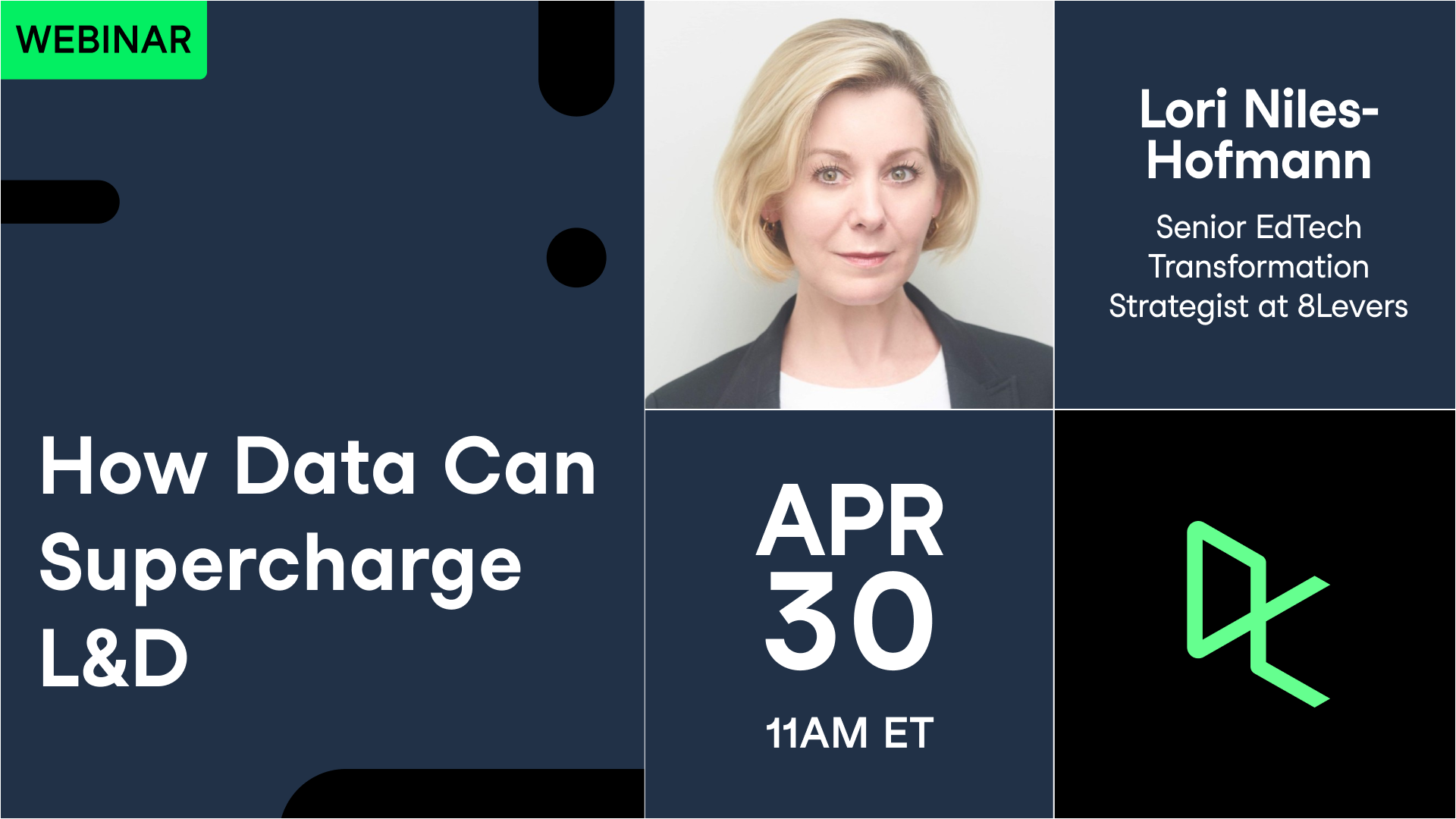
스피커
2명 이상을 교육하시나요?
팀원들이 중앙 집중식 보고, 과제, 프로젝트 등을 포함한 DataCamp 라이브러리 전체에 액세스할 수 있도록 하세요.How Data Can Supercharge L&D
May 2025
Slides + Session Resources
Summary
Data can transform Learning and Development (L&D) departments from cost centers to strategic partners that drive organizational growth. Many L&D teams miss the opportunity to adopt data-driven methodologies, and this gap was explored by Lori Niles-Hofmann. Lori, a seasoned EdTech transformation strategist, highlighted the importance of predictive analytics, combining data from different sources, and closed-loop reporting in L&D. These strategies not only improve the effectiveness of L&D but also allow for more personalized and impactful learning experiences. Lori emphasized the role of technologies like SCORM and xAPI, which are essential to L&D data, despite their limitations. She urged L&D professionals to seek insights from various data sources within their organization to inform learning strategies. Additionally, Lori pointed out the immense potential in using AI to create more iterative, data-driven learning designs that respond in real-time to learner needs, much like how Duolingo personalizes language learning. However, she cautioned about the ethical implications of using AI in L&D, particularly regarding data privacy and the potential for bias in AI-driven decisions.
Key Takeaways:
- Predictive analytics can vastly improve L&D effectiveness by anticipating learning needs.
- Combining data from multiple sources provides deeper insights and more personalized learning paths.
- Current L&D technologies like SCORM and xAPI have significant limitations in data capture and analysis.
- AI offers potential for creating personalized, iterative learning experiences but raises ethical concerns.
- The future of L&D lies in leveraging technology to create continuous, adaptive learning systems.
Explorations
Predictive Analytics in L&D
Predictive analytics represents a l ...
더 읽어보기
Combining Data for Deep Insights
Combining data from various sources within an organization can provide deep insights that single data points cannot. Lori discussed how bringing together data from Learning Management Systems (LMS), HR systems, and talent marketplaces can reveal patterns and anomalies in learning behaviors and outcomes. This comprehensive approach allows L&D teams to understand not just what learning is happening, but also its effectiveness and alignment with business goals. For instance, combining data can identify regions or departments where skill gaps are prevalent, enabling targeted interventions. Lori highlighted that this method of data analysis can also uncover disconnects, such as employees completing courses but not applying for relevant roles, indicating potential misalignment between learning and career development. By using AI tools and advanced data analytics frameworks, L&D can gain a comprehensive view of learning dynamics, facilitating more informed decision-making and strategic planning.
Challenges of Current L&D Technologies
Current L&D technologies like SCORM and xAPI, though essential, present significant challenges due to their limitations in data capture and flexibility. SCORM, developed over two decades ago, provides minimal data beyond basic metrics like completion rates and test scores. This limited data restricts L&D’s ability to derive meaningful insights and adapt learning experiences dynamically. Lori pointed out that while xAPI offers more detailed data tracking capabilities, such as user interactions and engagement with learning content, it requires sophisticated data management systems to store and analyze this data effectively. Moreover, the fragmented nature of L&D systems, which often do not integrate smoothly with other enterprise data systems, further complicates data-driven decision-making. These technological constraints highlight the need for L&D departments to innovate and adopt more advanced data analytics tools that can handle diverse and complex data sets, enabling more granular insights and personalized learning solutions.
AI in Learning Design
AI holds transformative potential for learning design, offering the ability to create personalized, adaptive learning experiences that evolve in real-time based on learner interactions. Lori illustrated this by referencing platforms like Duolingo, which use data to personalize language learning paths for users. However, she also cautioned about the ethical concerns surrounding AI in L&D, including data privacy issues and potential biases in AI-driven content recommendations. The goal is for AI to support a continuous feedback loop in learning design, where content is iteratively improved based on user data, leading to more efficient and effective learning outcomes. This approach contrasts with traditional, linear learning models, allowing L&D to respond dynamically to learner needs and organizational objectives. Despite these advancements, Lori stressed the importance of maintaining a human-centric approach to learning design, ensuring that AI serves to enhance, rather than replace, the nuanced understanding that skilled L&D professionals bring to the table.
관련된
white paper
What 300+ L&D Leaders Have Learned About Building Data Fluency
Learn all about how to build a data-fluent culture and the wins you can unlock.white paper
The L&D Guide to Data Literacy
Find the appropriate distribution of data skills across your organization.webinar
How L&D Leaders are Shaping Data Literate Workforces
Successful data literacy upskilling programs from a variety of industrieswebinar
Don’t Wait: What 300 L&D Leaders Have Learned About Data Fluency
Hugo explains what value data fluency can actually add to your organization.webinar
Customer Story: How the Novartis L&D Team Scaled Their Data Training
Learn practical tips for how to scale training at your organization.webinar