Vai al contenuto principale

Inserisci i tuoi dati per sbloccare il webinar

Continuando, accetti i nostri Termini di utilizzo, la nostra Informativa sulla privacy e che i tuoi dati siano conservati negli Stati Uniti.

Share this webinar

Close your data and AI skills gap

We're the only platform uniquely engineered to advance data and AI skills across your entire organization. Let's explore a tailored program.

Book an Enterprise Demo
Upskilling a small team?Get started today
Data Literacy

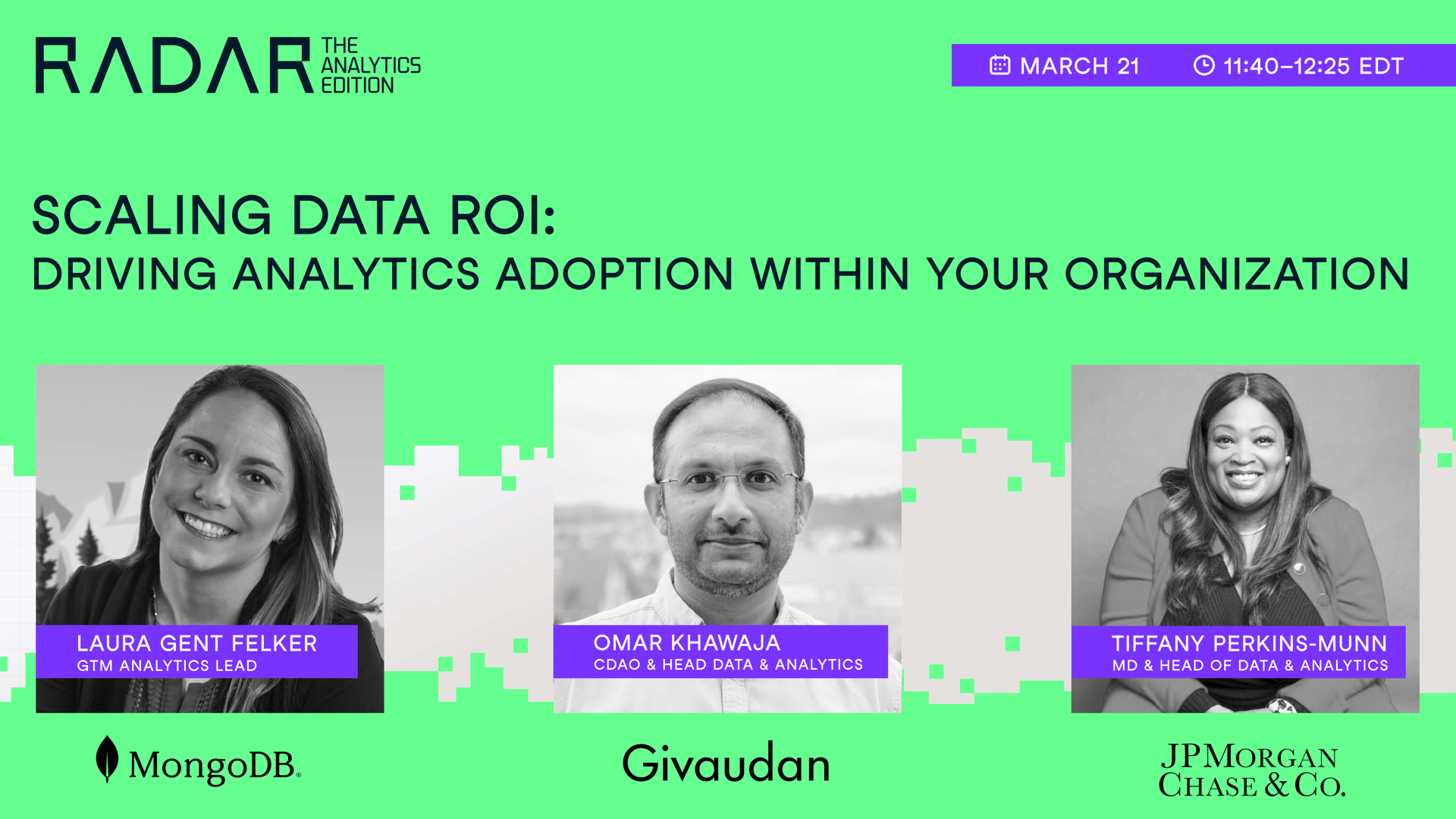
RADAR: The Analytics Edition - Scaling Data ROI: Driving Analytics Adoption Within Your Organization

March 2024
Webinar Preview

Your Presenter(s)

Foto di Laura Gent Felker

Laura Gent Felker

Director, Data Insights and Scalability at SalesForce

Laura has been at Salesforce for the last decade specializing in data and insights for the Quote-to-Cash (QTC) lifecycle. She built a best-in-class data organization from the ground up focusing on data visualization, data engineering, and data science. Her goal is for QTC stakeholders to develop a data literacy culture that can make actionable data-driven business decisions. In her tenure, Salesforce has rapidly grown from a $4B to a $30B+ company. Therefore, automation, continuous learning, and leveraging the right technology have been imperative for her team's success. A big piece of Salesforce’s culture is giving back through the 1-1-1 model. In 2021, Laura joined GlobalMindED on the Board of Directors to advise with technology implementation to scale for the future. GlobalMindED helps close the equity gap by connecting first-generation college students to mentors, internships, and jobs. As a leader in technology and data, Laura is passionate about creating an equitable and inclusive business environment for her team, stakeholders, and the world around her.

Foto di Omar Khawaja

Omar Khawaja

CDAO & Global Head Data & Analytics at Givaudan

Omar Khawaja is a data & analytics thought leader with over 23+ years of experience in the software, consumer goods, life sciences and manufacturing industry. Omar is passionate about creating business value with data & AI. He has also multiple years of experience in leading the development & operations of data & analytics platforms. Omar is currently working as Global Head of Data & Analytics / CDAO for Givaudan. Before joining Givaudan, Omar worked at Roche for 3.5 years leading the BI & Analytics team for Roche Diagnostics. Omar spearheaded the implementation of data mesh for Roche Diagnostics & before joining Givaudan he was driving the overall platform strategy for Informatics. Before joining Roche, Omar worked at Novartis in Basel, Switzerland, where he has performed various roles over the last ten years. Originally from Pakistan, Omar first started at Novartis in his home country, where he was the Chief Information Officer (CIO) for more than two years. He then moved to Switzerland in 2012 as CIO for Novartis Pharma Services (Exports Headquarters for Novartis).He held other roles like the Regional Business Partner for emerging markets, and spent the last 4 years at Novartis in data & insights roles. He led the sales insights team in the Commercial IT organization and prior to joining Roche, he was leading the commercial analytics team as part of the Analytics Center of Excellence for Novartis. Omar is also an active member of the LinkedIn data & analytics community. You can also listen to his other podcast interviews & webinars. For fun, he enjoys spending time with his family, hiking and reading.

Foto di Tiffany Perkins-Munn

Tiffany Perkins-Munn

Managing Director & Head of Data & Analytics at JPMorgan Chase

Dr. Tiffany Perkins-Munn is on a mission to bring research, analytics, and data science to life. She earned her Ph.D. in Social-Personality Psychology with an interdisciplinary focus on Advanced Quantitative Methods. Her insights are the subject of countless lectures on psychology, statistics, and their real-world applications. As the Head of Data and Analytics for the innovative CDAO organization at J.P. Morgan Chase, her knack involves unraveling complex business problems through operational enhancements, augmented financials, and intuitive recruiting. After over two decades in the industry, she consistently forges robust relationships across the corporate spectrum, becoming one of the Top 10 Finalists in the Merrill Lynch Global Markets Innovation Program.

Summary

Data initiatives demand substantial investment in tools and talent, and understanding the return on investment (ROI) is essential for organizations. The discussion accentuated that ROI is not solely about financial gains but also includes department-specific metrics that contribute to overall business goals. Key strategies for enhancing data capabilities include building a strong infrastructure, promoting collaboration between technical and non-technical teams, and nurturing a data-focused culture. Making data insights understandable through storytelling is an important skill for connecting technical insights and business understanding. The vital role of executive support in advocating for data initiatives and the role of change management in overcoming resistance to cultural shifts were also discussed. Lastly, the challenges of expanding analytics capabilities were discussed, concentrating on data quality, infrastructure, skill gaps, and integration.

Key Takeaways:

  • ROI for data initiatives goes beyond revenue, covering various metrics like operational efficiency and customer satisfaction.
  • Effective data management requires a blend of the suitable tools, processes, and skilled personnel.
  • Using storytelling to make data insights relatable and actionable for non-technical stakeholders is vital.
  • Executive leadership and change management are essential for nurturing a data-focused culture.
  • Organizations face challenges in expanding analytics, including data quality, infrastructure, and integration.

Deep Dives

Understanding ROI in Data Initiatives

The concept of return on investment in data initiatives is complex, going beyond just financial metrics. As Tiffany Perkins-Munn noted, ROI can be linked to specific business goals, such as customer satisfaction and operational efficiency. "It's really about how do you use data and analytics to achieve a specific business goal," she explained. This approach requires organizations to consider various metrics, including cost reduction, resource allocation, and customer experience. By aligning data initiatives with these metrics, companies can ensure they are delivering tangible value.

Building a Data-Driven Culture

A data-focused culture is essential for using data effectively across an organization. This involves integrating data literacy across all levels, from executives to frontline employees. Omar Khawaja emphasized the need for "targeted data literacy programs" that cater to different personas within a company. Moreover, making complex data insights understandable through storytelling is an important part of this culture. As Tiffany Perkins-Munn articulated, "It's not about simplifying information too much, it's just about learning how to tell the story."

Overcoming Resistance to Change

Change management plays an important role in transitioning to a data-focused organization. Resistance often stems from fear or misunderstanding of data's role in daily operations. Laura Gent-Volker highlighted the importance of involving employees in decision-making to promote a sense of ownership and accountability. Pilot projects can serve as proof of concept, demonstrating the benefits of data initiatives incrementally. Engaging skeptics and understanding their concerns is essential to successfully implementing change.

Scaling Analytics Capabilities

As organizations aim to expand their analytics capabilities, they encounter several challenges. Data quality is vital, as inconsistent or inaccurate data can undermine decision-making. Infrastructure limitations, such as inadequate data storage and processing power, need addressing to accommodate growing data volumes. Skill gaps in data management and analytics also present hurdles. Tiffany Perkins-Munn noted, "The issues are always the same: data quality, infrastructure, skill gaps." Organizations must strategically tackle these issues to enhance their analytics functions effectively.


Correlato

webinar

Scaling Data ROI: Driving Analytics Adoption Within Your Organization

In this session, Laura Gent Felker, Tiffany Perkins-Munn, and Omar Khawaja will explore best practices when it comes to scaling analytics adoption within the wider organization.

webinar

RADAR: The Analytics Edition - From Data Governance to Data Discoverability: Building Trust in Data Within Your Organization

In this session, industry leaders share strategies for improving data quality, fostering a culture of trust around data, and balancing robust governance with the need for accessible, high-quality data.

webinar

RADAR: The Analytics Edition - The Art of Data Storytelling: Driving Impact with Analytics

In this session, three industry leaders will shed light on the art of blending analytics with storytelling, a key to making data-driven insights both understandable and influential within any organization.

webinar

RADAR: The Analytics Edition - Building a Learning Culture for Analytics Functions

In the session, Russell Johnson, Denisse Groenendaal-Lopez and Mark Stern address the importance of fostering a learning environment for driving success with analytics.

webinar

Radar Data & AI Literacy Edition: From Insight to Impact with Data Storytelling

In this session, join Gary Wolf, Lea Pica and Jason Forrest as they delve into the world of data stories and how they play out in our lives. 

webinar

Radar—Keynote—Building the Data-Driven Workforce of the Future

The challenges individuals and organizations face in the era of data fluency.