Vai al contenuto principale

Inserisci i tuoi dati per sbloccare il webinar

Continuando, accetti i nostri Termini di utilizzo, la nostra Informativa sulla privacy e che i tuoi dati siano conservati negli Stati Uniti.

Share this webinar

Close your data and AI skills gap

We're the only platform uniquely engineered to advance data and AI skills across your entire organization. Let's explore a tailored program.

Book an Enterprise Demo
Upskilling a small team?Get started today
Data Leader

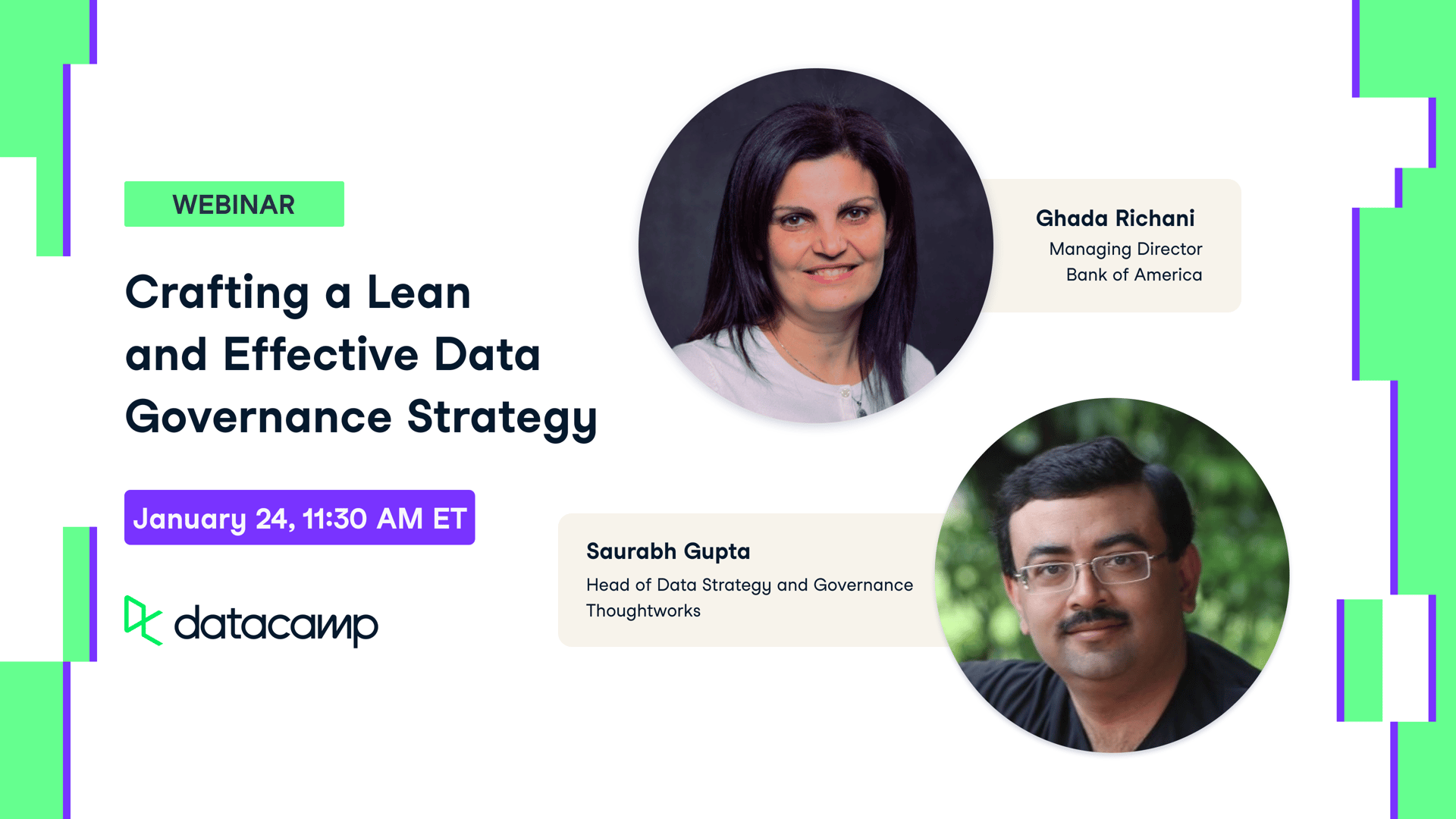
Crafting a Lean and Effective Data Governance Strategy

January 2024
Webinar Preview

Your Presenter(s)

Foto di Ghada Richani

Ghada Richani

Managing Director, Data & Technology Strategy and the Project Management Office at Bank of America

Ghada Richani is a seasoned executive with extensive experience in data and technology strategy and project and program management. Currently serving as the Managing Director of Data and Technology Strategy and the Project Management Office at the Risk organization within Bank of America, Ghada plays a crucial role in implementing the organization's consumer data strategy. This involves aligning it with broader enterprise goals to enhance operational efficiency and risk management. Leading a team of experts, she oversees consumer product data and model development initiatives.

Ghada is a strong advocate for diversity and inclusion in the workplace. She actively contributes to initiatives like the Employee Diversity and Inclusion Council, focusing on fostering inclusive environments by leading conversations on unconscious bias. Ghada also leads a Women Power of 10 group, encouraging networking and connectivity among women across various sectors.

In her personal life, Ghada resides in Southern California with her family. During her leisure time, she enjoys outdoor activities, including hiking trips, camping, and geocaching.

Foto di Saurabh Gupta

Saurabh Gupta

Chief Strategy & Revenue Officer at The Modern Data Company

Saurabh is a seasoned technology executive and is currently Chief Strategy & Revenue Officer at The Modern Data Company, formerly leading the Data Strategy & Governance practice at Thoughtworks. With over 25 years of experience in tech, data and strategy, he has led many strategy and modernization initiatives across industries and disciplines. Through his career, he has worked with various Internation Organizations and NGOs, Public sector and Private sector organizations. Before joining Thoughtworks he was the CDO/Director for Washington DC Gov., where he developed the digital/data modernization strategy for education data. Prior to DCGov he played leadership and strategic roles at organizations including IMF and World Bank where he was responsible for their Data strategy and led the OpenData initiatives. He has also closely worked with African Development Bank, OECD, EuroStat, ECB, UN and FAO as a part of inter-organization working groups on data and development goals. As a part of the taskforce for international data cooperation under the G20 Data Gaps initiative, he chaired the technical working group on data standards and exchange. He also played an advisor role to the African Development Bank on their data democratization efforts under the Africa Information Highway. Saurabh has also been a party of the startup community and advises/mentors several startup/founders. People are the key to sustain any large impactful change and he spends a lot of time focusing on team development, collaboration and opportunities to ensure the change is more sustainable. He lives with his wife, teenage daughter and dog in the DC metropolitan area and love traveling as a family and spend time exploring.

Summary

Data governance and data quality are essential elements in driving success within data-driven organizations, but they are often perceived as burdensome rather than beneficial. This perception is a hindrance to the effective implementation of data governance strategies, which are key to resolving the increasing number of data quality incidents. Industry experts Ghada Rishani and Sourabh Gupta discuss the evolution of data governance, emphasizing the need for a cultural shift in organizations to view these programs as strategic imperatives rather than overheads. They discuss the challenges in changing mindsets, the importance of demonstrating quick wins, and the role of data literacy in decentralizing data governance. Additionally, the potential impact of generative AI on data governance is examined, highlighting the need for agile, iterative approaches to managing data. The discussion emphasizes the need for internal marketing of data initiatives and the integration of governance as part of the organization's culture to truly utilize the power of data.

Key Takeaways:

  • Data governance is often seen as an enforcement mechanism, creating resistance within organizations.
  • Quick wins and agile methodologies are essential for demonstrating the value of data governance.
  • Data literacy is vital for decentralization and creating a culture that supports data governance initiatives.
  • Generative AI presents both opportunities and challenges for data governance programs.
  • Effective internal marketing can shift perceptions of data governance from a burden to a strategic necessity.

Deep Dives

The Perception of Data Governance as Overhead

Data governance is frequently perceived as a burdensome overhead, which can hinder its effective implementation. This perception originates from its historical role as an enforcement mechanism, often viewed as the 'bad cop' of data management. Ghada Rishani notes that this view is gradually shifting, with organizations beginning to recognize the strategic importance of data governance in driving business success. Both Ghada and Saurabh Gupta emphasize the need for organizations to reframe data governance as a strategic imperative, integrated within the organizational culture, rather than a set of external rules imposed upon the data teams. This shift requires a significant cultural change, focusing on data governance as a means to enable, rather than restrict, innovative data use.

Agile Methodologies and Quick Wins

Adopting agile methodologies in data governance can help organizations demonstrate value quickly and efficiently. Saurabh Gupta highlights the importance of starting small and achieving quick wins to build momentum and support for data governance initiatives. This approach mirrors the agile practices used in software development, encouraging iterative progress and continuous improvement. Quick wins, such as resolving data quality issues that take less than four hours to fix, can showcase the benefits of data governance and help overcome resistance from stakeholders. Ghada Rishani adds that these quick wins should be communicated effectively within the organization to highlight their impact on business objectives.

Data Literacy and Decentralization

Data literacy is a crucial component in decentralizing data governance and embedding it within the organizational culture. Educating employees about data products and their uses can turn them into advocates for data governance, helping to connect the gap between data teams and business units. Ghada Rishani suggests involving users in setting data governance policies to ensure they are practical and widely supported. By empowering employees to take ownership of data use and quality, organizations can create a more collaborative environment where data governance is seen as a shared responsibility rather than an imposed burden.

The Role of Generative AI in Data Governance

Generative AI presents new opportunities and challenges for data governance programs. As the use of AI models becomes more prevalent, ensuring data quality and governance becomes even more vital. Ghada Rishani points out that generative AI can automate and enhance various data governance functions, such as data lineage and quality assessment, making these processes more efficient. However, this also raises concerns about data bias, privacy, and ethical use, which must be addressed through strong governance frameworks. Sourabh Gupta emphasizes the importance of integrating data governance into the AI development lifecycle to ensure that AI models are built on reliable, unbiased data and that their outputs are transparent and explainable.


Correlato

webinar

Unpacking the Fun in Data Governance: The Key to Scaling Data Quality

In this webinar, Tiankai Feng, Head of Data Strategy & Data Governance at Thoughtworks Europe, will walk you through the objectives, concepts, and best practices of setting up effective data governance programs.

webinar

Unpacking the Fun in Data Governance: The Key to Scaling Data Quality

In this webinar, Tiankai Feng, Head of Data Strategy & Data Governance at Thoughtworks Europe, will walk you through the objectives, concepts, and best practices of setting up effective data governance programs.

webinar

From Data Governance to Data Discoverability: Building Trust in Data Within Your Organization

In this session, industry leaders share strategies for improving data quality, fostering a culture of trust around data, and balancing robust governance with the need for accessible, high-quality data.

webinar

Building a Data Strategy: Key Steps for Aligning Data with Business Goals

Libba Stanford, a Data Strategy Consultant at The K2G Group, covers how to understand business objectives, assess data maturity, and define a data strategy that is aligned with the organization’s overall objectives.

webinar

5 Things Every Business Leader Needs to Know About Data Strategy

Find out the 5 key aspects of data strategy across different industries.

webinar

Developing a Data Mindset: How to Think, Speak, and Understand Data

In this webinar, Jordan Goldmeier teaches you the secrets of how "data head"'s minds work.