Condividi questo webinar
Colma il divario nelle tue competenze in data e AI
Siamo l’unica piattaforma progettata in modo unico per far crescere le competenze in ambito dati e AI in tutta la tua organizzazione. Esploriamo insieme un programma su misura.
Prenota Una Demo EnterpriseData Visualization for Data Storytelling
March 2026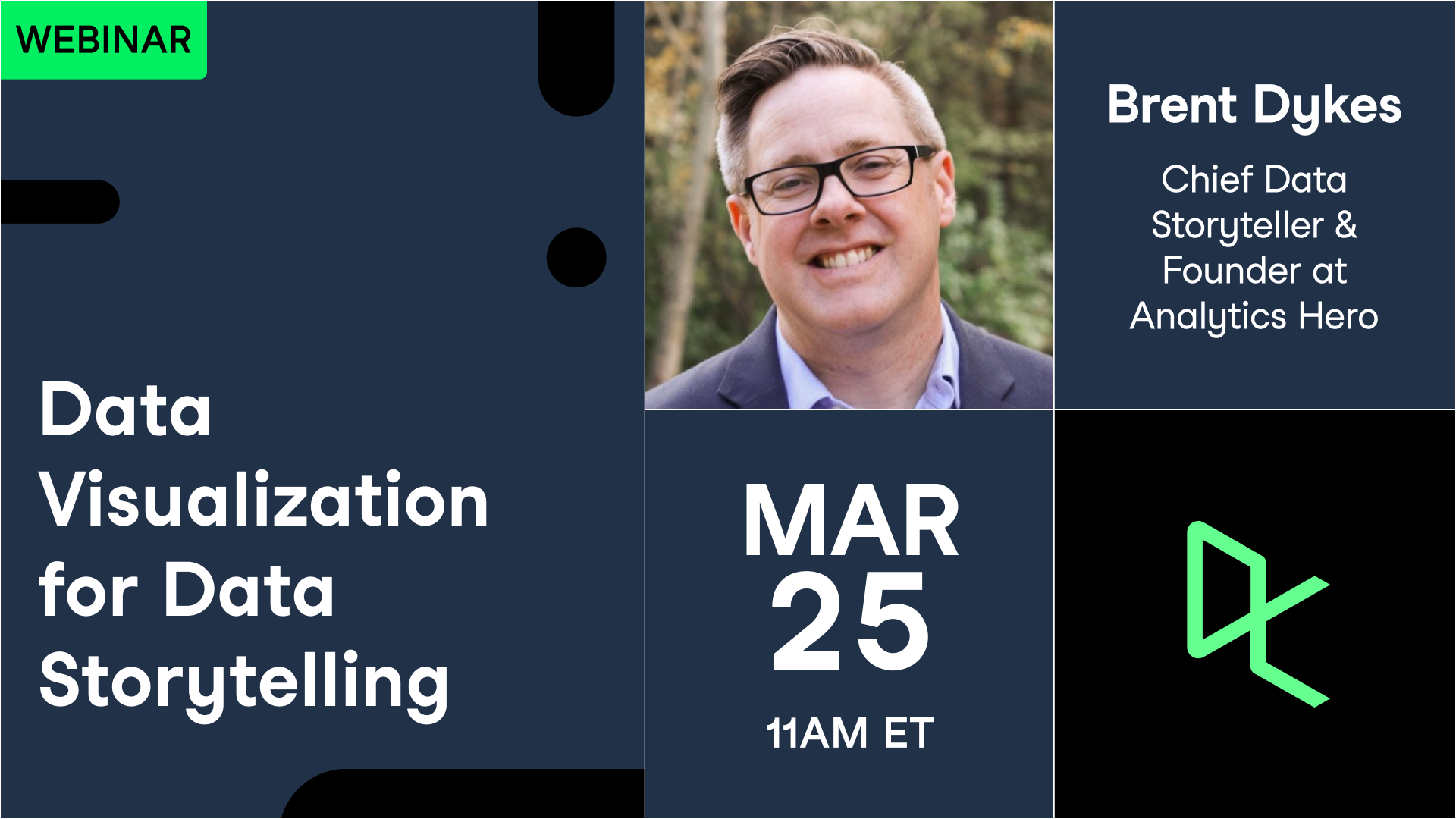
I tuoi presentatori

Brent Dykes
Chief Data Storyteller & Founder at Analytics Hero
Brent is one of the world's leading thinkers on data storytelling. He runs the data training and consultancy company Analytics Hero. Previously, Brent was Senior Director of Insights and Data Storytelling at Blast Analytics as well as having stints as a data executive at Omniture, Adobe, and Domo. Brent is the author of the bestselling "Effective Data Storytelling".
Session Resources + Brent's Book
Summary
A practical session for analysts, data scientists, and BI professionals who want their work to land with decision-makers—not just impress other analysts.
Data work rarely fails in the math; it fails in the handoff. Once results exist, the job is not “done” until someone else can understand them, trust them, and act. The conversation pushes back on the idea that “the numbers speak for themselves,” and instead treats communication as a core analytic skill—one that needs audience awareness, a clear data storytelling structure, and careful use of visuals.
Brent Dykes (Chief Data Storyteller at Analytics Hero) lays out a simple data storytelling framework: data is the foundation, narrative gives structure, and visualization supports explanation rather than substituting for story. From there, the session moves into practical craft—how to define a real insight (not simply an interesting fact), how to avoid narrating the analyst’s step-by-step process, and how to guide an audience along a “golden path” toward an “uh-huh” moment. For anyone asking “How do I create a data story?”, the implied process is repeatable: find the insight, define the audience, map the story arc, choose visuals that match the message, and end with a recommendation people can act on.
The discussion also covers real-world constraints: imperfect data, mixed attention spans, and differing delivery modes (live presentations versus asynchronous documents). Finally, it turns to AI as a collaborator—useful for automation, faster exploration, drafting, and feedback—while warning that automated “story floods” and hallucinations can quickly erode trust. The full session is richest in its examples, analogies, and tactical advice on assembling stories that move from context to consequence to action—especially when presenting data to executives and other stakeholders.
Key Takeaways:
- Data storytelling starts where analysis ends: communicating results so others can see what you see—and do something with it (a data story, not a report).
- An insight is more than a pattern; it creates an unexpected shift in how the audience understands the situation and what they think is possible.
- Strong stories are shaped by the audience: align to their problems, desired outcomes, current actions, and key measures (the “4D framework”).
- Narrative structure matters in business settings; don’t narrate the full analysis process—lead stakeholders down the “golden path” to the point and the recommended actions.
- AI can speed up work and improve storytelling quality, but over-automation and hallucinations can destroy credibility fast—use a human review step before sharing with leaders.
Detailed Sections
1) Insight, Not Output: Why the Numbers Don’t “Speak for Themselves”
The session begins with a familiar trap: treating analysis as the finish line. Richie Cotton frames it as a career mistake many analysts make—believing that once the numbers are crunched, the work is complete. Dykes’ diagnosis is blunt: analysts become “intimately aware” of a dataset’s contours, so the results feel obvious to them. But audiences do not share that context. The same chart that reads like a clear sentence to the analyst can look like an undeciphered code to an executive, a product manager, or a finance partner. The gap isn’t intelligence; it’s context—domain knowledge, incentives, and the simple fact that other people weren’t inside the data for days or weeks.
That gap is where data storytelling lives. Data storytelling, as presented here, is not decoration and not “making dashboards prettier.” It is the intentional work of turning findings into a clear sequence that brings others to understanding and a decision. The turning point is the concept of an “insight,” which Dykes treats with unusual precision. He adopts a definition from psychologist Gary Klein that separates genuine insight from mere observation:
“An unexpected shift in the way we understand something.”
That definition raises the bar. A weekly KPI update may be useful, but it doesn’t necessarily shift understanding. A true insight reframes the problem, changes beliefs about cause and effect, or surfaces a hidden opportunity or risk. It is also audience-relative: what surprises a marketing team may bore a pricing analyst. The analyst’s task, then, is not simply to report what happened, but to identify what meaningfully changes the organization’s understanding—and then communicate that shift in a way others can absorb quickly.
The session’s subtext is that “letting the numbers speak” often means letting them mumble. Storytelling is the act of translating analysis into clarity: what changed, why it matters, what it implies, and what should happen next. The webinar is particularly useful for viewers who sense they’re producing good work that nevertheless stalls in meetings—because it treats that stall as a communication problem that can be fixed with structure, not as a mysterious failure of stakeholder buy-in.
2) Audience-First Storytelling: The 4D Framework and the Reality of Imperfect Data
One of the most practical parts of the conversation is the insistence that audience thinking cannot be added at the end. If you wait until results exist to ask who cares and why, you’ve already limited what you can discover, how you can validate it, and which decisions it can influence. Dykes offers a compact planning tool—the “4D framework”—to force that early alignment. Before choosing metrics or visuals, he argues, you should understand four dimensions of your audience’s world: (1) the problem they are trying to address, (2) the outcomes they want (targets, thresholds, future state), (3) the actions they’re already taking (where budget, time, and attention currently go), and (4) the measures they use to judge success (KPIs that define winning and losing). If you’re communicating data insights to executives, these four questions double as an audience discovery checklist for what leaders will ask first: “What problem is this solving?”, “What does good look like?”, “What are we doing today?”, and “How will we know it worked?”
This is more than stakeholder empathy. It is a filtering mechanism for analysis. When analysts complain their insights “aren’t going anywhere,” the hidden issue is often misalignment: the work is technically correct but strategically irrelevant. By anchoring analysis to problems, outcomes, actions, and measures, you increase the odds that an insight becomes a decision rather than a footnote.
The discussion of data quality adds a pragmatic edge. Dykes agrees that downstream work—storytelling, dashboards, AI—depends on credible data, even using a memorable formulation:
“If we have weak or bad data, your story is dead.”
Yet he also resists perfectionism. Real organizations rarely have immaculate datasets, and executives can overreact to blemishes by rejecting usable information. Dykes’ point is not to excuse bad data, but to keep teams from freezing: sometimes data is “directionally correct,” and the job is to isolate what’s trustworthy, state the limits clearly, and steadily improve the foundation.
Most interesting is his cultural argument: data storytelling can help improve data quality. Tell one compelling story in an area where you’ve cleaned and validated the data, then use that success to create demand elsewhere—“we can do this for your function too, if we improve the data.” It’s a subtle shift: rather than treating data quality as a nagging back-office issue, you frame it as the price of admission to better decisions.
3) Building the Narrative Arc: From “Analysis Journey” to the Golden Path
The session’s central craft lesson is that many analysts tell the wrong story—even when they believe they’re storytelling. Dykes names the most common misfire: narrating the analysis walkthrough. That version of events typically starts with data sources, cleaning steps, exploratory dead ends, and methodological choices, only later arriving at the finding. It is chronologically true and professionally conscientious, but strategically misaligned. Business audiences, Dykes notes, want the “cut to the chase” version: what you found, why it matters, and what decision it suggests. The technical steps matter primarily as supporting evidence when challenged—and can live in an appendix, notes section, or follow-up.
For structure, Dykes borrows from dramatic theory rather than business templates. He rejects the hero’s path as too complex (dozens of stages) and considers the classic three-act structure too vague (“a report has a beginning, middle, and end”). Instead, he adapts Gustav Freytag’s arc into a business-friendly data storytelling structure that moves through: status quo (what “normal” looks like), a hook (the surprising spike or dip that earns attention), rising insights (key analytical points that connect the dots), the “uh-huh” moment (the core insight), and finally options and resolution (what to do about it, with trade-offs). Read as a step-by-step process for how to tell a story with data: set context, earn attention, build evidence in a logical order, state the insight plainly, then move to actions and expected impact.
Most importantly, this is not just a presentation trick; it is a persuasion mechanism. Dykes argues that the goal is not to ask stakeholders to accept your conclusion on authority, but to lead them to the same conclusion so they experience the realization themselves. He describes this as avoiding all the exploratory side paths and instead guiding the audience along a single coherent route:
“We’re taking the golden path through the data.”
The webinar also addresses format. In live settings, cluttered slides compete with the speaker; in asynchronous settings, the narrative must be embedded in text. Dykes offers a pragmatic workaround for teams tempted to “kill two birds with one stone”: keep slides clean for the live room, put the talk track in speaker notes, and share a notes-based PDF for those who weren’t present. It’s the kind of advice that feels small until you recognize how often it determines whether a story is understood—or merely skimmed.
4) Visualization and AI: Choosing Charts, Using Assistants, Protecting Trust
Although the title foregrounds visualization, Dykes intentionally treats visuals as supportive rather than primary. He cautions against equating storytelling with “clean charts,” and emphasizes that visuals are a means to an end: they help audiences spot patterns, anomalies, and comparisons that are hard to grasp in raw tables. But he also argues—somewhat provocatively—that if your data and narrative are solid, weaker visuals are survivable; the reverse is not.
On chart selection, his process starts with the metric, not the graphic. Once the narrative beats are clear, you determine whether you’re conveying a trend, a comparison, or a part-to-whole relationship—and only then pick the chart type. He also punctures the myth that business storytelling requires exotic, data-journalism-style visuals. In most organizations, three charts do the bulk of the work: line charts (change over time), bar charts (comparisons and ranking), and pie/donut charts (simple part-to-whole). He acknowledges the controversy around pie charts, but argues they remain useful when constrained—think one to three slices, not a “pizza” of twenty categories. The point isn’t aesthetic purity; it’s rapid comprehension.
AI enters as a practical collaborator, not an author. Dykes outlines four roles: task automation (freeing time), analytic augmentation (natural-language queries, quicker exploratory visuals), content creation (summaries, drafts, talk tracks), and feedback facilitation (finding gaps, checking logical flow, audience fit, and even bias detection). The posture is cautious: keep “a hand on the wheel,” using AI to move faster without giving up responsibility. In practice, this can look like using ChatGPT for data storytelling in narrow, reviewable steps—for example: “Draft an executive summary from these three findings,” “List likely objections an executive will raise and what evidence answers them,” “Suggest the simplest chart type for each point (trend vs comparison vs part-to-whole),” or “Rewrite this slide title as a clear claim plus metric.”
His sharpest warning concerns trust. Automated storytelling can repeat the failure mode of automated alerts: too many low-value outputs train people to ignore them. Worse, a single hallucinated statistic can contaminate everything that follows. In his words, if audiences discover that even a portion of a story was fabricated, “all of your stories are now crap.” The promise of AI, then, is not volume; it’s leverage—more time for higher-quality thinking, better iteration, and stronger audience alignment. To see how he operationalizes that balance in practice, the full webinar is worth watching in detail, especially the sections on feedback prompts, what to keep in the appendix, and presentation design choices for leaders.
Correlati
webinar
Effective Data Storytelling: How to Turn Insights into Action
Discover the three pillars of data storytelling - with expert Brent Dykeswebinar
The Art of Data Storytelling: Driving Impact with Analytics
In this session, three industry leaders will shed light on the art of blending analytics with storytelling, a key to making data-driven insights both understandable and influential within any organization.webinar
Creating Compelling Data Visualizations
In the first of three data storytelling sessions, three data visualization experts take you through how to create impactful visualizations for any audience.webinar
Data Visualization Best Practices for Dashboards
Nick Desbarats, author of "Practical Charts on Demand", will share proven best practices for designing dashboards that inform and persuade.webinar
Effective Data Storytelling for Financial Services
Learn simple communication techniques to make your ideas understood, whether you are speaking to a technical audience or a business audience.webinar