Course
Introduction to Python
BasicSkill Level4.8+10,927 reviews4 hr
Master the basics of data analysis with Python in just four hours. This online course will introduce the Python interface and explore popular packages.
AI TutorBuild your Python skills with interactive courses for data science, data analysis and machine learning, curated by real-world experts
Course
Master the basics of data analysis with Python in just four hours. This online course will introduce the Python interface and explore popular packages.
AI TutorTrack
Grow your data skills, discover how to manipulate and visualize data, and apply advanced analytics to make data-driven decisions.
Not sure where to start?
Take an AssessmentTopic
Skill Level
Content type
duration (hours)
Course
Master the basics of data analysis with Python in just four hours. This online course will introduce the Python interface and explore popular packages.
AI TutorCourse
Level up your data science skills by creating visualizations using Matplotlib and manipulating DataFrames with pandas.
Course
Master the fundamentals of programming in Python. No prior knowledge required!
Course
Grow your machine learning skills with scikit-learn in Python. Use real-world datasets in this interactive course and learn how to make powerful predictions!
Course
Learn how to import and clean data, calculate statistics, and create visualizations with pandas.
AI TutorCourse
Grow your statistical skills and learn how to collect, analyze, and draw accurate conclusions from data using Python.
Course
Dive into the Python ecosystem, discovering modules and packages along with how to write custom functions!
Course
Learn how to explore, visualize, and extract insights from data using exploratory data analysis (EDA) in Python.
Course
Learn to combine data from multiple tables by joining data together using pandas.
Course
Dive into data science using Python and learn how to effectively analyze and visualize your data. No coding experience or skills needed.
Course
Navigate and use the extensive repository of models and datasets available on the Hugging Face Hub.
Course
Learn how to create informative and attractive visualizations in Python using the Seaborn library.
Course
Learn to diagnose and treat dirty data and develop the skills needed to transform your raw data into accurate insights!
Course
Build Python skills to elevate your finance career. Learn how to work with lists, arrays and data visualizations to master financial analyses.
Course
Learn how to create, customize, and share data visualizations using Matplotlib.
Course
Learn how to cluster, transform, visualize, and extract insights from unlabeled datasets using scikit-learn and scipy.
Course
Dive into the exciting world of APIs as we introduce you to the basics of consuming and working with Web APIs using Python.
Course
Continue to build your modern Data Science skills by learning about iterators and list comprehensions.
Course
Learn the art of writing your own functions in Python, as well as key concepts like scoping and error handling.
Course
Learn to import data into Python from various sources, such as Excel, SQL, SAS and right from the web.
Course
Discover how to build AI-powered applications using LLMs, prompts, chains, and agents in LangChain.
Course
Integrate AI/LLM applications with APIs, databases, and filesystems easier than ever before with the Model Context Protocol (MCP).
Course
Learn about modularity, documentation, and automated testing to help you solve data science problems more quickly and reliably.
Course
Improve your Python data importing skills and learn to work with web and API data.
Course
Predict housing prices and ad click-through rate by implementing, analyzing, and interpreting regression analysis with statsmodels in Python.
Course
Consolidate and extend your knowledge of Python data types such as lists, dictionaries, and tuples, leveraging them to solve Data Science problems.
Course
Learn to use best practices to write maintainable, reusable, complex functions with good documentation.
Course
Explore data structures such as linked lists, stacks, queues, hash tables, and graphs; and search and sort algorithms!
Course
Master your skills in NumPy by learning how to create, sort, filter, and update arrays using NYC’s tree census.
Course
In this course, youll learn how to use tree-based models and ensembles for regression and classification using scikit-learn.

Blog

Abid Ali Awan
15 min

Blog

Matt Crabtree
15 min
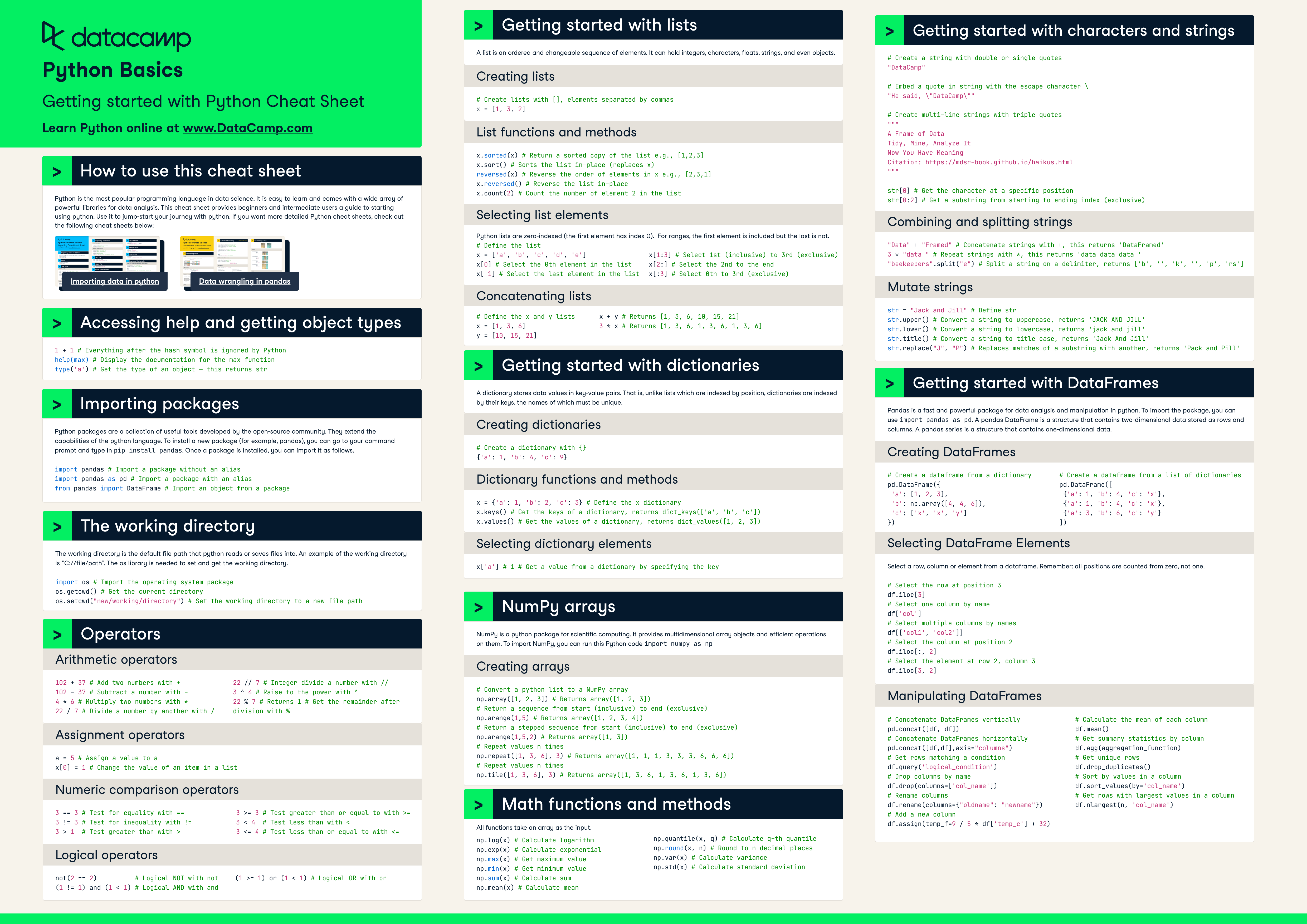
Cheat Sheet

Richie Cotton
8 min
Projects allow you to apply your knowledge to a wide range of datasets
to solve real-world problems in your browser
Project
Use data manipulation and summary statistics to analyze test scores across New York Citys public schools!
Exploratory Data Analysis
Project
Find out when and where crime is most likely to occur, along with the types of crimes commonly committed in LA.
Data Manipulation, Exploratory Data Analysis
Project
Perform a hypothesis test to determine if more goals are scored in womens soccer matches than mens!
Probability & Statistics
Python is a widely-used, high-level programming language known for its readability, simplicity, and extensive libraries. It is important because of its versatility in various fields like web development, automation, data analysis, and artificial intelligence, making it a fundamental skill for many technological and scientific applications. This broad applicability has made Python one of the most popular programming languages in the world.
No, you don't need previous programming experience. Our courses are designed to be beginner-friendly, guiding you step by step.
Learning Python opens doors across multiple industries due to its high demand, offering broad career opportunities in technology, data science, finance, healthcare, academia, and marketing. Its versatility in data handling and analysis is particularly valued for driving data-driven decisions and innovation. Mastering Python can significantly enhance your professional skillset, making you a valuable asset in numerous fields.
Python opens the door to a variety of career paths, serving as a catalyst for roles such as data scientist, data analyst, machine learning engineer, software developer, and web developer. Its widespread application in diverse fields like finance, healthcare, technology, and research means that proficiency in Python can significantly advance career prospects in these and many other industries.
The most effective way to learn Python is through a practical, hands-on approach. Interactive courses led by industry experts provide structured learning and real-world problem-solving, while building your own projects allows you to apply and solidify your skills, helping you to excel faster in Python programming. Read our full guide on how to learn Python for more guidance.
Python is a versatile and user-friendly language ideal for general programming and data science, whereas R is more specialized for statistical analysis, complex data manipulation, and data visualization. Check out our Python vs R article for a more detailed comparison.
Yes, we regularly update our courses to reflect the latest trends and technologies in the field.
DataCamp offers professional certifications for Data Scientists and Data Analysts. You can use Python in either of these certifications to prove your skills and build a strong portfolio.
Make progress on the go with our mobile courses and daily 5-minute coding challenges.