Course
Introduction to Python
BasicSkill Level4.8+10,927 reviews4 hr
Master the basics of data analysis with Python in just four hours. This online course will introduce the Python interface and explore popular packages.
AI TutorBuild your Python skills with interactive courses for data science, data analysis and machine learning, curated by real-world experts
Course
Master the basics of data analysis with Python in just four hours. This online course will introduce the Python interface and explore popular packages.
AI TutorTrack
Grow your data skills, discover how to manipulate and visualize data, and apply advanced analytics to make data-driven decisions.
Not sure where to start?
Take an AssessmentTopic
Skill Level
Content type
duration (hours)
Course
Detect anomalies in your data analysis and expand your Python statistical toolkit in this four-hour course.
Course
This course will equip you with the skills to analyze, visualize, and make sense of networks using the NetworkX library.
Course
Are customers thrilled with your products or is your service lacking? Learn how to perform an end-to-end sentiment analysis task.
Course
Leverage the power of Python and PuLP to optimize supply chains.
Course
Build AI teams that work together, automate workflows, and generate content with CrewAI.
Course
Master the core operations of spaCy and train models for natural language processing. Extract information from unstructured data and match patterns.
Course
Explore association rules in market basket analysis with Python by bookstore data and creating movie recommendations.
Course
Learn how to build intelligent agents that reason, act, and solve real-world tasks using Python.
Course
Use Seaborns sophisticated visualization tools to make beautiful, informative visualizations with ease.
Course
Learn techniques to extract useful information from text and process them into a format suitable for machine learning.
Course
Learn to manipulate and analyze flexibly structured data with MongoDB.
Course
Learn to solve real-world optimization problems using Pythons SciPy and PuLP, covering everything from basic to constrained and complex optimization.
Course
Learn to design and run your own Monte Carlo simulations using Python!
Course
Create more accurate and reliable RAG systems with Graph RAG and hybrid RAG.
Course
Learn how to identify, analyze, remove and impute missing data in Python.
Course
Learn to analyze financial statements using Python. Compute ratios, assess financial health, handle missing values, and present your analysis.
Course
Prepare for your next coding interviews in Python.
Course
This course covers everything you need to know to build a basic machine learning monitoring system in Python
Course
Learn to perform the two key tasks in statistical inference: parameter estimation and hypothesis testing.
Course
Learn how to import, clean and manipulate IoT data in Python to make it ready for machine learning.
Course
Learn all about the advantages of Bayesian data analysis, and apply it to a variety of real-world use cases!
Course
Learn how to approach and win competitions on Kaggle.
Course
Learn the fundamentals of neural networks and how to build deep learning models using TensorFlow.
Course
Learn how to build interactive and insight-rich dashboards with Dash and Plotly.
Course
Ensure high data quality in data science and data engineering workflows with Pythons Great Expectations library.
Course
Learn the fundamentals of exploring, manipulating, and measuring biomedical image data.
Course
Visualize seasonality, trends and other patterns in your time series data.
Course
Combine text, images, audio, and video with the latest AI models from Hugging Face, and generate new images and videos!
Course
Learn how to build advanced and effective machine learning models in Python using ensemble techniques such as bagging, boosting, and stacking.
Course
Learn to conduct image analysis using Keras with Python by constructing, training, and evaluating convolutional neural networks.

Blog

Abid Ali Awan
15 min

Blog

Matt Crabtree
15 min
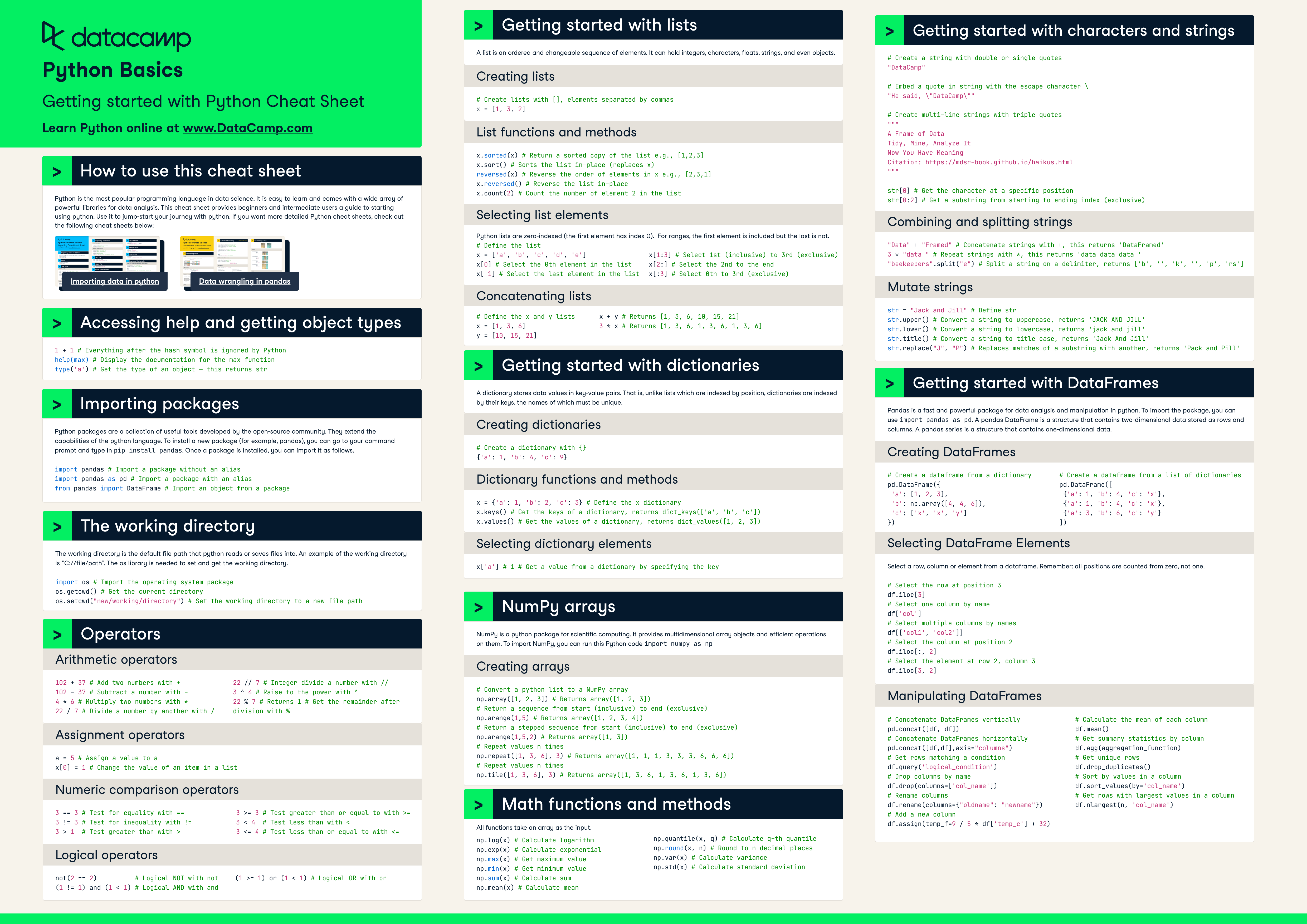
Cheat Sheet

Richie Cotton
8 min
Projects allow you to apply your knowledge to a wide range of datasets
to solve real-world problems in your browser
Project
Use data manipulation and summary statistics to analyze test scores across New York Citys public schools!
Exploratory Data Analysis
Project
Find out when and where crime is most likely to occur, along with the types of crimes commonly committed in LA.
Data Manipulation, Exploratory Data Analysis
Project
Perform a hypothesis test to determine if more goals are scored in womens soccer matches than mens!
Probability & Statistics
Python is a widely-used, high-level programming language known for its readability, simplicity, and extensive libraries. It is important because of its versatility in various fields like web development, automation, data analysis, and artificial intelligence, making it a fundamental skill for many technological and scientific applications. This broad applicability has made Python one of the most popular programming languages in the world.
No, you don't need previous programming experience. Our courses are designed to be beginner-friendly, guiding you step by step.
Learning Python opens doors across multiple industries due to its high demand, offering broad career opportunities in technology, data science, finance, healthcare, academia, and marketing. Its versatility in data handling and analysis is particularly valued for driving data-driven decisions and innovation. Mastering Python can significantly enhance your professional skillset, making you a valuable asset in numerous fields.
Python opens the door to a variety of career paths, serving as a catalyst for roles such as data scientist, data analyst, machine learning engineer, software developer, and web developer. Its widespread application in diverse fields like finance, healthcare, technology, and research means that proficiency in Python can significantly advance career prospects in these and many other industries.
The most effective way to learn Python is through a practical, hands-on approach. Interactive courses led by industry experts provide structured learning and real-world problem-solving, while building your own projects allows you to apply and solidify your skills, helping you to excel faster in Python programming. Read our full guide on how to learn Python for more guidance.
Python is a versatile and user-friendly language ideal for general programming and data science, whereas R is more specialized for statistical analysis, complex data manipulation, and data visualization. Check out our Python vs R article for a more detailed comparison.
Yes, we regularly update our courses to reflect the latest trends and technologies in the field.
DataCamp offers professional certifications for Data Scientists and Data Analysts. You can use Python in either of these certifications to prove your skills and build a strong portfolio.
Make progress on the go with our mobile courses and daily 5-minute coding challenges.