Course
Introduction to Python
BasicSkill Level4.8+10,927 reviews4 hr
Master the basics of data analysis with Python in just four hours. This online course will introduce the Python interface and explore popular packages.
AI TutorBuild your Python skills with interactive courses for data science, data analysis and machine learning, curated by real-world experts
Course
Master the basics of data analysis with Python in just four hours. This online course will introduce the Python interface and explore popular packages.
AI TutorTrack
Grow your data skills, discover how to manipulate and visualize data, and apply advanced analytics to make data-driven decisions.
Not sure where to start?
Take an AssessmentTopic
Skill Level
Content type
duration (hours)
Course
Learn how to make attractive visualizations of geospatial data in Python using the geopandas package and folium maps.
Course
Learn how to detect fraud using Python.
Course
Learn to construct compelling and attractive visualizations that help communicate results efficiently and effectively.
Course
Take Polars further with text manipulation, rolling statistics, DataFrame joins, and advanced analytics.
Course
Explore the concepts and applications of linear models with python and build models to describe, predict, and extract insight from data patterns.
Course
Build real-world applications with Python—practice using OOP and software engineering principles to write clean and maintainable code.
Course
This course is for R users who want to get up to speed with Python!
Course
Learn to optimize, scale, and test Polars data pipelines for production-ready performance.
Course
Learn how to load, transform, and transcribe speech from raw audio files in Python.
Course
Get hands-on experience making sound conclusions based on data in this four-hour course on statistical inference in Python.
Course
Learn how to make GenAI models truly reflect human values while gaining hands-on experience with advanced LLMs.
Course
Learn how to segment customers in Python.
Course
Learn to solve increasingly complex problems using simulations to generate and analyze data.
Course
Prepare for your next statistics interview by reviewing concepts like conditional probabilities, A/B testing, the bias-variance tradeoff, and more.
Course
Use your knowledge of common spreadsheet functions and techniques to explore Python!
Course
Extend your regression toolbox with the logistic and Poisson models and learn to train, understand, and validate them, as well as to make predictions.
Course
Step into the role of CFO and learn how to advise a board of directors on key metrics while building a financial forecast.
Course
Learn about GARCH Models, how to implement them and calibrate them on financial data from stocks to foreign exchange.
Course
Sharpen your knowledge and prepare for your next interview by practicing Python machine learning interview questions.
Course
In this course youll learn to use and present logistic regression models for making predictions.
Course
In this course, youll learn how to collect Twitter data and analyze Twitter text, networks, and geographical origin.
Course
Learn to build pipelines that stand the test of time.
Course
Learn to use Amazon Bedrock to access foundation AI models and build with AI - without managing complex infrastructure.
Course
Learn how to use Python to analyze customer churn and build a model to predict it.
Course
Analyze time series graphs, use bipartite graphs, and gain the skills to tackle advanced problems in network analytics.
Course
From customer lifetime value, predicting churn to segmentation - learn and implement Machine Learning use cases for Marketing in Python.
Course
Build AI agentic workflows that can plan, search, remember, and collaborate, using LlamaIndex.
Course
Learn to build recommendation engines in Python using machine learning techniques.
Course
Learn efficient techniques in pandas to optimize your Python code.
Course
Learn how to develop deep learning models with Keras.

Blog

Abid Ali Awan
15 min

Blog

Matt Crabtree
15 min
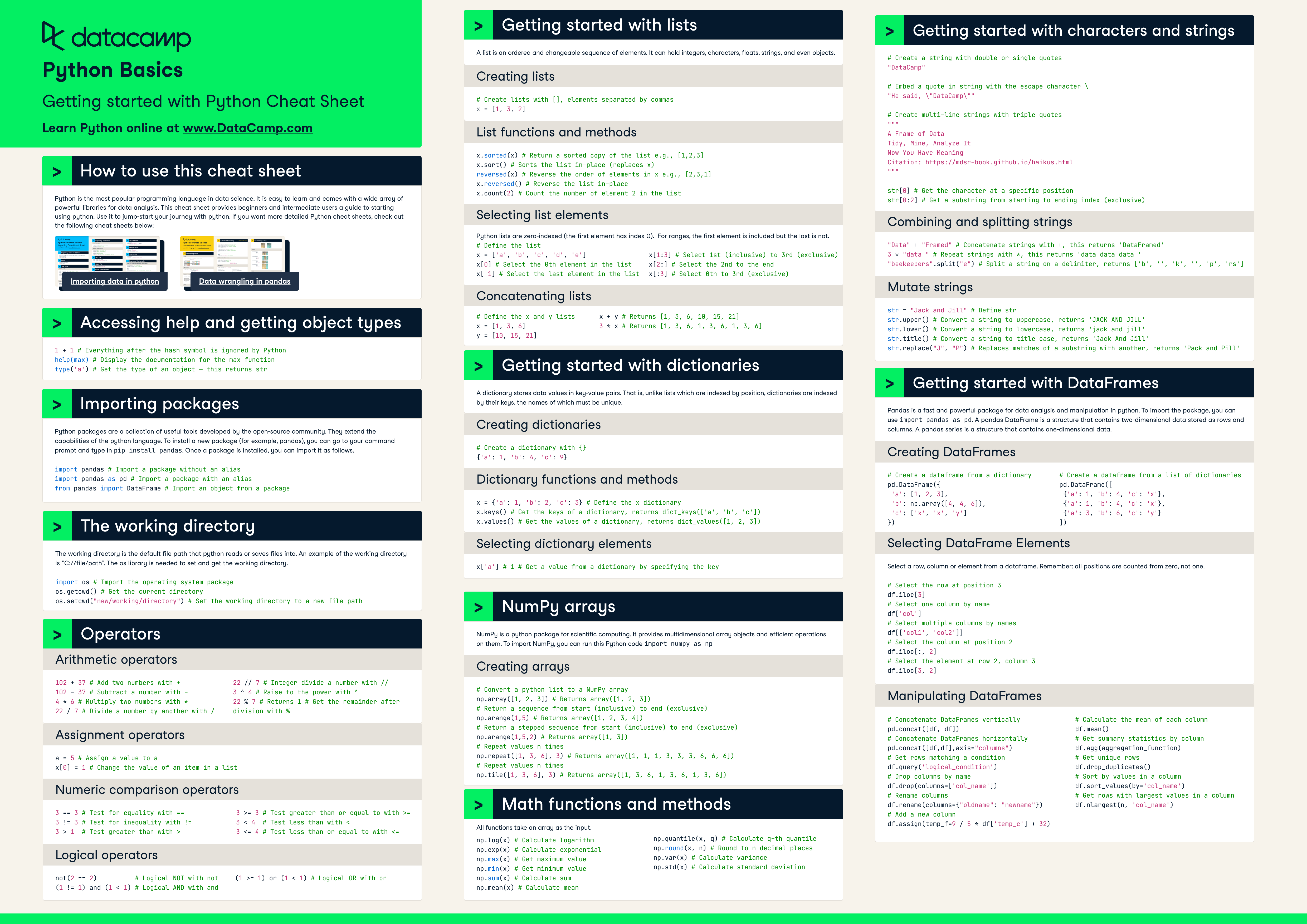
Cheat Sheet

Richie Cotton
8 min
Projects allow you to apply your knowledge to a wide range of datasets
to solve real-world problems in your browser
Project
Use data manipulation and summary statistics to analyze test scores across New York Citys public schools!
Exploratory Data Analysis
Project
Find out when and where crime is most likely to occur, along with the types of crimes commonly committed in LA.
Data Manipulation, Exploratory Data Analysis
Project
Perform a hypothesis test to determine if more goals are scored in womens soccer matches than mens!
Probability & Statistics
Python is a widely-used, high-level programming language known for its readability, simplicity, and extensive libraries. It is important because of its versatility in various fields like web development, automation, data analysis, and artificial intelligence, making it a fundamental skill for many technological and scientific applications. This broad applicability has made Python one of the most popular programming languages in the world.
No, you don't need previous programming experience. Our courses are designed to be beginner-friendly, guiding you step by step.
Learning Python opens doors across multiple industries due to its high demand, offering broad career opportunities in technology, data science, finance, healthcare, academia, and marketing. Its versatility in data handling and analysis is particularly valued for driving data-driven decisions and innovation. Mastering Python can significantly enhance your professional skillset, making you a valuable asset in numerous fields.
Python opens the door to a variety of career paths, serving as a catalyst for roles such as data scientist, data analyst, machine learning engineer, software developer, and web developer. Its widespread application in diverse fields like finance, healthcare, technology, and research means that proficiency in Python can significantly advance career prospects in these and many other industries.
The most effective way to learn Python is through a practical, hands-on approach. Interactive courses led by industry experts provide structured learning and real-world problem-solving, while building your own projects allows you to apply and solidify your skills, helping you to excel faster in Python programming. Read our full guide on how to learn Python for more guidance.
Python is a versatile and user-friendly language ideal for general programming and data science, whereas R is more specialized for statistical analysis, complex data manipulation, and data visualization. Check out our Python vs R article for a more detailed comparison.
Yes, we regularly update our courses to reflect the latest trends and technologies in the field.
DataCamp offers professional certifications for Data Scientists and Data Analysts. You can use Python in either of these certifications to prove your skills and build a strong portfolio.
Make progress on the go with our mobile courses and daily 5-minute coding challenges.