Course
Introduction to Python
BasicSkill Level4.8+10,927 reviews4 hr
Master the basics of data analysis with Python in just four hours. This online course will introduce the Python interface and explore popular packages.
AI TutorBuild your Python skills with interactive courses for data science, data analysis and machine learning, curated by real-world experts
Course
Master the basics of data analysis with Python in just four hours. This online course will introduce the Python interface and explore popular packages.
AI TutorTrack
Grow your data skills, discover how to manipulate and visualize data, and apply advanced analytics to make data-driven decisions.
Not sure where to start?
Take an AssessmentTopic
Skill Level
Content type
duration (hours)
Course
Learn how to reduce training times for large language models with Accelerator and Trainer for distributed training
Course
Learn how bonds work and how to price them and assess some of their risks using the numpy and numpy-financial packages.
Course
Learn how to use RNNs to classify text sentiment, generate sentences, and translate text between languages.
Course
Use survival analysis to work with time-to-event data and predict survival time.
Course
Transition from MATLAB by learning some fundamental Python concepts, and diving into the NumPy and Matplotlib packages.
Course
Master RAG with Weaviate! Embed text and images for retrieval, and experiment with vector, BM25, and hybrid search.
Course
Discover the power of discrete-event simulation in optimizing your business processes. Learn to develop digital twins using Pythons SimPy package.
Course
Take vital steps towards mastery as you apply your statistical thinking skills to real-world data sets and extract actionable insights from them.
Course
Explore the Stanford Open Policing Project dataset and analyze the impact of gender on police behavior using pandas.
Course
Learn how to design, automate, and monitor scalable forecasting pipelines in Python.
Course
Learn to use the Census API to work with demographic and socioeconomic data.
Course
Learn how to use Python parallel programming with Dask to upscale your workflows and efficiently handle big data.
Course
Learn to process sensitive information with privacy-preserving techniques.
Course
Discover how to talk to your data using text-to-query AI agents with MongoDB and LangGraph.
Course
Discover what all of the DeepSeek hype was really about! Build applications using DeepSeeks R1 and V3 models.
Course
Create a healthcare AI agent using Haystack, an open-source framework for orchestrating LLMs and external components.
Course
Learn how to prepare and organize your data for predictive analytics.
Course
Learn how to analyze survey data with Python and discover when it is appropriate to apply statistical tools that are descriptive and inferential in nature.
Course
In this course youll learn how to apply machine learning in the HR domain.
Course
Learn how to effectively and efficiently join datasets in tabular format using the Python Pandas library.
Course
Learn how to create interactive data visualizations, including building and connecting widgets using Bokeh!
Course
Are you curious about the inner workings of the models that are behind products like Google Translate?
Course
Learn how to predict click-through rates on ads and implement basic machine learning models in Python so that you can see how to better optimize your ads.
Course
Learn to build conversational LLM applications — with reliable structured output, persistent conversation history, and real-time streaming.
AI TutorCourse
Learn to build knowledge-grounded LLM applications that retrieve relevant information from structured and unstructured sources before generating responses.
AI TutorCourse
Learn to extend your LLM applications with external tools, so your applications can retrieve live data, perform computations, and take real-world actions.
AI TutorCourse
Learn to systematically measure and improve LLM application quality.
AI TutorCourse
Learn to build agentic systems using LangGraph.
AI TutorCourse
Learn to write effective prompts and systematically improve them through evaluation rather than intuition.
AI TutorTrack
Grow your data skills, discover how to manipulate and visualize data, and apply advanced analytics to make data-driven decisions.

Blog

Abid Ali Awan
15 min

Blog

Matt Crabtree
15 min
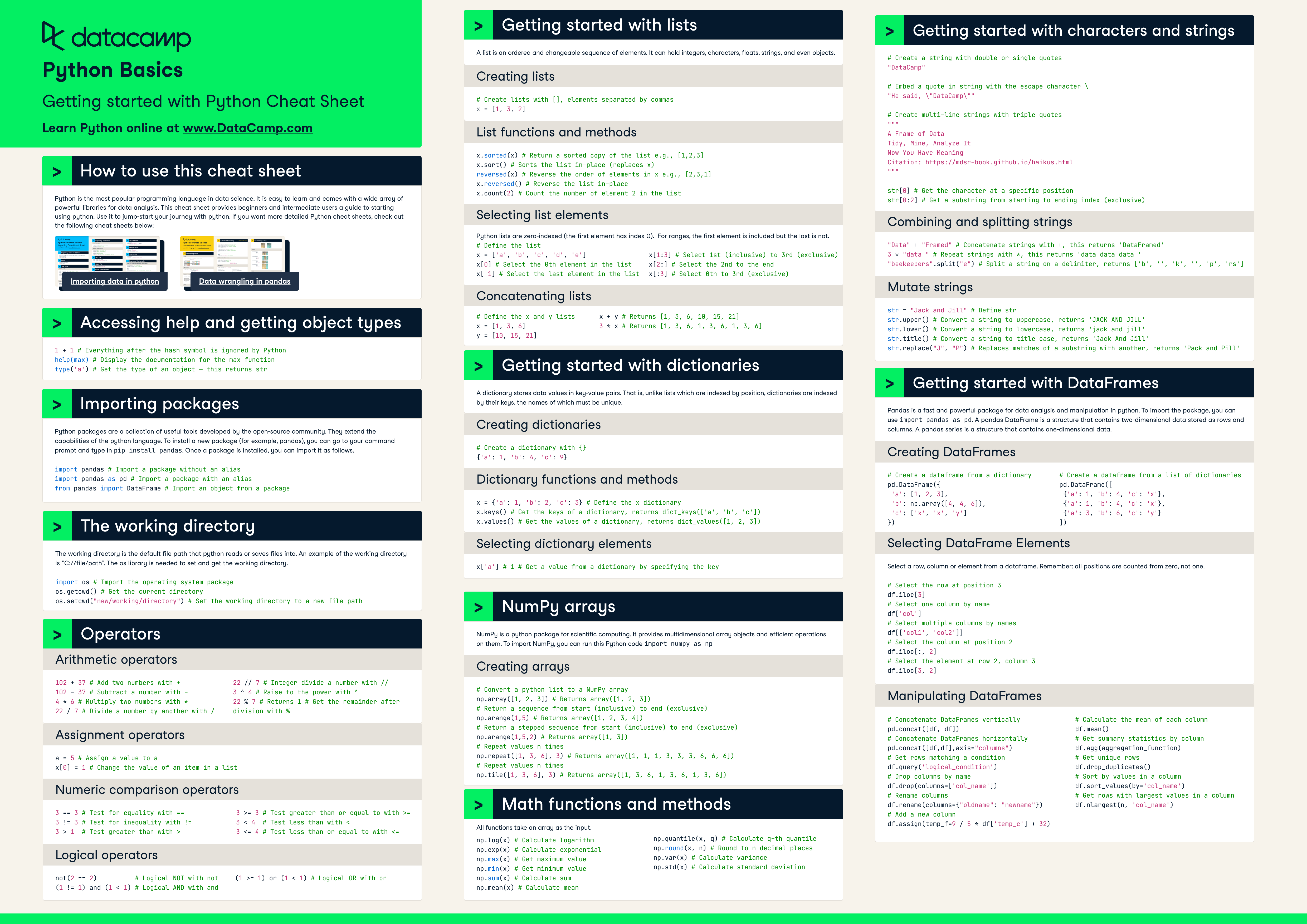
Cheat Sheet

Richie Cotton
8 min
Projects allow you to apply your knowledge to a wide range of datasets
to solve real-world problems in your browser
Project
Use data manipulation and summary statistics to analyze test scores across New York Citys public schools!
Exploratory Data Analysis
Project
Find out when and where crime is most likely to occur, along with the types of crimes commonly committed in LA.
Data Manipulation, Exploratory Data Analysis
Project
Perform a hypothesis test to determine if more goals are scored in womens soccer matches than mens!
Probability & Statistics
Python is a widely-used, high-level programming language known for its readability, simplicity, and extensive libraries. It is important because of its versatility in various fields like web development, automation, data analysis, and artificial intelligence, making it a fundamental skill for many technological and scientific applications. This broad applicability has made Python one of the most popular programming languages in the world.
No, you don't need previous programming experience. Our courses are designed to be beginner-friendly, guiding you step by step.
Learning Python opens doors across multiple industries due to its high demand, offering broad career opportunities in technology, data science, finance, healthcare, academia, and marketing. Its versatility in data handling and analysis is particularly valued for driving data-driven decisions and innovation. Mastering Python can significantly enhance your professional skillset, making you a valuable asset in numerous fields.
Python opens the door to a variety of career paths, serving as a catalyst for roles such as data scientist, data analyst, machine learning engineer, software developer, and web developer. Its widespread application in diverse fields like finance, healthcare, technology, and research means that proficiency in Python can significantly advance career prospects in these and many other industries.
The most effective way to learn Python is through a practical, hands-on approach. Interactive courses led by industry experts provide structured learning and real-world problem-solving, while building your own projects allows you to apply and solidify your skills, helping you to excel faster in Python programming. Read our full guide on how to learn Python for more guidance.
Python is a versatile and user-friendly language ideal for general programming and data science, whereas R is more specialized for statistical analysis, complex data manipulation, and data visualization. Check out our Python vs R article for a more detailed comparison.
Yes, we regularly update our courses to reflect the latest trends and technologies in the field.
DataCamp offers professional certifications for Data Scientists and Data Analysts. You can use Python in either of these certifications to prove your skills and build a strong portfolio.
Make progress on the go with our mobile courses and daily 5-minute coding challenges.