Share this webinar
Close your data and AI skills gap
We're the only platform uniquely engineered to advance data and AI skills across your entire organization. Let's explore a tailored program.
Book an Enterprise Demo[RADAR AI x Human] Easy Wins: How Non-technical Teams Thrive with AI
April 2026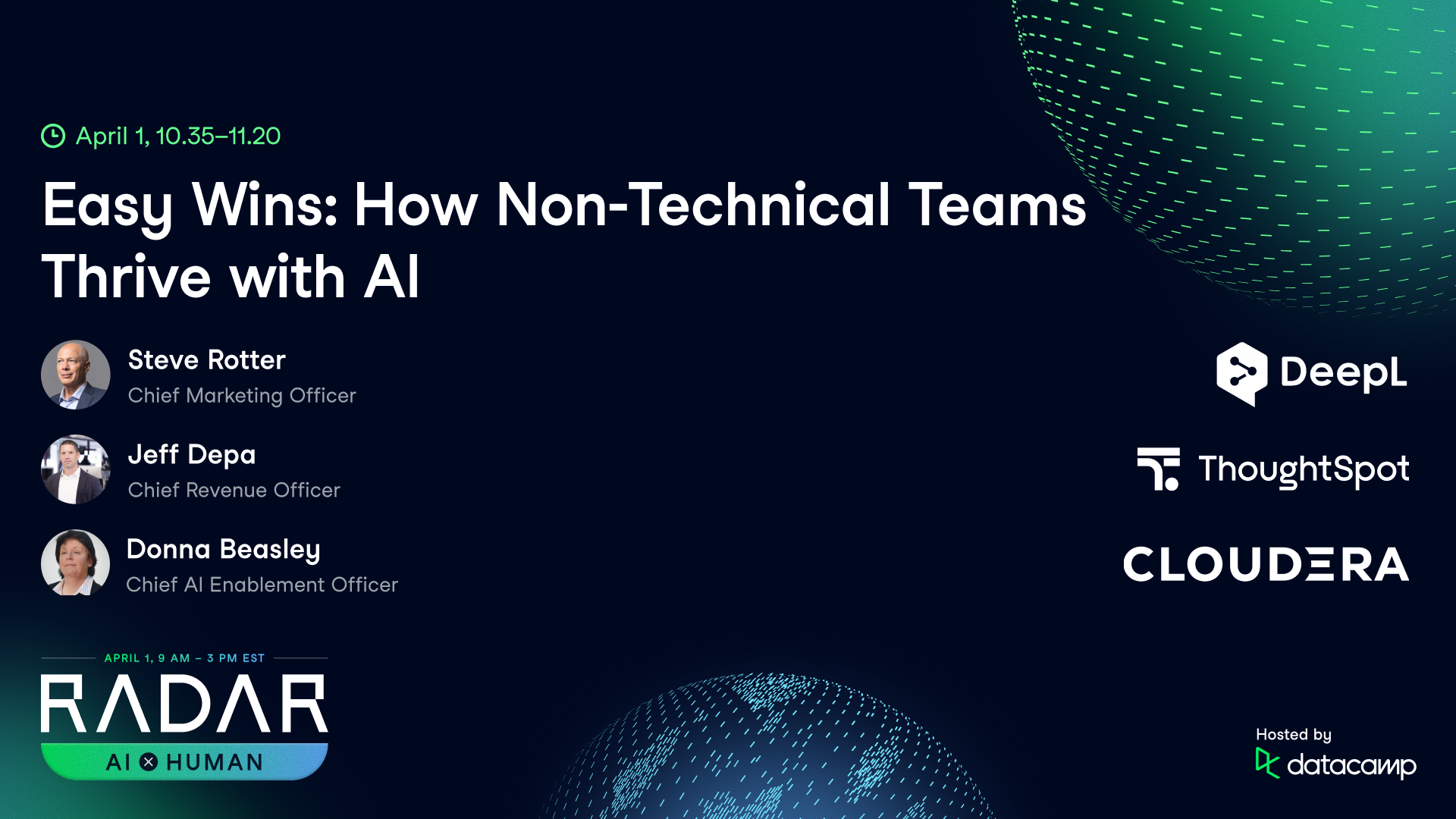
Your Presenter(s)

Jeff Depa
Chief Revenue Officer at ThoughtSpot
Jeff leads go-to-market strategy and execution for ThoughtSpot. He has over two decades of experience as a tech sales executive. Preivsouly, he was CRO at Gainsight and Lucidworks, and has stints at DataStax and Oracle.

Steve Rotter
Chief Marketing Officer at DeepL
Steve runs the marketing department at AI translation company DeepL. He has close to three decades of experience as a technology marketing executive. Previously, Steve was CMO at a variety of startups, across supply chain, low code software development, and AI content generation.

Donna Beasley
Chief AI Enablement Officer at Cloudera
Donna has over two decades of experience as a technology leader, leading global teams across product management, marketing, and operations. At Cloudera, she drives AI innovation and global product strategy. Previously, Donna was VP of Marketing & AI Strategy at media-tech company Naviga.
Summary
A practical conversation for sales, marketing, HR, operations, and product teams that want to use AI at work without needing a technical background.
AI is moving from a specialist’s craft to a mainstream skill, and many of the fastest wins show up in commercial workflows: prospecting, account-based marketing (ABM), personalization, sales enablement, and performance optimization. The speakers described how non-technical operators can now build useful agents in days, not quarters—when they start with the business question and the workflow (what decision needs to improve, what inputs exist, and what “good” looks like). At the same time, they cautioned that generative AI is probabilistic, which raises real concerns about accuracy, consistency, and brand risk when outputs show up in customer-facing moments.
A recurring theme was trust: clean, well-defined data; shared definitions; and governance guardrails that make safe experimentation possible. Just as important was culture—leaders modeling usage, teams sharing what they’ve built, and organizations making it clear that AI is meant to increase impact rather than reduce headcount. For individuals, the advantage shifts toward domain expertise, clear thinking, and curiosity: the ability to map work into a repeatable workflow, identify bottlenecks, run a small pilot, measure results, and keep learning as tools evolve (even 30 minutes a day). The full session offers concrete examples (and warnings) that help translate AI ambition into repeatable day-to-day practice.
Key Takeaways:
- Non-technical teams can deploy high-impact AI quickly when they start with clear, domain-specific questions and a defined workflow—not coding expertise.
- Personalization at scale is becoming practical in ABM and outbound, but it depends on data quality, approval steps, and clear do’s/don’ts for customer-facing content.
- Generative AI’s probabilistic nature makes deterministic layers, consistent definitions, and traceability necessary for business use (especially in analytics and reporting).
- Humans remain important for judgment, context, and customer-facing nuance; the best workflows blend automation with review and clear escalation rules.
- Adoption rises when leaders model AI use, governance removes fear, and teams build a simple learning habit (for example, sharing one useful workflow each week).
Deep Dives
1) “Easy wins” in go-to-market: from ABM signals to SDR agents
The most compelling early gains came from applying AI where commercial teams already struggle: prioritization, personalization, and speed. Steve Rotter described moving beyond basic content generation toward improving marketing performance at scale, using behavioral signals to refresh who deserves attention right now. In his example, web engagement becomes a living ABM input—less a static target list and more a real-time system that tells marketing and sales where interest is rising and what to do next (who to route to sales, what message to lead with, and which channel to use).
Jeff Depa pushed the point further: the “easy win” is no longer only better content or faster research, but an internal agent that consolidates an organization’s scattered knowledge—structured CRM fields, unstructured documents, call notes, and historical learnings—into a usable briefing for frontline teams. His story is intentionally disarming: “on Sunday morning, he deployed an agent that helps our SDRs from a prospecting perspective.” The significance is less the novelty of an agent and more the operational shift: a non-specialist can produce an asset that changes daily execution, especially when the agent is tied to a clear output (a prospect brief, first-touch angle, relevant proof points) and a clear success metric (reply rates, meetings set, time saved per account).
What the SDR agent actually does matters. It doesn’t simply summarize a company; it pulls the relevant touchpoints, proposes questions a rep should ask, and recommends the most fitting case studies by analyzing prior wins and matching patterns across similar prospects. That last step closes a long-standing gap between marketing assets and sales usage—getting the right evidence into the rep’s hands when it’s needed, rather than buried in a shared drive. It also points toward a practical sales enablement use case: connect unstructured content (case studies, decks, call snippets) to structured fields (industry, segment, product, outcomes) so AI can suggest “what to send” with a reason.
Donna Beasley framed the same arc through the lens of personalization. For years, teams knew personalized messaging worked, but it “didn’t scale” because humans couldn’t produce it fast enough and keep it consistent. AI changes that constraint: you can create experiences that feel timely and specific without tripling headcount—if you treat AI as part of the workflow, not a bolt-on. The session’s examples are worth watching in full because they show the practical middle: not “AI replaces the team,” but “AI takes the repetitive parts and makes the best work easier to deliver consistently,” with guardrails around what can be auto-sent versus what must be reviewed.
2) Trust and data foundations: why “probabilistic” AI needs deterministic business layers
As the conversation turned from excitement to reliability, the panel became precise about what breaks in real organizations. Generative AI, Depa noted, is fundamentally “probabilistic”—excellent at producing plausible outputs, inconsistent at producing the same answer twice, and often unable to explain itself in ways a business user can trust. That mismatch becomes acute when teams apply an LLM to inherently structured questions (pipeline metrics, performance analysis, segmentation definitions) and expect clean, repeatable answers.
The solution offered was not “use less AI,” but design the right layers around it. Depa emphasized the importance of determinism and shared definitions—often implemented through a semantic layer—so that a question like “What’s driving conversion in enterprise?” yields consistent logic even when phrased differently. Without that foundation, adoption collapses for a simple reason: AI can be “confidently wrong,” and commercial teams operate where consequences are immediate (a misguided campaign, a mis-prioritized account list, a flawed QBR narrative, or outreach that damages trust).
Steve Rotter brought the discussion down to the day-to-day reality for marketers: AI is only as good as the data underneath, and many teams are still wrestling with inconsistent taxonomies, blurry attribution, and duplicate sources of truth. If the underlying data is clean and clearly defined, AI becomes a useful analyst—helping decide whether to spend more in Japan versus Germany, which programs to scale, how to adjust media spend, and where engagement is truly compounding. If not, AI speeds up confusion and produces “answers” that look polished but don’t match how the business measures reality.
Donna Beasley added an operational point that often gets skipped: AI doesn’t simply “use data,” it exposes process quality. When teams try to automate a workflow, they discover that the workflow was never clearly documented—or that different people do it differently. In her view, transformation becomes “only as good as the SOP you can refine.” That’s why the trust conversation is bigger than model choice: it’s data governance, definition discipline, approval paths for sensitive use cases, and process clarity that makes results consistent.
The full session is valuable here because it offers a sober framing: commercial AI succeeds when organizations design for traceability and repeatability first, then use generative capabilities where they add leverage (summarization, synthesis, multi-step reasoning) rather than treating AI as an all-purpose answer engine.
3) Human-in-the-loop: where judgment and nuance still matter
Even among advocates, the panel drew a clear boundary between automation and accountability. Depa offered a succinct definition: “I think of AI as a tool for accelerating and pressure testing human judgment.” That framing matters because it resists a common failure mode—handing decisions to AI instead of using AI to sharpen the thinking behind decisions. In commercial settings, where tradeoffs are constant and context changes quickly, judgment is the output.
Steve Rotter grounded the human-in-the-loop case in his company’s core domain: translation. The risk is not theoretical. Translating a vacation menu can tolerate small mistakes; translating “customer contracts or your legal agreements” cannot. His recommendation was a blended strategy: use AI where speed is the goal, and add review where stakes are high. The message for non-technical teams is broader than language: AI can draft, classify, summarize, propose, and optimize—but humans must validate when errors carry legal, reputational, or financial costs, and when brand voice or customer trust is on the line.
Donna Beasley described a complementary view from internal operations: target repetitive work that people “didn’t really like doing anyway,” remove the grunt work, and redeploy time to higher-level decision-making—campaign judgment, product narrative choices, customer strategy. The prize is not only faster output; it’s a more consistent workflow that doesn’t break when a new employee joins or when volume spikes, because the steps are clearer and quality checks are built in.
That said, the session also acknowledged a subtler challenge: AI can surface “signals” that look meaningful but are “masked by context.” A model might identify a correlation that is technically true but strategically irrelevant—or recommend content that fits a pattern but misses the human reality of the account. The “human in the loop” is not only proofreading; it is sense-making, prioritization, and knowing when to ignore a recommendation.
Watching the full conversation is useful because it details practical ways leaders apply this: using AI to draft QBR insights, then debating and pressure-testing them; using AI to speed up production, then redesigning downstream review steps so approvals don’t become the new bottleneck. The panel’s implicit rule is a good one: automate the repeatable steps, but keep responsibility with the people who understand consequences.
4) Adoption and culture: governance, leadership modeling, and learning rituals
The barrier to AI adoption in non-technical teams is rarely access to tools; it’s fear and ambiguity. People worry about safety, compliance, brand risk, and—quietly—whether they are “training their replacement.” The panel addressed these concerns directly, and their prescriptions were notably operational.
Donna Beasley described governance as the “unsexy” prerequisite that makes everything else possible. A security council that evaluates tools and use cases gives employees permission to experiment without guessing where boundaries are. In practice, many employees are not trying to “go rogue”; they are asking, “Is this safe? Can I do this?” When guardrails are explicit, teams can run pilots in sandboxes, learn quickly, protect customer data, and avoid accidental misuse.
Leadership signaling is the other lever. Beasley noted the advantage of having a CEO publicly clarify intent: “We are not reducing any headcount. That is not what this is about.” That statement reframes AI from threat to opportunity—an expectation that everyone can “punch above their weight.” Steve Rotter echoed the cultural split as “a growth mindset… or a reduction mindset,” arguing that adoption rises when employees see automation as a route to more impactful work, not elimination.
Rotter also offered a practical habit for building momentum: institutionalize learning. His team runs “a weekly kind of AI recap” in all-hands—sharing what someone built, what worked, and what others can reuse. That matters because progress compounds socially: one person’s small automation becomes another team’s starting point, and experimentation becomes normal rather than exceptional.
Finally, the panel emphasized that adoption reveals bottlenecks. Beasley shared an example where faster code generation created a new constraint: human code review couldn’t keep pace. That pattern generalizes: AI doesn’t only speed up tasks; it moves constraints to downstream steps (reviews, approvals, data fixes, and handoffs). The full session is worth watching because it treats adoption as change management—tools, governance, leadership behavior, and workflow redesign—not a single training session or a one-time rollout.
संबंधित
webinar
Radar Data & AI Literacy Edition: From Data Literacy to AI Literacy
Join data literacy pioneers, Jordan Morrow & Valerie Logan, as they discuss the emergence of AI literacy, key steps leaders can take to foster it, and more.webinar
[RADAR AI x Human] The Future of Education. This Time It's Personal!
Everyone deserves a world-class personal tutor.webinar
Designing An Effective AI Literacy Strategy: A How-to Guide for Leaders
Alex Jaimes, CAIO at Dataminr, and Doug Laney, Innovation Fellow at West Monroe, teach you how to develop a strategy to enable all your employees to become AI literate.webinar
AI Literacy at Scale: Building a Future-Ready Workforce
Industry experts explore strategies for scaling AI literacy across diverse teams, bridging the gap between technical expertise and business understanding.webinar
Spreading Data & AI Literacy Across Your Organization
Learn how to devise a data and AI strategy that aligns with your business strategy, and how to combine technology and training to increase the data and AI literacy across your company for business success.webinar