Share this webinar
Close your data and AI skills gap
We're the only platform uniquely engineered to advance data and AI skills across your entire organization. Let's explore a tailored program.
Book an Enterprise Demo[RADAR AI x Human] Closing & AMA
April 2026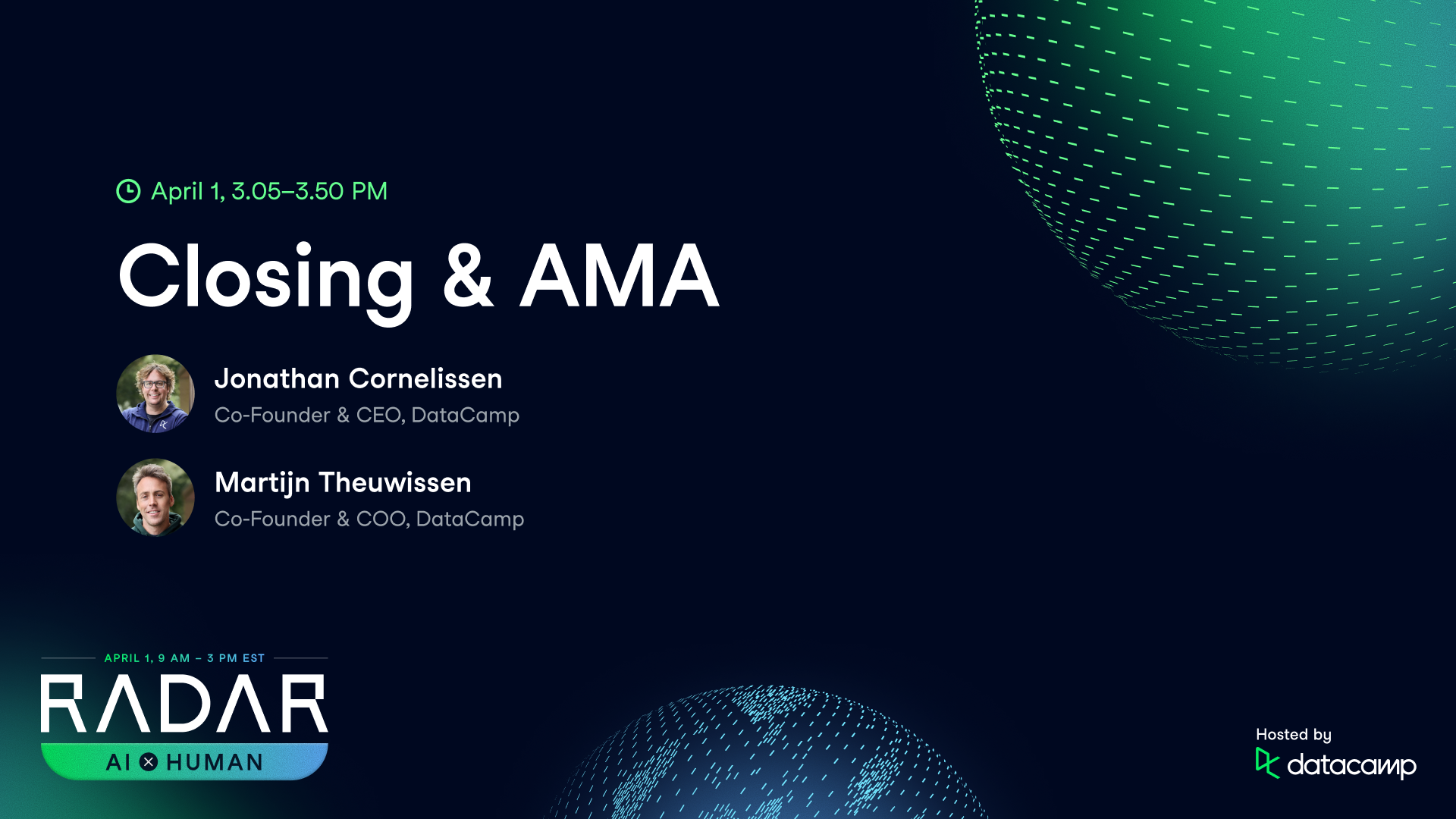
Your Presenter(s)

Jonathan Cornelissen
Co-founder and CEO of DataCamp

As the Co-founder & CEO of DataCamp, he helped grow DataCamp to upskill over 10M+ learners and 2800+ teams and enterprise clients. He is interested in everything related to data science, education, and entrepreneurship. He holds a Ph.D. in financial econometrics and was the original author of an R package for quantitative finance.

Martijn Theuwissen
COO and Co-Founder at DataCamp
As the COO and co-founder of DataCamp, Martijn helps DataCamp’s enterprise clients with their data and digital transformation strategies, enabling them to make the most of DataCamp for Business’s offering, and helping them transform how their workforce uses data.
Summary
A closing keynote and audience Q&A for data and AI practitioners—especially those trying to keep skills current as models, tooling, and expectations change week to week.
The conversation opened on a pragmatic note: recent advances in coding-focused models are no longer limited to impressive demos, but a shift that makes real automation routine. “We’ve seen an inflection point in the quality of models when it comes to coding,” Jo Cornelissen said, describing how natural-language querying tied to a data warehouse and catalog can now support self-serve analysis and even dashboard building—imperfect, but increasingly dependable. Martijn Theuwissen added a second accelerant: accessibility. Advanced models are available to individuals, enabling a bottom-up wave of experimentation that’s compressing product cycles and multiplying new applications.
From there, the discussion moved into how learning itself is changing. DataCamp’s “AI native” course format aims to replace side-panel chat with a tutor-led experience that adapts to skill level, pace, and context. In other words, the tutor is built into the course flow instead of sitting beside it as a separate chatbot. Cornelissen framed it as a new authoring model: “As a content creator, I’m actually creating the ingredients of the course. I’m not creating the end results.” The session also tackled enterprise realities—how to measure whether training improves productivity and quality (not only completion rates), what needs to be standardized versus role-specific, and how to cultivate the mindset of an “eternal learner” when AI skill half-lives are shrinking.
Key Takeaways:
- Coding models have crossed a threshold where real workflows can be automated, enabling non-specialists to answer questions without always routing through technical teams.
- AI’s unusually broad accessibility is driving rapid, bottom-up innovation—and raising the baseline expectations for every knowledge role.
- “AI native” learning reframes courses as expert-designed building blocks that a tutor can personalize, rather than static lessons everyone consumes identically.
- Upskilling impact should be tracked through business outcomes—productivity and output quality—rather than tool usage or course completion alone.
- Responsible AI, governance, and privacy are becoming core competencies; DataCamp emphasized guardrails and clear stances on learner data use.
Deep Dives
1) The coding-model inflection point—and what it unlocks
The most consequential shift described in the session wasn’t a new model name or a single breakthrough benchmark. It was a change in reliability. Cornelissen argued that, in the last few months, coding assistance has moved from “sometimes magical” to operationally useful across a range of tasks. “We’ve seen an inflection point in the quality of models when it comes to coding,” he said—an inflection that matters because it changes who can build, and how fast.
In his example, the user is not an engineer asking an engineer for help. Instead, he described going into a coding environment connected to an internal data warehouse and catalog and simply asking questions—then using the responses to assemble dashboards and answer business queries. He was careful about limitations (“it’s not a 100% correct”), but the key point was trajectory: what was fragile is becoming dependable enough to reshape day-to-day practice.
That reliability also changes organizational throughput. Cornelissen described productivity multipliers for software engineers—“two, three, five, 10 times more productive depending on the task”—but the more interesting implication is diffusion beyond technical roles. As Richie Cotton noted, the shift reduces the need to “have communications with…your technical [experts] every time you wanna do a bit of data analysis.” In plain terms, the bottleneck moves. Teams that once queued work behind specialists can increasingly prototype, explore, and validate ideas before escalating only the hardest problems.
Theuwissen’s contribution widened the lens: because advanced models are “universally accessible,” experimentation happens everywhere, not only in well-funded labs. That bottom-up energy produces a constant stream of new tools and workflows—exciting, but also destabilizing. The session leaves viewers with a question worth sitting with: if automation and self-serve building are becoming normal, what remains uniquely valuable in your role—problem framing, domain judgment, data quality stewardship, or something else? The answers are the heart of the broader RADAR theme, and they’re developed more fully across the event’s other sessions—worth revisiting with this inflection point in mind.
2) AI-native learning: from static courses to adaptive tutoring
One of the session’s clearest themes was that AI is not only changing what people need to learn—it’s changing how learning should be delivered. DataCamp’s leadership framed “AI native” courses as a break from the familiar pattern of static lessons plus an optional chatbot. Cornelissen emphasized that the tutor is not an add-on but the interface: “It’s not a chatbot on the side. It’s like the whole experience, gets transformed and personalized.” Practically, that means learners can ask questions in-context and get explanations and practice help that match what they’re doing in the course at that moment.
That personalization, as described, is grounded in a specific design choice: expert-authored structure first, adaptive delivery second. Historically, online courses have been created as fixed sequences—everyone gets the same explanations, examples, and pacing. DataCamp’s earlier innovation was interactive practice and feedback, but still within a common scaffold. The AI-native approach shifts the author’s role further upstream. “As a content creator, I’m actually creating the ingredients of the course. I’m not creating the end results,” Cornelissen said. Those “ingredients” include outlines, learning objectives, and researched inputs—then the tutor adapts the presentation based on the learner’s level, progress, and interests while staying within the course goals.
The promised benefits are concrete: adjusting examples to an industry or country, allowing deeper exploration of a confusing concept, and making the experience more accessible through language. Cornelissen noted the tutor already supports “more than 20 languages,” a practical step for learners who’ve long been disadvantaged by English-only training. The goal is to balance personalization with guardrails so the tutor doesn’t “make up a bunch of nonsense,” staying grounded in the course objectives, the provided materials, and clear constraints.
The session also surfaced a less technical but arguably more important advantage: emotional safety. Theuwissen highlighted the ability to “constantly ask questions during the course,” and Cornelissen expanded on why that matters: learners often avoid questions in classrooms or corporate trainings because they feel embarrassed. An AI tutor, he noted, “doesn’t judge people,” which can unlock more frequent—and deeper—questioning. The early engagement data they cited (AI-native beating “DataCamp Classic in almost every metric”) is suggestive, but the bigger story is behavioral: when the cost of asking is near zero, persistence rises.
If you’re deciding whether AI-native learning is a meaningful step forward or only a UI change, this part of the conversation is the one to watch closely in full—because it spells out what “personalized” is supposed to mean, how the tutor fits into the course itself, and where the boundaries are meant to be.
3) Upskilling inside organizations: standardize the base, customize the role
For companies, the session offered a useful way to think about training design without reducing everything to one-size-fits-all. Theuwissen proposed a layered model. Start with foundational “building blocks” that are broadly applicable—core concepts, common tools, and baseline fluency. Those elements can be standardized across the organization. But the next layer, he argued, must be role-specific: different workflows for legal, marketing, engineering, analytics, and beyond; different models and practices depending on domain risk; and different expectations about what “good” looks like.
This framing helps explain why many AI training programs stall. If the curriculum remains too generic, employees can’t connect it to real work. If it becomes too specific too early, it’s expensive and hard to maintain. The session’s answer is sequencing: a stable core plus targeted specialization—then continuous revision as tools and practices evolve.
That “continuous” part became the most pointed advice. Theuwissen said the differentiator will be whether people and organizations commit to being “eternal learner[s],” supported by structures such as internal academies where employees can educate themselves “comfortably on all this rapid…developments.” Cornelissen sharpened the urgency with an observation about obsolescence: “If you were an AI expert two years ago, most of that knowledge is actually completely outdated and may actually hurt you.” In other words, training can’t be treated as a one-time initiative; it has to be a living system.
For individuals inside these programs, the discussion also hinted at a practical reality: personalization isn’t only convenience. It can be the difference between adoption and avoidance. Learners come in with widely varying skill levels; AI-native tutoring, in their view, can widen access without slowing down advanced learners.
The most valuable subtext here is measurement: organizations need feedback loops that connect learning inputs to real job outputs. The session doesn’t pretend that’s easy—but it does argue that AI-native interactions can reveal where people are stuck, what they’re trying to do, and what blockers exist. If your organization is struggling to move from “training completed” to “behavior changed,” this segment is a strong on-ramp to the more detailed measurement discussion that follows.
4) Measuring outcomes, building careers, and keeping AI responsible
The conversation about training didn’t stop at delivery; it pressed on the harder question: how do you know upskilling is working? Theuwissen offered two complementary lenses. The first is productivity—are engineers shipping faster, are sales teams doing better research more quickly, are teams delivering more with the same headcount? The second is quality of output, which he argued receives less attention than it deserves. With modern models, workers can access domain expertise on demand, improving precision in tasks like adapting technical messaging or producing more accurate work products. Productivity gains matter, but quality gains often determine whether AI adoption is trusted—or quietly resisted.
Cornelissen added a measurement argument specific to AI-native learning: conversational tutoring produces richer signals about learner progress than static content. Over time, those signals could help organizations close that gap between course metrics and business metrics—surfacing what’s working, what isn’t, and what blockers exist (with stated attention to privacy). It’s a subtle shift: the platform teaches, and it also observes where the change is failing.
On career pathways, Theuwissen pointed learners to structured options—career tracks for job transitions (including an AI engineering track) and an AI assistant to help pick courses when the catalog becomes hard to choose from. That guidance matters for common goals like moving into data analyst, data scientist, or AI engineering roles, where sequencing and practice time often make the difference. Cotton’s aside was telling: even experienced practitioners can start too many courses at once; guidance and sequencing are part of the product now, not a nice-to-have.
The responsible-AI segment was brief but concrete. Theuwissen pointed to skill tracks in “AI ethics, data ethics, data governance,” plus certifications linked to frameworks such as the EU AI Act. That combination speaks to two needs at once: teams need practical guardrails (privacy, acceptable use, and risk-based deployment), and individuals increasingly need proof of competence as compliance requirements rise. And when asked directly about privacy, Cornelissen was explicit: “Right now, we don’t use any student data to train and adapt any AI models.” In a moment when data use is often ambiguous, the clarity matters.
Taken together, this theme ties the session’s major threads into a single proposition: AI capability without measurement is noise; AI adoption without responsibility is risk; and career growth without continuous learning is temporary. The full keynote and AMA adds important nuance around where those boundaries should sit—and what, exactly, learners should do next.
संबंधित
webinar
Closing Session & AMA
Join DataCamp executives for closing words to cap off the day. Followed by an "ask me anything" with all of them.webinar
Radar AI Edition 2024: Closing Session & AMA
Join DataCamp CEO and COO Jonathan Cornelissen & Martijn Theuwissen for closing words to cap off the day. Followed by an "ask me anything" with both of them.webinar
RADAR: The Analytics Edition - Closing Session & AMA
DataCamp CEO and COO Jonathan Cornelissen & Martijn Theuwissen share closing words to cap off the day. Including an "ask me anything" with both of them.webinar
Radar Data & AI Literacy Edition: Closing words & AMA
Join DataCamp CEO and COO, Jonathan Cornelissen & Martijn Theuwissen for closing words to cap off the day. Followed by an "ask me anything" with both of them.webinar
Closing Session & AMA
DataCamp CEO and COO Jonathan Cornelissen & Martijn Theuwissen share closing words to cap off the day. Including an "ask me anything" with both of them.webinar