Share this webinar
Close your data and AI skills gap
We're the only platform uniquely engineered to advance data and AI skills across your entire organization. Let's explore a tailored program.
Book an Enterprise DemoAI Use Cases in L&D
May 2026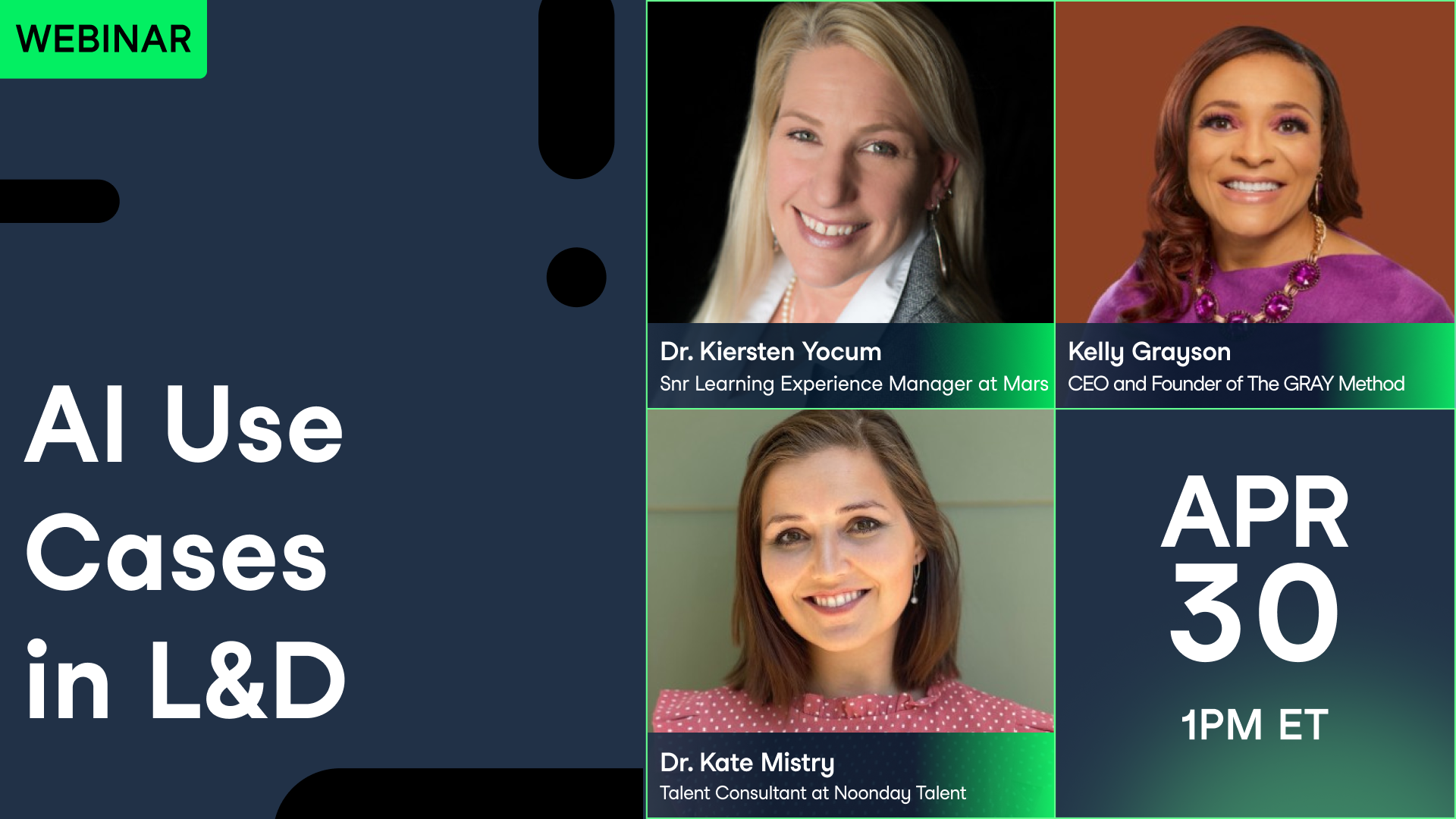
Your Presenter(s)

Kiersten Yocum
Senior Learning Experience Manager at Sweetrush
Kiersten designs learning experiences for Mars University, including using AI tools to create innovative, engaging learning programs across the business. In addition to her work at Mars, she is Managing Director of The Agile Learning Guru L&D consultancy. Kiersten has over 25 years of experience in instructional design and L&D.

Kelly Grayson
CEO and Founder of The GRAY Method
Kelly Grayson is the CEO and Founder of The GRAY Method, a consulting and coaching firm that uses a proven framework to help individuals and organizations achieve their personal and professional goals. With more than 20 years of experience in talent development, Kelly blends human-centered leadership practices with the strategic integration of AI to elevate learning and business performance. Her career includes serving as Director of Talent Development at Southern Glazer’s Wine & Spirits and Senior Learning and Development Manager at Sally Beauty Holdings.

Kate Mistry
Talent Development Consultant at Noonday Talent
Kate is a Talent Development Consultant and Co-Founder of Noonday Talent. With a doctorate in the field of human and organizational learning and over a decade of corporate learning experience, she specializes in designing and delivering engaging, science-backed learning experiences that drive real impact. Previously, she served as Associate Vice President & Director of Talent Development at Limbach, leading enterprise learning and talent initiatives.
Summary
AI is changing learning and development — but the instructional designer is not going anywhere.
Three senior L&D practitioners — Kiersten Yocum, Senior Learning Experience Manager at Mars; Kate Mistry, Talent Development Consultant at Noonday Talent; and Kelly Grayson, CEO of The Gray Method — brought a combined fifty-plus years of instructional design experience to a conversation about which AI use cases are worth your time and which are not. What you get is a working practitioner's account: real tools, real failures, and real results, not a vendor pitch.
The clearest wins are in production speed and practice. Course development that used to take six months now takes under a week with the right AI course development platforms. AI role-play simulations give learners a low-stakes environment to practice difficult conversations at scale, without the logistics of pairing people up in a classroom. The clearest gaps are in emotional resonance, storyboarding, and anything that requires reading a room. And the biggest bottleneck, all three agreed without hesitation, has not changed: subject matter expert availability.
Watch the full session to hear their specific tool recommendations, the cautionary tales, and their take on what the L&D role looks like five years from now.
Key Takeaways
- AI role-play simulations let learners practice interpersonal skills — difficult conversations, coaching conversations, sales scenarios — at scale and on demand, without scheduling a partner or a facilitator.
- Course development timelines have collapsed. A one-hour eLearning course that previously took six months can now be built in under a week with AI-assisted authoring tools.
- Subject matter experts are still the biggest bottleneck, AI or not. Production is faster, but you still need human domain knowledge to vet the output — and SMEs still do not have time for it.
- Prompt specificity determines output quality. Naming the audience, role, industry, and theoretical framework produces work you can use. Vague prompts produce generic content.
- AI-generated training content can be technically accurate and completely flat. Learners notice the difference between content designed with AI assistance and content that was generated and shipped.
- Hallucinations are a real production risk. AI-generated content needs human review before it reaches learners, especially for factual or compliance-sensitive material.
- Facilitation, coaching, and mentoring stay human. These require emotional intelligence and relational trust that AI can simulate but cannot replicate.
- L&D professionals are shifting from content producers to learning architects and strategic partners — a move the guests see as an elevation, not a displacement.
Deep Dives
AI Role-Play Simulations for Employee Training: Solving the Practice Problem
Teaching interpersonal skills has always had a logistics problem. You need a partner, a facilitator, scheduled time, and enough psychological safety that learners will engage rather than perform. All three guests named AI role-play simulations as the application that most changes this equation, and each arrived at the same answer before anyone prompted it.
Kiersten Yocum described using simulations at Mars for leadership development around difficult conversations: "I've created some for the difficult conversations for leadership where [they can] practice in a safe environment and they get feedback. They don't have to worry about being judged by their partner in a classroom." Learners arrive at the real conversation having already done the reps.
Kate Mistry framed it as closing a gap L&D has had for years: "Most of the learning happens not in a classroom, not in a course they're gonna forget by Friday, but it's real-time contextual support at the moment of need. And AI is finally making it accessible at scale." Kelly Grayson's team used adaptive AI simulations in a coaching certification rollout, letting leaders self-assess against a specific coaching model and identify gaps — inclusive language, creating space for others — before engaging with human coaches.
The technology is not fully there yet. Mistry has not found a coaching bot she trusts completely. But the direction is clear. Giving every learner unlimited practice reps, with immediate feedback, at any time, is a capability shift that L&D could not deliver at scale before now.
AI Course Development: Using AI as a Variation Engine
For day-to-day L&D work, the guests agreed that AI course development earns its keep most in planning — not by generating finished content, but by generating options. Kate Mistry described the technique that unlocked the most value: asking for variations.
"Give me the same curriculum through the lens of constructivism. Now through Kolb's experiential learning...or give me the same curriculum for sales professionals with less than five years of sales experience in [a specific] industry." She ran this approach for a program serving commercial HVAC technicians learning to generate recurring revenue — specific enough that a generic treatment would have missed entirely. "It pushes you outside of your own default framework. It surfaces assumptions and approaches, and it becomes a true thought partner that has read every learning theory textbook and never gets tired of exploring ideas."
Kiersten Yocum added that platforms like Uplimit and Sana Labs have collapsed the production side: "It used to take us six months to develop a one-hour eLearning course, and we can do that now inside of a week." These tools build a course structure from source content. A designer still has to go in and make it work. The starting point is no longer a blank page.
Both Yocum and Mistry use AI to unblock resistant SMEs: generate a first draft, then bring it to the subject matter expert for reaction. Getting someone to critique a draft takes far less time than getting them to produce one. Yocum learned this through experience — and through one cautionary counterexample. She asked AI to create "a sales course for Mars" without specifying Mars Inc. and received a curriculum about sales leaders on the planet Mars. "Make sure you are very specific in your prompting."
Knowledge Management: Getting What's in People's Heads
Kate Mistry made a case for a use case that rarely gets attention: using AI to surface and organize institutional knowledge before it walks out the door.
The conventional approach — asking SMEs to write documentation — fails because the people who know the most are also the busiest, and writing is not their job. Mistry's alternative is a structured AI-assisted interview: the AI helps ask follow-up questions, spots gaps, and synthesizes the output into usable formats. "All the subject matter expert does is talk."
She described a project at a customer service organization with fifty years of recorded sales calls. AI crawled those calls, emails, and shared drives to surface knowledge that was scattered and unstructured, then organized and tagged it. The output was a conversational knowledge base where employees ask questions in plain language and get answers drawn from the company's own documented experience. The system could also flag gaps — areas where employees were asking questions the knowledge base could not answer — giving the L&D team a live view of what was missing.
The privacy and governance concerns are real, and Mistry acknowledged them: "It's one we have to be careful with in organizations." Getting the permissions right matters. For organizations willing to do it carefully, the payoff is learning infrastructure grounded in what actually worked rather than what someone decided to write down.
Where AI Falls Short: Storyboards, Uncanny Valleys, and Flat Content
The guests were direct about failure modes. They have real experience with them.
Kiersten Yocum flagged storyboarding as a persistent weakness. When she feeds content into ChatGPT and asks for a storyboard, she gets skeletal outlines — one or two sentences per screen — rather than the screen-by-screen content flow an eLearning developer needs. "I've even specifically said, I'm looking for on-screen content as well as prompts for what images or videos should go there...can't get it to understand that it needs to build that content in there." She also flagged AI-generated video. Synthetic presenters sit in an uncanny valley — close enough to human to raise expectations, but not quite meeting them. "They're not quite human enough to really relate to, which is a real problem for learning because we want that humanity in there."
Kate Mistry's concern was more systemic: "I've seen content that's technically competent but it's also completely soulless." Organizations that treat AI as the output rather than the input — generating content and shipping it without design judgment — produce training that learners can see through. Learning is a human experience, and outsourcing too much of the thinking strips out the empathy and storytelling that makes it land. "AI is an accelerant to that, but you still have to bring that human side and that expertise."
Kelly Grayson raised organizational risks: inconsistent adoption across teams, individuals using AI as their sole information source, hallucinations going unreviewed. "Unless you prompt it not to hallucinate, it can give you irrelevant information." Building the human review processes that keep AI output accountable matters as much as choosing the right tool.
The Future L&D Role: Architects, Not Factories
The question of where the L&D role is heading produced the most consistent answer of the session.
Kate Mistry was direct: "I do not think we get less relevant. If anything, we become more relevant." As AI handles production and logistics, the practitioners who thrive will be the ones who build stakeholder relationships, read organizational culture, and diagnose why performance gaps exist rather than just naming them. "The L&D professional of the future is maybe slightly less a content producer and more a learning architect and a strategic partner."
Kelly Grayson added a skills intelligence angle. Organizations adopting AI at scale need someone to identify what capabilities the technology creates, which roles change, and how to develop the workforce to meet those demands. Workforce planning and skills gap analysis become more central to what L&D does.
Kiersten Yocum pushed back on the most anxious version of the conversation: "Someone said to me the other week, 'It's so great to have AI. We're not even gonna need instructional designers in the future.' And I said, that is not at all true." Instructional design is, in her framing, "wicked problem solving" — a complex, context-specific practice that requires human judgment at every step. AI assists that work. All three guests named prompt engineering as a skill every L&D professional will need. The ability to direct AI well, specify an audience precisely, and know when to push for variation is now part of the craft.
Tools Mentioned by Guests
- Claude (Anthropic) — Large language model used as a thinking partner for curriculum design, skills intelligence analysis, and workforce planning. Kate Mistry uses it as a "skills intelligence database" for client engagements, building skill graphs and forecasting capability needs.
- ChatGPT (OpenAI) — Large language model used for content generation, brainstorming, and course structure drafting. Multiple guests mentioned it as a standard part of their day-to-day toolkit.
- Gemini (Google) — Google's large language model, mentioned alongside Claude and ChatGPT as a general-purpose AI thinking partner for L&D work.
- Synthesia — AI video generation platform that creates presenter-led video content without on-camera talent or production overhead. Noted for reducing schedule burden, but flagged for uncanny-valley issues in learner feedback.
- Uplimit — All-in-one AI course development and delivery platform. Cohort-based; supports virtual instructor-led training and self-paced learning; generates course structure from uploaded content. Kiersten Yocum's current top pick, used at Mars.
- Sana Labs — AI-powered learning platform for course development and delivery. Builds course structure from source content and surfaces interactive activity suggestions. Described as strong across development, delivery, and engagement design.
- NanoBanana — Google's image generation tool, used to create visual quick reference documents. Kiersten Yocum noted it handles multi-box document layouts better than ChatGPT's image generation tools.
- Microsoft Copilot — AI assistant built into Microsoft 365. Used for recording and summarizing intake meetings, generating content outlines from SME conversations, and drafting training communications. Kelly Grayson noted it is often the entry point for organizations at the start of AI adoption, since it comes bundled with existing Microsoft licenses.
- Articulate — eLearning authoring tool with integrated AI features, widely used by instructional designers for building interactive courses. Mentioned by Kelly Grayson as a tool her instructional designer clients are actively adopting.
- BeyondGo — Platform with AI features used to bring training production to life and reduce content turnaround time. Kelly Grayson cited it as useful across intake, design, and delivery phases.
- Neo — Mars Inc.'s internal proprietary AI tool, used by their L&D team for content structuring and course development, used similarly to ChatGPT but scoped to the organization's own data and guidelines.
Связанный
webinar
Learning in the Age of AI: How Will AI Reshape the L&D Function in 2025?
Three industry experts discuss how AI is reshaping the L&D function, how to best drive AI literacy for the wider organization, and how learning teams can future proof their workflows for 2025 and beyond.webinar
Integrating AI Into L&D
Colin Cosgrove, Founder at Movizmo Coaching Solutions, explores how AI can be integrated into L&D programs to improve outcomes and learner satisfaction.webinar
Making AI Work in Healthcare
Experts discuss what it really takes to deploy AI in healthcare and life sciences.webinar
AI Upskilling: Lessons from the Frontlines
Experts discuss their experiences running AI upskilling programs at scale. You’ll learn how to define training personas, boost adoption and engagement, and measure the ROI of your efforts.webinar
The Executive Guide to Data & AI Literacy
Experts share how to design and implement a literacy strategy that works. Hear practical lessons on training at scale, increasing data and AI maturity, and identifying the highest-impact use cases.webinar