Share this webinar
Close your data and AI skills gap
We're the only platform uniquely engineered to advance data and AI skills across your entire organization. Let's explore a tailored program.
Book an Enterprise DemoClaude in the Enterprise
April 2026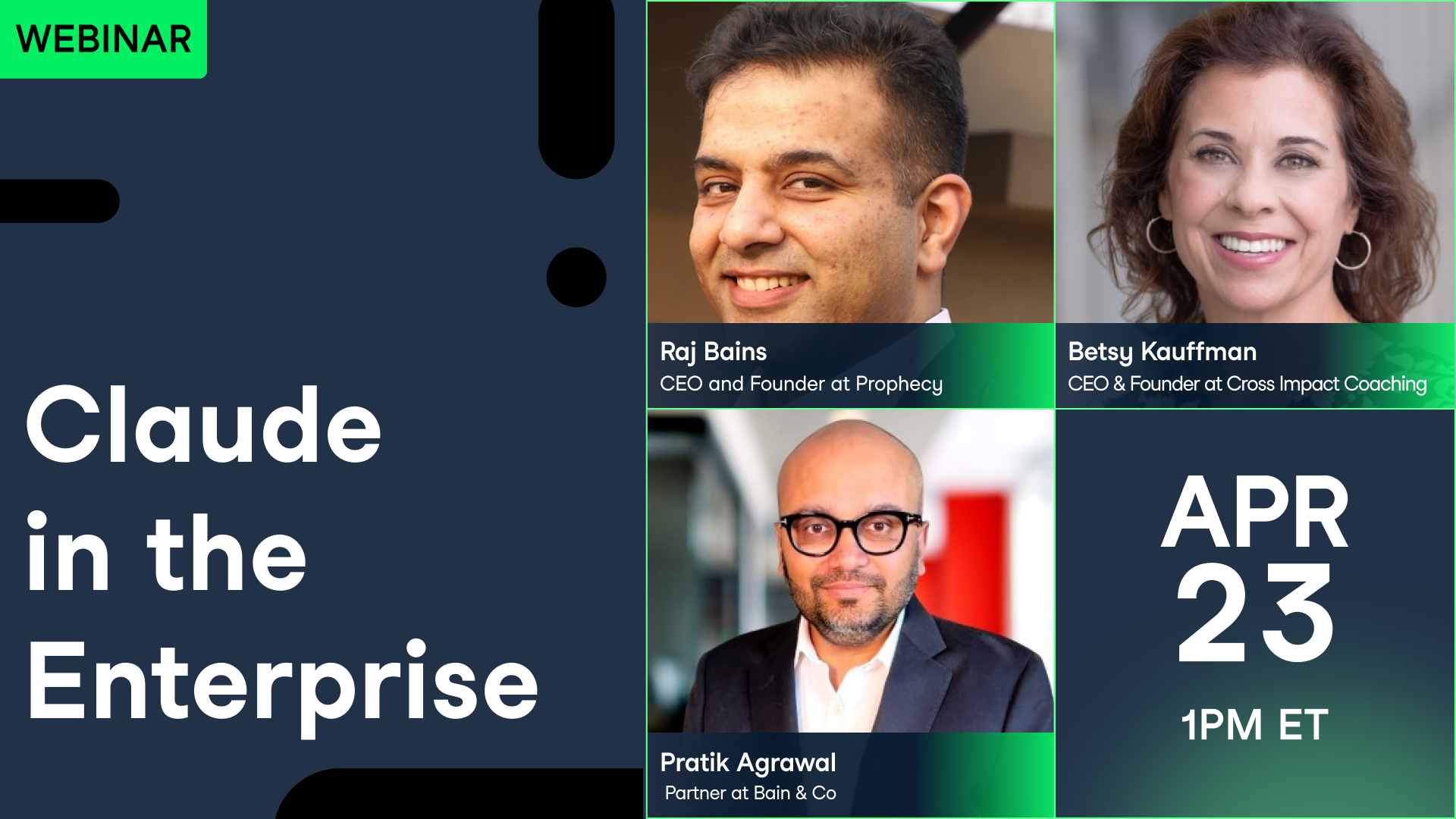
Your Presenter(s)

Raj Bains
CEO and Founder at Prophecy
Raj runs the AI-powered data preparation platform Prophecy. He's a software developer and big data project manager turned entrepreneur. Previously, Raj was a Product Manager for Apache Hive at Hortonworks, and had stints at NVIDIA and Microsoft.

Betsy Kauffman
CEO & Founder at Cross Impact Coaching
Betsy runs the digital transformation consultancy Cross Impact Coaching. She helps executives navigate complex challenges like AI adoption. After 25 years leading large-scale technology transformations across Fortune 500 companies, she now focuses on helping leadership teams close the gap between strategy and execution. Her TED Talk, “4 Tips for Honest Conversations at Work,” has over 1.6 million views.

Pratik Agrawal
Partner at Bain & Company
Pratik is a Partner at Bain & Company, where he leads transformative work at the intersection of AI, digital strategy, and enterprise value creation. With over 19 years of global experience, he works closely with CEOs, Boards, and PE sponsors to drive profitable growth, operational excellence, and long-term digital advantage across industries. Pratik leads AI in aviation, automotive, and mining globally at Bain.
Session Resources
Summary
Large organizations stall on AI adoption before the technology ever becomes the problem.
Three enterprise AI practitioners made that case in the session, working through what it takes to deploy Claude AI at scale inside a real company. Raj Bains, CEO of data preparation platform Prophecy, runs marketing operations and internal planning through AI agents. Pratik Agrawal, a Bain and Company partner, works with Fortune 500 CEOs on enterprise AI adoption strategy across aviation, automotive, and mining. Betsy Kauffman, founder of Cross Impact Coaching, spent twenty-five years guiding large-scale technology transformations. She now helps leadership teams close the gap between AI strategy and execution.
All three pushed back on the prevailing "AI-first" narrative. Going AI-first does not mean transforming everything at once. The technology is rarely the main obstacle. Automation does not primarily threaten jobs. The session covered where Claude AI fits in a real enterprise tech stack, how to build AI governance without strangling momentum, why change management consumes roughly 70% of any AI transformation, and what working adoption looks like in practice. If you are moving from AI pilot to production, or from individual experiments to company-wide capability, this session has answers.
Key Takeaways
- Change management is the dominant challenge in enterprise AI adoption. A Bain estimate puts it at 70% of the work; AI algorithms account for just 10%.
- Most large companies are still running pilots. Startups move faster because they design processes from scratch rather than retrofit existing ones.
- The Chief AI Officer role works best as a translator between business and technical teams, tying AI investments to measurable ROI.
- Claude AI functions best as a reasoning layer inside existing products and workflows. When the model improves, most of the surrounding architecture stays intact.
- AI governance guardrails matter most when agents connect to multiple tools and systems. Business users working one-on-one with a model face a much lower risk profile.
- Token costs will decrease. AI competes economically with human labor, which costs orders of magnitude more per unit of output.
- Enterprise AI adoption strategy works best when teams start with a specific business problem and apply AI to it. Starting with the technology and looking for problems produces expensive pilots with thin ROI.
- C-suite alignment is the prerequisite for enterprise-wide adoption. Without it, enthusiasm stays siloed and unsanctioned experimentation creates data security exposure.
Deep Dives
Why 70% of AI Transformation Has Nothing to Do with AI
Pratik Agrawal opens with a breakdown most technologists would rather not hear. In his experience at Bain, roughly 10% of the challenge in enterprise AI adoption is algorithms, 20% is the tech stack, and 70% is change management and process redesign.
Organizations underinvest in the harder work of changing how people actually operate. Agrawal gave a concrete example: a client firm had a demand forecasting model running at 90% accuracy. Production planners, working from personal laptops, built their own forecasts and deleted them weekly. The AI output never reached anyone. "That is not a tech problem," he said. "That is a change management problem."
Betsy Kauffman sees the same pattern from the organizational side. When employees believe they are being asked to automate themselves out of a job, adoption stalls regardless of how capable the tooling is. That anxiety rarely surfaces in executive briefings, which makes it harder to address. Transparency from leadership is operationally necessary. Workers who understand the actual goal — whether it is cost reduction, product acceleration, or capability expansion — make better decisions about how and when to use AI tools. Workers left guessing make defensive ones.
"If we are going to want adoption and user acceptance," Kauffman said, "leaders have to help with that change management side, the human side of it."
The panel agreed that process change requires deliberate investment, not good intentions. Identifying communication gaps, redesigning workflows around new capabilities, and keeping humans accountable for AI-assisted decisions are slow, unglamorous work. Skipping it is why most AI pilots never become programs. The technology readies faster than the organization does.
AI-First Is a Destination, Not a Starting Point
Most "AI-first" companies are running AI pilots with patchy ROI. Agrawal was direct about what he sees at large enterprises: pockets of genuine use, a lot of experimentation, and a wide gap between executive announcements and what is actually running in production.
Startups are the exception. Raj Bains described Prophecy running marketing operations through connected Claude AI agents, using AI for annual operating plan scenario modeling, and redesigning roles wholesale, merging presales and post-sales into "forward deployed engineers" who work directly with customers on interface design.
"Startups, I can see a lot of the leading edge companies are AI first," Bains said. "Enterprises will take some time."
Large organizations face a structural problem. Existing systems, existing roles, and years of embedded process create friction a well-prompted model cannot dissolve on its own. The realistic opportunity is targeted automation of specific tasks within existing workflows, freeing people for higher-value work. Bains gave the example of structured finance teams spending hours cleaning messy mortgage data from multiple banks. AI handles that. The analyst's judgment about what to do with clean data is a different question.
Agrawal's framing was useful: think of AI like a hammer, and the job is to find the right nails rather than swing at everything. Organizations that define the business problem first, then identify where AI helps, get traction faster than those chasing the technology for its own sake. The "AI-first" label tends to produce pressure without direction. Problem-first thinking produces results.
How Claude AI Fits into the Enterprise Tech Stack
Raj Bains described two integration patterns he sees playing out across enterprise deployments of Claude AI.
In the first, Claude sits inside a product as its reasoning layer. At Prophecy, Claude translates natural language prompts into visual data workflows that users can inspect, edit, and validate. The model receives data context, available tools, and domain knowledge specific to the business. The user experience is built around what Claude produces. This is the pattern for any product company that wants AI at its core rather than bolted on.
In the second, Claude functions as an orchestration layer across enterprise systems, connecting marketing platforms, CRM tools, financial models, and internal databases to handle multi-system workflows. This is where agents become architecturally complex and where AI governance questions become pressing, because the model now has access to sensitive systems and can take actions.
Bains made a point that shapes how organizations should think about their AI budgets. Neither architecture becomes obsolete when the underlying model improves. The scaffolding — integrations, domain context, interface design — retains its value regardless of which model version runs beneath it. "If the model gets twice as good next year, would I not need any of this?" he asked. In almost every case they examined, the answer was no. Build around the model; treat the model itself as a swappable component.
Richie Cotton summarized it: "You want to make sure you can swap out the model, and a lot of the rest of the stack is maybe moving a bit slower."
AI Governance and Guardrails: Enabling Experimentation Without the Disasters
Betsy Kauffman opened this section with a scenario enterprise security teams already know. Employees are downloading consumer AI apps on personal devices and feeding them company data, medical records, and client information without thinking through the implications. In healthcare and insurance, where she works extensively, this is not a hypothetical risk. It is happening now.
Her recommendation: establish data handling rules before adoption scales, communicate them clearly, and frame them as protective infrastructure rather than restrictions. "We love the excitement and the energy around it," she said, "but we've got to say, what are some of the rules around data?"
Agrawal made the case that AI governance fails when applied after the fact. He described a firm with a strong initial AI use case that opened access to the whole organization without a framework. Costs climbed to "an astronomical figure" that the company was then trying to recover. Strategic guardrails — defining what teams should experiment on and why — are distinct from cybersecurity guardrails. Both need to exist before adoption scales, and both need to be set before the first wave of enthusiasm, not after the first incident.
Raj Bains drew a line between typical business users and engineering teams building agents. Most employees working one-on-one with a model face a manageable risk profile. Complexity and exposure compound when agents connect to multiple tools and can take actions autonomously. "It is only when you start automating tasks, giving access to computer, that you get into trouble," he said. That is where tighter governance, human review loops, and deliberate architecture decisions become non-negotiable. For most business teams, the practical message is simpler: use the organization's approved tools, not personal accounts.
How to Actually Get People Using AI
Three answers came up across the panel for what actually drives enterprise AI adoption in practice.
Champions. Identify enthusiasts in each business unit and give them room to demonstrate what AI can do for their specific work. Top-down mandates produce slow, reluctant compliance. Watching a colleague get hours of manual work handled automatically is faster and more persuasive than any training program. Kauffman described teams moving from skeptical to evangelizing once they saw what Claude AI could do for the tasks they found most tedious. "How could I have done my job before having this?" is the question that signals adoption has taken hold.
Problem specificity. Agrawal pushed back on the "shiny toy" approach, where everyone gets AI access and is told to figure out what to do with it. Build the experiment around a measurable business outcome. People engage more when the tool connects to something they care about, and they build skills faster when there is a defined problem to solve rather than an open canvas to explore.
Career expansion rather than job replacement. Technical employees gaining AI exposure are moving into product roles, bringing engineering depth into business contexts they could not previously access. "AI is not replacing their job today," Agrawal said. "It is essentially like now they have been given more powers to do more." Raj Bains put it in individual terms: "Become the most AI-powered person in your organization." The job loss narrative, he argued, is overblown. The competitive advantage of being an AI-enabled worker inside an AI-adopting organization is real and growing.
Betsy Kauffman closed with the organizational prerequisite for all of it: C-suite alignment on what the company is trying to accomplish with AI, communicated clearly enough that every team knows where the boundaries are and why. Without that, adoption stays fragmented, and the enthusiasm of early movers never compounds into company-wide capability.
ที่เกี่ยวข้อง
webinar
Using AI To Increase Your Productivity
Industry experts share real-world examples of how professionals across these fields are using AI to get more done with less effort.webinar
AI In The Enterprise: From Prototype to Production
Aishwarya Naresh Reganti, Supreet Kaur, and Luke Jinu Kim discuss how to navigate the journey from AI prototypes to production-ready applications.webinar
Making AI Work in Healthcare
Experts discuss what it really takes to deploy AI in healthcare and life sciences.webinar
Building a Learning Culture in the Age of Generative AI
Industry experts explore how organizations can foster continuous learning and adaptability in the age of AI.webinar
Make AI Work More Than 5% of the Time
Industry experts discuss what separates successful AI implementations from the 95% that never make it.webinar