Ana içeriğe atla

Web seminerinin kilidini açmak için ayrıntıları doldurun

Devam ederek Kullanım Şartlarımızı, Gizlilik Politikamızı ve verilerinizin ABD’de saklandığını kabul etmiş olursunuz.

Share this webinar

Close your data and AI skills gap

We're the only platform uniquely engineered to advance data and AI skills across your entire organization. Let's explore a tailored program.

Book an Enterprise Demo
Upskilling a small team?Get started today
Artificial Intelligence

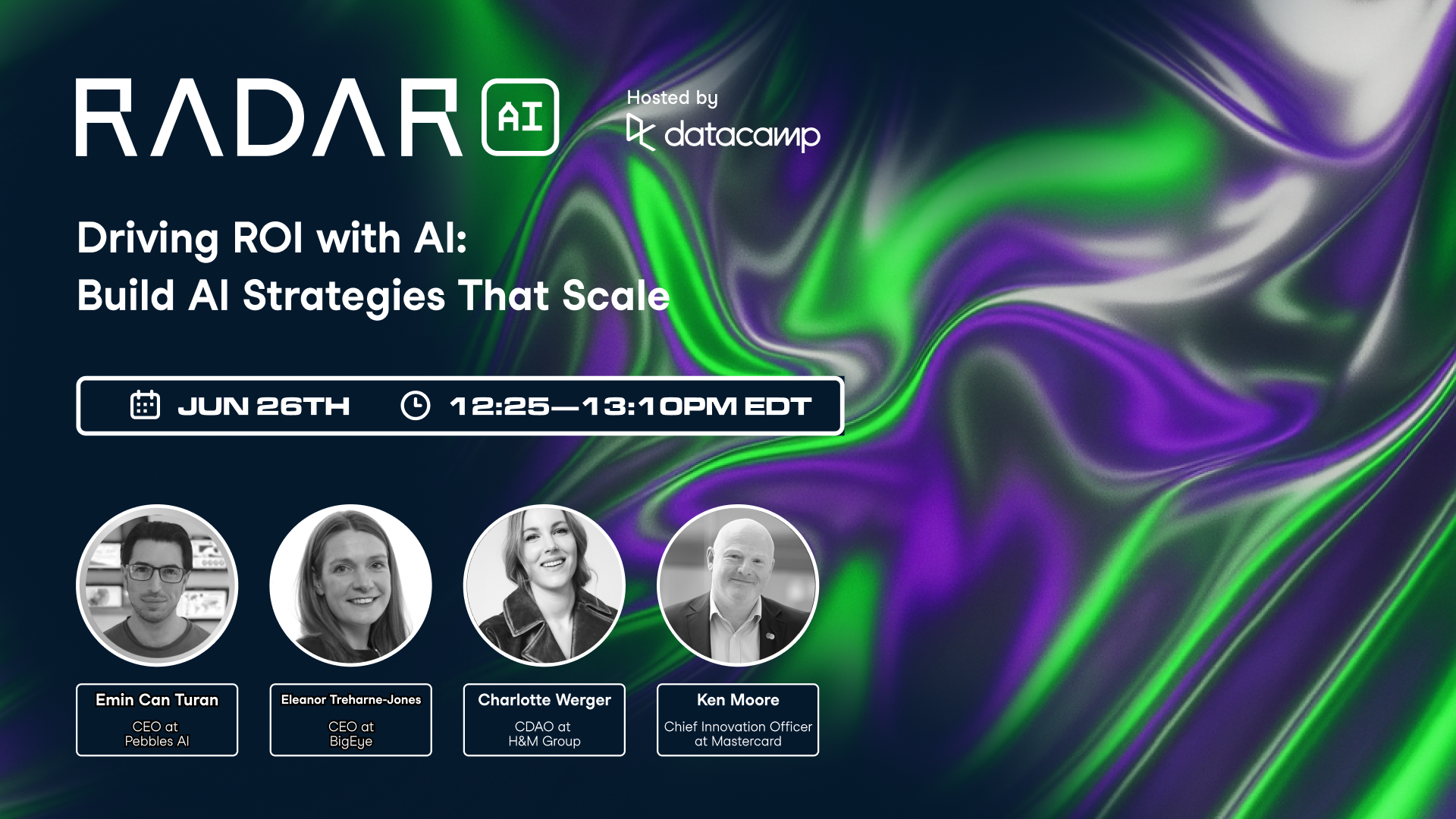
Driving ROI with AI: Build AI Strategies That Scale

July 2025
Webinar Preview

Your Presenter(s)

Emin Can Turan Fotoğrafı

Emin Can Turan

CEO and Lead Researcher at Pebbles Ai

Emin Can Turan (Can) is a serial entrepreneur and published (Oxford Uni Press, 2022) all-round B2B Marketing Strategist with first-rate leadership background with various Fortune 500 firms. A solid 10+ years of experience across strategic fields of marketing.

Previously at Google, Cisco and Walmart Global Tech in Product Marketing, Data Insight, and B2B Pricing, driving performance by the millions. Architect of the GTMS™ strategy models at Can & Co, and ex-Co-founder at AnalystPro AI, a SFC Capital backed SaaS venture.He is currently the Founder and Lead Researcher at Pebbles Ai, an all-in-one Revenue Growth Platform that unites neurosymbolic AI,  advanced AI agents with smart go-to-market workflows — purpose-built for B2B success.

Eleanor Treharne-Jones Fotoğrafı

Eleanor Treharne-Jones

CEO at BigEye

Eleanor Treharne-Jones is the CEO of Bigeye, the leading data observability platform powering trusted AI and analytics. With over 20 years at the forefront of privacy, risk management, and data innovation, Eleanor is a proven leader in helping organisations turn complex challenges into strategic advantage. An experienced speaker on privacy, governance, and responsible AI, she delivers insights grounded in practical use cases. At Bigeye, she is building a future where trusted data fuels transformative AI outcomes. Based in New York City, Eleanor is passionate about leading resilient, customer-first companies that unlock the true potential of data.

Charlotte Werger Fotoğrafı

Charlotte Werger

CDAO at H&M Group

Charlotte Werger is the Head of AI, Analytics & Data at H&M, where she leads the company’s AI, data and analytics strategy and initiatives. With a strong background in data science and AI, Charlotte is instrumental in transforming H&M into a data-driven organization.Before joining H&M, Charlotte held several prominent roles in the field of data science. Most recently, she was Director of Analytics & Data Science for Richemont, a Switzerland-based luxury goods company. Previously, she was Director of Advanced Analytics and Machine Learning at Nike where she led a team that delivered end-to-end AI and machine learning solutions, Head of Data Science at Van Lanschot Kempen where she focused on integrating AI and machine learning into financial services and at BlackRock where she applied machine learning models to financial markets.Charlotte holds a PhD from the European University Institute in Florence.Her expertise and leadership continue to drive innovation and efficiency at H&M, making her a key figure in the company’s ongoing digital transformation.

Ken Moore Fotoğrafı

Ken Moore

Chief Innovation Officer at Mastercard

Ken Moore is chief innovation officer at Mastercard and a member of the company's Management Committee. He leads the Mastercard Foundry organization, inclusive of R&D, Digital Futures, Product Lifecycle Management, and Experience Research & Design teams.In this role, Ken is responsible for the company's innovation agenda, including incubating and bringing new products and services to market, unlocking the potential of emerging technologies, and anticipating changes in customer needs. Ken is an advisory board member to the World Intellectual Property Organization on the production of the Global Innovation Index.He joined Mastercard in 2016 as executive vice president, Mastercard Labs, where he led the teams creating new products and experiences in digital payments, financial inclusion and the commercial space. He extended Mastercard's partner ecosystem by scaling its global startup engagement program Start Path, which helps innovative later-stage startups grow.Ken is an Expert-in-Residence at Harvard Innovation Labs at the Harvard John A. Paulson School of Engineering and Applied Sciences.Prior to joining Mastercard, Ken held roles of increasing seniority at Citi, Accenture and Misys. He has over 25 years of experience in International Financial Services across retail and corporate banking and has worked extensively throughout the U.S., Latin America, Europe, Asia and Africa. He has held executive leadership roles in Product Management, Technology Delivery, Business Development, and Strategy and Innovation. Ken holds a BSc in Commercial Computer Applications from the Institute of Technology in Waterford, Ireland, and is a certified Board Director with the Institute of Directors.

Summary

Three years into the AI revolution, organizations are exploring how to transition from proofs of concept to operational AI that delivers real value. The key question is how to scale AI initiatives, driving ROI and making AI an integral part of business strategy. AI leaders from various sectors—Emin Can Turan, CEO of pebbles.ai; Eleanor Treharne-Jones, CEO of Big Eye; Charlotte Werger, Chief Data and AI Officer at H&M Group; and Ken Moore, Chief Innovation Officer at Mastercard—discussed the essential components of successful AI strategies. They emphasized aligning AI with business objectives, ensuring data quality and governance, and encouraging a culture of innovation and adaptability. Key pitfalls in AI projects include neglecting change management, failing to identify high-value use cases, and inadequate data foundations. The panelists agreed that AI should support existing business strategies rather than dictate them, emphasizing the importance of customized solutions over generic models. Additionally, they highlighted the necessity of trust in AI systems, both in terms of data handling and in building confidence among users and stakeholders. The conversation highlighted the importance of communication and collaboration across departments, encouraging a culture where experimentation and learning are integral to adapting to AI's evolving environment.

Key Takeaways:

  • Align AI initiatives with clear business strategies to ensure meaningful outcomes.
  • Prioritize data quality and governance to build trust and reliability in AI systems.
  • Address change management proactively to facilitate AI adoption across teams.
  • Encourage cross-functional collaboration to integrate AI solutions effectively.
  • Focus on high-value, low-risk use cases to maximize early AI returns.

Deep Dives

Aligning AI with Business Strategy

AI should not exist in isolation as a separate strategy; rather, it should be smoothly integrated into the business strategy. As Charlotte Werger noted, "There shouldn't be such a thing almost as an AI strategy, but very much a business strategy." This approach ensures that AI initiatives are purpose-driven, addressing specific business challenges and opportunities. The panelists emphasized the importance of understanding the core business problems before designing AI solutions. For instance, Charlotte highlighted that H&M focuses on supply chain efficiencies to deliver significant ROI. This alignment not only optimizes resource allocation but also ensures that AI initiatives have a tangible impact on business performance. Ken Moore added that AI should support the business strategy by enhancing commerce—making it safer, smarter, and more personal—thus reinforcing Mastercard's broader goals.

Data Quality and Governance

Data quality and governance are foundational to the success of AI initiatives. Eleanor Treharne-Jones stressed the importance of reliable data, stating, "AI brings the why now moment" for addressing longstanding data issues. As AI systems increasingly make autonomous decisions, the integrity of the data they rely on becomes crucial. Continuous monitoring and validation are necessary to maintain trust in AI-driven outcomes. Eleanor's focus on building an AI trust platform reflects the industry's shift towards ensuring transparency and accountability in AI operations. This involves not just managing the inputs and outputs but also ensuring that the models themselves are transparent and reliable. In the financial sector, as Ken highlighted, the stakes are even higher, requiring rigorous data handling protocols to prevent breaches of trust.

Change Management and Cultural Adaptation

Effective change management is critical in driving AI adoption. Charlotte Werger pointed out the importance of change management, especially in large-scale implementations like those at H&M, where aligning thousands of demand planners with new AI tools is essential. Ignoring the human element can result in resistance, as Ken Moore observed with Mastercard's AI projects. He noted that addressing employees' fears about job displacement is crucial, shifting the narrative to how AI can enhance their roles. This involves clear communication about the benefits of AI and providing the necessary training and support. The panelists agreed that encouraging an environment where experimentation is welcomed and learning is prioritized can significantly enhance AI adoption and integration.

Trust and Ethical Considerations in AI

Building trust in AI systems is essential, particularly as data-sharing between organizations becomes more prevalent. Ken Moore emphasized that "trust is the currency of innovation," advocating for strong consent models and governance frameworks. This trust extends beyond data handling to include ethical considerations in AI development and deployment. Ensuring that AI systems are designed with ethical principles in mind is essential to gaining stakeholder confidence and avoiding potential misuse. Emin Can Turan discussed the importance of ethical AI, particularly in safeguarding proprietary data and ensuring that AI systems serve the intended business purposes without unintended cross-pollination of sensitive information. This focus on ethics and trust ensures that AI solutions are not only effective but also sustainable and aligned with broader societal values.


İlgili

webinar

Transforming AI Into Value: Driving Business Growth and ROI

Industry experts explore the strategies and frameworks needed to harness AI effectively. Discover how to drive adoption of AI, build clear alignment with business goals, and unlock the ROI of your AI investments.

webinar

Building Trust in AI: Scaling Responsible AI Within Your Organization

Explore actionable strategies for embedding responsible AI principles across your organization's AI initiatives.

webinar

Building Trust in AI: Scaling Responsible AI Within Your Organization

Explore actionable strategies for embedding responsible AI principles across your organization's AI initiatives.

webinar

Getting ROI from AI

In this webinar, Cal shares lessons learned from real-world examples about how to safely implement AI in your organization.

webinar

AI Upskilling: Lessons from the Frontlines

Experts discuss their experiences running AI upskilling programs at scale. You’ll learn how to define training personas, boost adoption and engagement, and measure the ROI of your efforts.

webinar

Building an AI Strategy: Key Steps for Aligning AI with Business Goals

Experts unpack the key steps necessary for building a comprehensive AI strategy that resonates with your organization's objectives.