


Course
Exploratory Data Analysis in SQL
Create Your Free Account
or
By continuing, you accept our Terms of Use, our Privacy Policy and that your data is stored in the USA.Loved by learners at thousands of companies
Training 2 or more people?
Try DataCamp for BusinessCourse Description
Feels like what you want to learn?
Start Course for FreeWhat you'll learn
- Assess date and timestamp fields through extraction, truncation, interval arithmetic, and generate_series to construct comprehensive temporal analyses
- Evaluate numeric variables with aggregate, variance, correlation, and binning functions to summarize distributions and detect anomalies
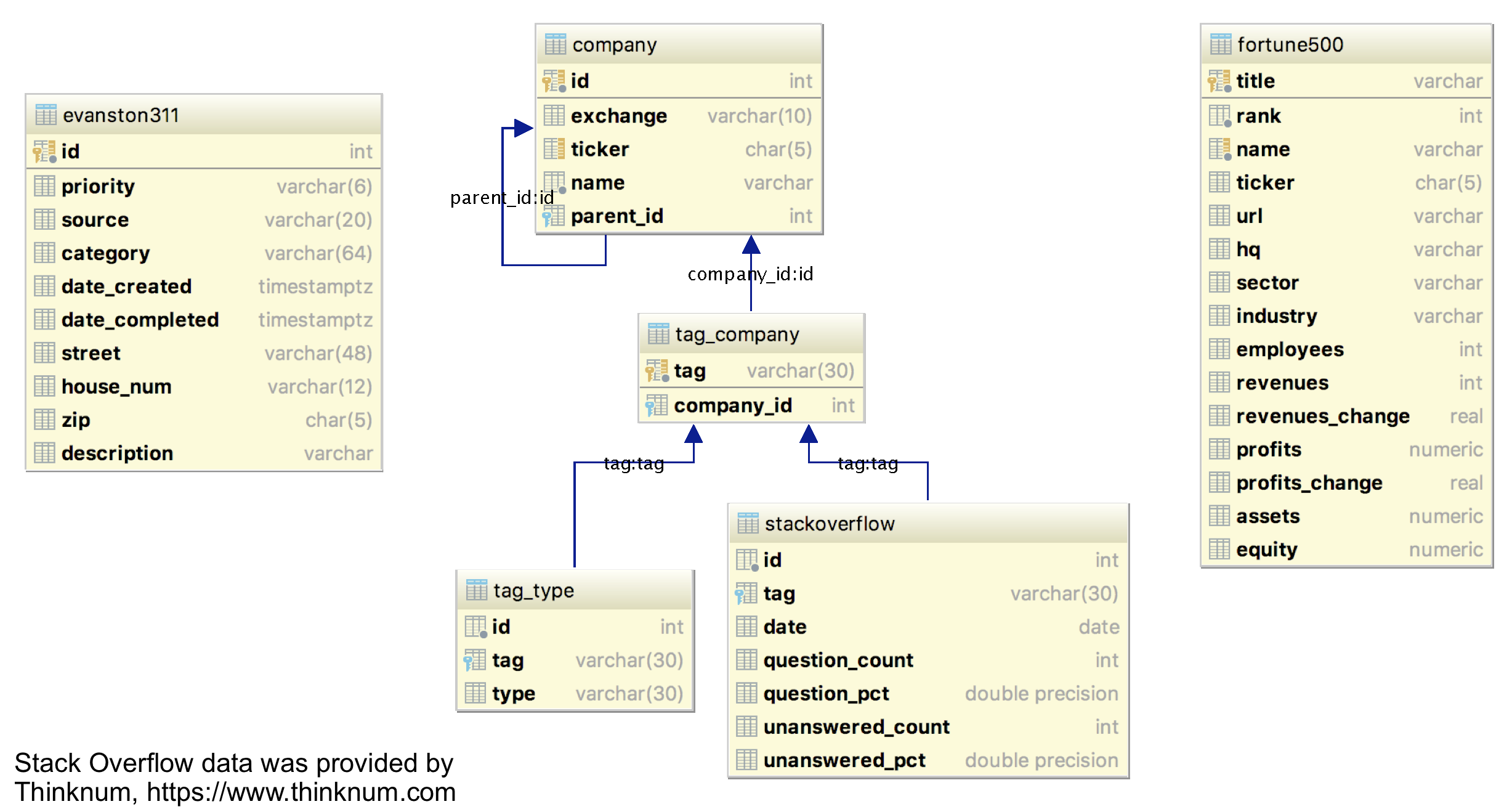
- Identify key database tables, relationships, and data types required for exploratory analysis in PostgreSQL
- Identify and apply PostgreSQL data capabilities including core/complex data types, full-text search, and extensibility via functions, types, and extensions
- Clean and summarize categorical and unstructured text using string operations, pattern matching, and temporary tables
Prerequisites
Data Manipulation in SQLWhat's in the Database?
Summarizing and Aggregating Numeric Data
Exploring Categorical Data and Unstructured Text
Working with Dates and Timestamps
Complete
Earn Statement of Accomplishment
Add this credential to your LinkedIn profile, resume, or CVShare it on social media and in your performance reviewEnroll Now
FAQs
Will I receive a certificate at the end of the course?
Yes, you will receive a DataCamp course certificate after completing all the course lessons.
Who will benefit from this course?
Exploratory Data Analysis in SQL is essential for anyone who works with data, but especially relevant to those in data science, data engineering, analytics, and business intelligence.
What types of data will be explored in the course?
The course introduces you to numeric, character, and date/time data types, using data from Stack Overflow, Fortune 500 companies, and 311 help requests from Evanston, IL.
What types of functions will be used in the course?
You will learn how to use numeric data functions such as min, max, average, variance, correlation, and percentile. As well as look at text or character data functions such as case, spacing, and delimiters.
What strategies can be used to deal with messy data?
You will learn to look for common problems in data and strategies to clean up messy data. These include identifying missing values, counting the number of observations, joining tables to understand relationships, coalescing and casting data, and using temporary tables to recode messy categorical data.
Join over 19 million learners and start Exploratory Data Analysis in SQL today!
Create Your Free Account
or
By continuing, you accept our Terms of Use, our Privacy Policy and that your data is stored in the USA.Grow your data skills with DataCamp for Mobile
Make progress on the go with our mobile courses and daily 5-minute coding challenges.