Home

R courses

R is a language for data analysis, statistics, and machine learning. DataCamp’s expert-led R courses offer interactive practice with projects to build job-ready skills fast. Start learning R today and unlock new data science opportunities.

Create Your Free Account

or

By continuing, you accept our Terms of Use, our Privacy Policy and that your data is stored in the USA.
Group

Training 2 or more people?

Try DataCamp for Business

Recomended For Starters

Become an R programmer and develop your R skills with interactive courses, tracks and projects, curated by real-world experts.

Course

Introduction to R

BasicSkill Level
4 hours
42K
Master the basics of data analysis in R, including vectors, lists, and data frames, and practice R with real data sets.

Track

R Programming Fundamentals

22 hours
15.4K
Level-up your R programming skills! Learn how to work with common data structures, optimize code, and write your own functions.

Not sure where to start?

Take an Assessment

Browse R courses and tracks

Course

Dimensionality Reduction in R

BasicSkill Level
4 hours
134
Learn dimensionality reduction techniques in R and master feature selection and extraction for your own data and models.

Course

Financial Trading in R

IntermediateSkill Level
5 hours
117
This course covers the basics of financial trading and how to use quantstrat to build signal-based trading strategies.

Course

Analyzing Social Media Data in R

IntermediateSkill Level
4 hours
115
Extract and visualize Twitter data, perform sentiment and network analysis, and map the geolocation of your tweets.

Course

Practicing Statistics Interview Questions in R

AdvancedSkill Level
4 hours
114
In this course, youll prepare for the most frequently covered statistical topics from distributions to hypothesis testing, regression models, and much more.

Course

Business Process Analytics in R

IntermediateSkill Level
4 hours
113
Learn how to analyze business processes in R and extract actionable insights from enormous sets of event data.

Course

Hyperparameter Tuning in R

AdvancedSkill Level
4 hours
107
Learn how to tune your models hyperparameters to get the best predictive results.

Course

ChIP-seq with Bioconductor in R

IntermediateSkill Level
4 hours
102
Learn how to analyse and interpret ChIP-seq data with the help of Bioconductor using a human cancer dataset.

Course

Fraud Detection in R

IntermediateSkill Level
4 hours
101
Learn to detect fraud with analytics in R.

Course

Bond Valuation and Analysis in R

IntermediateSkill Level
4 hours
89
Learn to use R to develop models to evaluate and analyze bonds as well as protect them from interest rate changes.

Course

Bayesian Modeling with RJAGS

AdvancedSkill Level
4 hours
84
In this course, youll learn how to implement more advanced Bayesian models using RJAGS.

Course

Sentiment Analysis in R

IntermediateSkill Level
4 hours
84
Learn sentiment analysis by identifying positive and negative language, specific emotional intent and making compelling visualizations.

Course

Defensive R Programming

IntermediateSkill Level
4 hours
78
Learn defensive programming in R to make your code more robust.

Course

Analyzing US Census Data in R

IntermediateSkill Level
4 hours
77
Learn to rapidly visualize and explore demographic data from the United States Census Bureau using tidyverse tools.

Course

Programming with dplyr

IntermediateSkill Level
4 hours
68
Learn how to perform advanced dplyr transformations and incorporate dplyr and ggplot2 code in functions.

Course

Parallel Programming in R

IntermediateSkill Level
4 hours
62
Unlock the power of parallel computing in R. Enhance your data analysis skills, speed up computations, and process large datasets effortlessly.

Course

Building Response Models in R

IntermediateSkill Level
4 hours
60
Learn to build simple models of market response to increase the effectiveness of your marketing plans.

Course

Forecasting Product Demand in R

IntermediateSkill Level
4 hours
58
Learn how to identify important drivers of demand, look at seasonal effects, and predict demand for a hierarchy of products from a real world example.

Related resources on R

R Project

blog

The Top 8 R Project Ideas for 2026

Discover what R is and all the benefits for using it while giving examples and new ideas for a project.
Elena Kosourova's photo

Elena Kosourova

14 min

blog

Python vs R for Data Science: Which Should You Learn?

This guide will help you answer one of the most frequently asked questions of newcomers in data science and help you choose between R and Python.
Javier Canales Luna's photo

Javier Canales Luna

10 min

cheat sheet

Getting Started with R Cheat Sheet

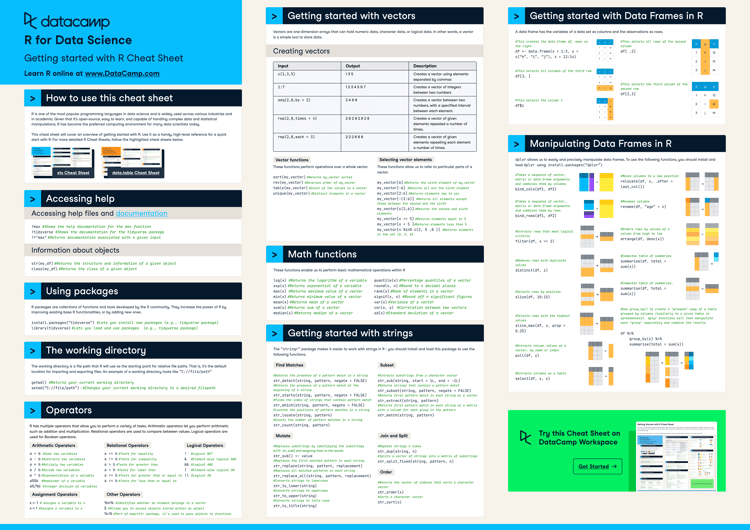
This cheat sheet will cover an overview of getting started with R. Use it as a handy, high-level reference for a quick start with R. For more detailed R Cheat Sheets, follow the highlighted cheat sheets below.
Richie Cotton's photo

Richie Cotton

9 min


Ready to apply your skills?

Projects allow you to apply your knowledge to a wide range of datasets
to solve real-world problems in your browser

Frequently asked questions

What is R?

R is a statistical computing and graphics system, consisting of the R language and a run-time environment. Originally designed for statistical purposes, it excels in data analysis, mining, modeling, and creating visualizations. Primarily used for statistics and data science, its applications extend to AI, machine learning, financial analysis, and more. Being open-source and equipped with a wide array of functions and packages, R is popular across multiple fields including academia, finance, and social media.

Do I need any prior programming experience to start learning R?

No prior programming experience is required to start learning R. Our courses are designed to be accessible to beginners, with step-by-step guidance that makes learning R straightforward—even for those new to programming.

How can learning R benefit my career?

Learning R can significantly enhance your career, especially if you are interested in fields like data analysis, statistics, or research. As a language specifically designed for statistical analysis and data visualization, R skills are highly sought after in industries ranging from healthcare and finance to academia and marketing, opening up a wide range of job opportunities and pathways for professional growth.

How do I get started with R?

Beginning your journey with R first involves grasping its fundamental concepts—such as understanding vectors, factors, lists, and data frames. Our Introduction to R programming course covers these basics, providing a solid foundation for further exploration into the R programming language.

What is the difference between R and Python?

Python is a general-purpose programming language, developed to handle a wide range of tasks from data science to web development, making it highly versatile and popular for various applications. R, on the other hand, was created for statistical analysis and excels in data visualization and exploratory data analysis.

Is R worth learning in 2025?

Absolutely, R is worth learning in 2025, especially for those focused on specialized areas like statistical analysis, data visualization, and academic research. Despite the rapid growth of Python, R maintains a strong presence in data science and analytics, valued for its advanced statistical capabilities and dedicated community.

Does Datacamp offer an R Certification?

DataCamp offers two R certifications: Data Analyst and Data Scientist. Both are available in R or Python. If you are interested in either, check out our Certifications here.

Other technologies and topics

technologies