Share this webinar
Close your data and AI skills gap
We're the only platform uniquely engineered to advance data and AI skills across your entire organization. Let's explore a tailored program.
Book an Enterprise DemoHow Data & AI are Changing Soccer Analytics
June 2026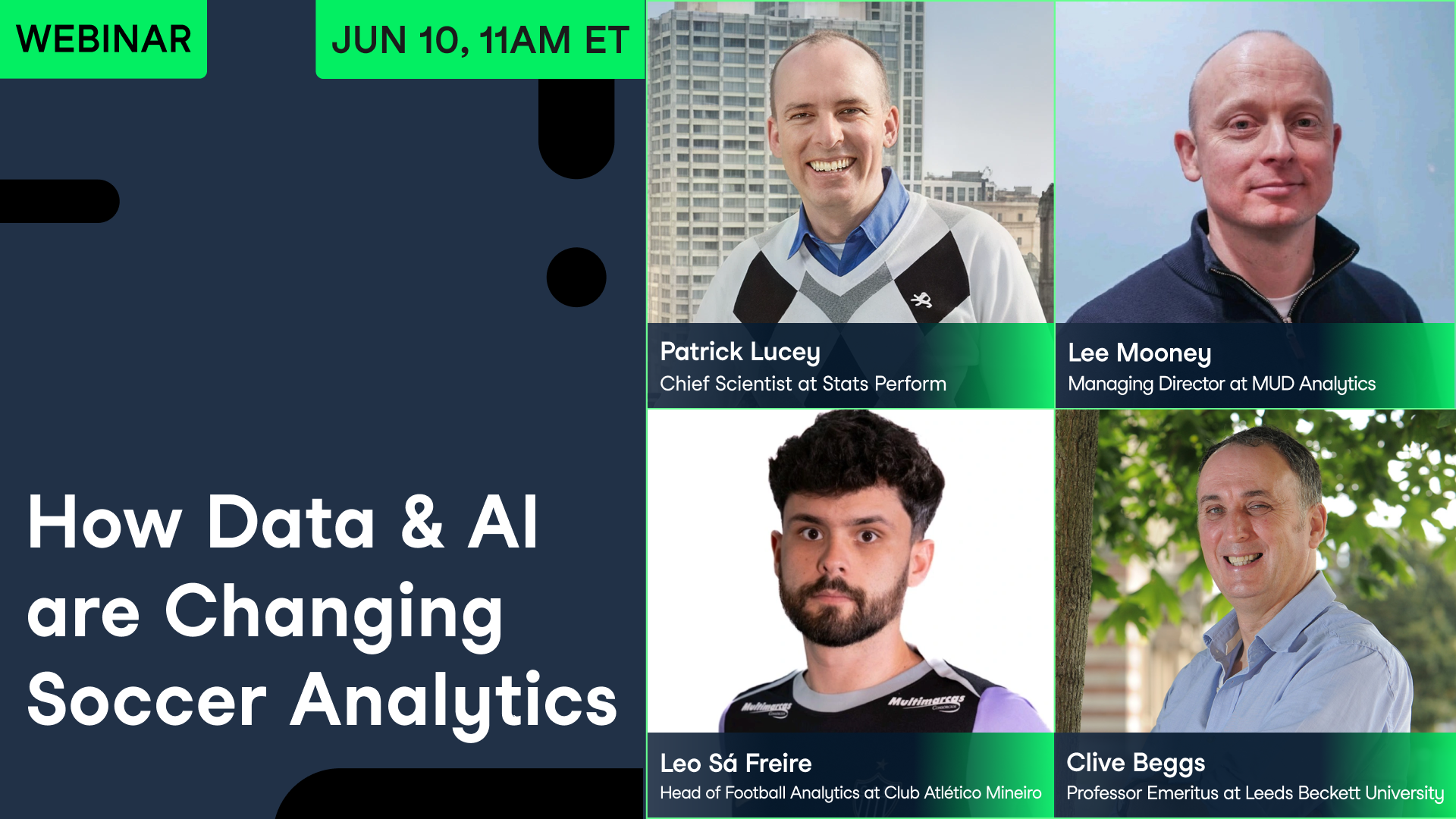
Your Presenter(s)

Patrick Lucey
Chief Scientist @ Stats Perform
Patrick is Chief Scientist at Stats Perform, and was previously a Research Scientist at Disney Research. He has extensive experience in Artificial Intelligence, working with unstructured data, and automated strategic analysis of sports.

Lee Mooney
Managing Director at MUD Analytics

Lee leads data and analytics consulting engagements to help organizations turn data into actionable insights and business value. He specializes in data strategy, visualization, and building analytics capabilities that drive better decision-making. Lee is also known for his work in the data visualization community, sharing practical approaches to storytelling with data. Previously, he held senior analytics and consulting roles, developing expertise in delivering impactful data solutions across industries.

Leo Sá Freire
Head of Football Analytics at Club Atlético Mineiro

Leo leads data-driven performance analysis to support player development, match strategy, and recruitment decisions. He specializes in applying data science and machine learning to football, translating complex analytics into actionable insights for coaches and technical staff. Leo is active in the sports analytics community, sharing perspectives on data-informed decision-making in football. Previously, he built experience in data science and analytics roles, developing expertise in sports performance analysis and applied modeling.

Clive Beggs
Professor Emeritus at Leeds Beckett University

Clive has decades of experience spanning bioengineering, physiology, infection control, and sports science. His research combines mathematical modelling, machine learning, and data analysis to study topics ranging from airborne disease transmission to sports analytics and neurophysiology. Previously, he held academic roles at the University of Bradford, University of Leeds, and University at Buffalo. Clive is the author of "Soccer Analytics: an introduction using R" and is an emeritus professor in the School of Sport at Leeds Beckett University.
Summary
Soccer generates more data than almost any other sport, and a panel of four analysts says the hardest part is no longer collecting it.
In the second session of DataCamp's data and AI series, host Jorge Vasquez brought together Patrick Lucey, chief scientist at Stats Perform (the company behind Opta); Lee Mooney, co-founder of MUD Analytics and a former Manchester City analytics lead; Leo Sá Freire, head of football analytics at a Brazilian top-flight club; and Clive Beggs, professor emeritus at Leeds Beckett University and author of Soccer Analytics: An Introduction Using R. They traced where AI is already changing the game: tracking data captured at scale across thousands of leagues, graph neural networks that predict passes in real time, and game simulations that let clubs test tactics no coach could risk on a Saturday. They were just as direct about the limits. Most clubs are "drowning in data" they cannot use, ChatGPT is flooding the sport with confident but wrong answers, and the analysts who succeed treat data as a supporting act rather than the star. The conversation closed on careers, on why football analytics jobs have never been more competitive, and on what each panelist thinks will win the World Cup.
Key Takeaways
- Stats Perform has tracked player movement since 1998, but AI now lets it capture the same data across roughly 13,500 leagues, including the men's and women's game.
- A Google DeepMind and Liverpool study used graph neural networks to analyze corners, and the same approach is moving toward real-time pass prediction.
- Game simulation lets clubs explore tactics that coaches cannot test in live matches without risking their jobs.
- Most clubs, especially outside the elite, buy large volumes of data and have no idea what to do with it.
- A small analytics budget spent on recruitment usually returns more than the same money spent on optimizing training drills.
- Around 80% of data insights can be shown to coaches through video rather than numbers, the language they already trust.
- ChatGPT produces fluent answers that are often wrong because it lacks access to proprietary match data, so verification now matters more than generation.
- Human skills like communication, collaboration, and judgment now matter more than raw engineering ability when hiring analysts.
Deep Dives
From tracking at scale to simulating the unplayed game
When Vasquez asked each panelist for the most exciting use of AI they had seen, the answers converged on two ideas: scale and simulation. Patrick Lucey pointed to reach. Stats Perform began tracking player movement in 1998, but doing it everywhere is new. "Really the exciting thing that I find about the use of AI in soccer is the ability to scale," he said, describing coverage that now stretches across roughly 13,500 leagues and both the men's and women's game. The methods are not soccer-specific. Lucey noted that his teams "use the same techniques that power autonomous vehicles and AlphaFold."
Clive Beggs picked a sharper technical example: graph neural networks. He cited a Nature Communications paper from the Google DeepMind team working with Liverpool that analyzed corners, a set piece he ranks as one of the most constrained moves in the game after penalties. What impressed him was the speed of progress, from modeling fixed set pieces to predicting passes as play unfolds.
Leo Sá Freire framed the same shift in terms of prediction. He is most excited by models that reconstruct movement sequences, because they open the door to simulation and counterfactual analysis, testing what would have happened if a player had moved differently.
Lee Mooney took that to its conclusion. Simulation, he argued, lets clubs "explore the solution space in ways that real coaches can't do." A coach cannot run experiments with live fire; lose two games and you are fired. Done in software, the same experiments become safe. Mooney described validating a tactic to the point where an analyst can walk into a coach's office with evidence strong enough to act on: a different defensive line, a buildup pattern, or a movement in the final third. The promise is not just measuring what happened but inventing advantages before anyone plays them.
Why most clubs are drowning in data
Ask what clubs actually struggle with day to day, and the glamour falls away. Clive Beggs, who teaches data skills to people from clubs, hears the same complaint everywhere. "We've got so much data. We're drowning in data," he said, summarizing the response he gets when he speaks to football professionals. "They're drowning in data and they don't know what to do with it to make good use of it." The problem is worst below the elite, where clubs buy large volumes of data without the analysts to read it, and where most of it stays univariate, looked at one column at a time instead of in combination.
Patrick Lucey sees the resource squeeze from the supply side. Many teams cannot afford to hire more people, so they are turning to agentic AI tools to cover the gap. The shift is not only about automating existing reports. "It's enabling them to do more where they just didn't have time or resources to do so," he said. Pre-match and post-match analysis that once took an analyst's full week can run closer to live, freeing people for higher-value work. Lucey called it "Jevon's paradox in motion." As analysis gets cheaper, clubs want far more of it, and a new line item appears: the budget for tokens.
Leo Sá Freire described the same maturing from inside a club. His team works mostly on scouting, strategy, and opposition analysis, and the biggest change is that the work has become routine rather than reactive. It "used to be a lot more on demand," he said; now data is built into daily workflows and decision processes rather than fetched whenever someone asks a question. The thread running through all three accounts is that the bottleneck has moved from gathering data to using it.
Small budgets, strategic thinking
The panel was unanimous that money is not what separates clubs getting value from data. Patrick Lucey listed the real variables: ownership structure, where a club sits in the football pyramid, and the length of its horizon. Above all, "it has to come from the top," he said, where leadership has "that analytics mindset compared to just kinda spending money." Sometimes, he admitted, spending a little more on a better player beats starting an analytics program. These are business questions before they are football ones.
Lee Mooney, who has worked with squads worth hundreds of millions and others costing under a million a year, argued that the same principles apply at every level. The deciding factor is thought, not budget. "It's very easy to chase shiny things, and you can spend a lot of money very quickly and achieve very little," he said. He offered a concrete trade-off. A club with £100,000 to spend on analytics could use it to fine-tune whether a drill runs in a 40-by-30-meter grid or a 30-by-25 one, or it could use it to find a talent for one million euros instead of five. Since a squad can consume 90% of a club's revenue (he cited Colombian clubs spending €30 million a year against €15 million in income), recruitment is where the same money moves the needle.
His conclusion was blunt: "the people who get the best returns are the ones who have the best thought process about what they're gonna invest in." Mooney also pushed back on the idea that analytics has to be complicated. From his time helping Manchester City win titles, he learned that "the bigger the organization, the simpler things need to be," because executives and boards have to understand and back the levers before they will fund them.
Data as the back-end dancer
The most practical thread of the conversation was about getting humans to act on data. Leo Sá Freire, who has worked alongside Luiz Felipe Scolari, the manager who won Brazil the 2002 World Cup, said resistance is constant and experience deserves respect. His answer is to speak the coach's language. Around 80% of the insights his team finds in data, he estimated, can be shown another way: "most of the times, it is possible to show what data has shown to you through video." When he has to choose between two models, he will give up "three, four, 5%" of accuracy to keep one a coach can interpret.
Lee Mooney made the point with a metaphor that stuck. Data should stay in the background. "No one wants to hear data sing," he said. "Never Beyonce, always a back end dancer." The goal is to support the people making decisions. He wants to turn a handful of scouts into "super scouts" by pointing their scarce attention at the most relevant clusters of players, then letting human relationships do the rest. He rejected the framing of "team data or team human" as nonsense, since each can supercharge the other. His rule for choosing between them is simple: "Let humans do what humans do brilliantly. Let data do what data does brilliantly." Video has zero latency and solves some problems instantly; data earns its place when reuse and rigor justify the wait.
Clive Beggs added the responsibility that sits on analysts. They tend to be comfortable with numbers and less comfortable with people who are not, and that has to change. Listening to coaches and scouts, he argued, is how analysts learn which data is worth connecting and how they build the trust that gets their work used. He wrote his book for exactly that audience: both coders who do not understand football, and football people who need to understand data well enough to make better decisions.
The age of verification
ChatGPT has become a new and unreliable voice in the building. Patrick Lucey described coaches, analysts, and owners using it for answers, then analysts spending their time debunking what it produces. The output "sounds really good, reads really well," he said, but it is often wrong, because the model has no access to proprietary match data and is "just a recommendation engine" that "can get us in the right neighborhood" and no further. His conclusion: "I think we're in the age of verification." The skill that matters now is knowing what the technology can do and, more importantly, what it cannot.
Clive Beggs agreed and offered the sharpest line of the session. Used carelessly, he said, "your average AI chatbot is equivalent to a very overconfident first year student who's very enthusiastic and doesn't know what they're doing." It will hand you everything, contradictions included, and you have to know enough to grade it. He uses AI daily and finds it useful, but treats its output as a draft to check, not an answer to trust.
That shift shapes hiring too. Asked how to get a job in football analytics, Lee Mooney was honest: it "probably has never been harder than it is now." When he moved from banking into Manchester City, the field was a clean slate and he had no competition. Now universities graduate football-analytics students by the thousand, and computer-vision projects that would be prized in other industries get offered six-month unpaid internships. What he looks for has changed accordingly. "Human skills become massively more important than engineering skills," he said: how a candidate thinks, whether they define the problem before reaching for an answer, and whether they can connect with a decision-maker who earns millions but never finished school. For anyone starting out, Beggs and Lucey pointed to open resources: Beggs's own R book, public datasets, and the Friends of Tracking community. Their one condition: learn to put the numbers in context.
関連している
webinar
How Data is Used in Soccer Analytics
Discover the tools and techniques used to analyze soccer datawebinar
AI and the Workforce: How Will AI Reshape Data and Technology Roles?
Industry experts explore how AI is reshaping the skills, responsibilities, and opportunities within the tech industry.webinar
Data Science and Business Intelligence in 2025: How will AI Transform the Data Team?
Three guests explore the impact of LLMs and GenAI on analytics and data functions in 2025, how they will lower the barrier to entry for working with data, the skills data teams need to develop, and a lot more.webinar
Data & AI Trends for 2026
Industry experts from MIT and IBM explore the most important trends shaping data and AI in 2026.webinar
Using Data and AI For GTM
GTM experts to explore how data and AI can enhance every stage of the go-to-market workflow.webinar