Fill in the details to unlock webinar

By continuing, you accept our Terms of Use, our Privacy Policy and that your data is stored in the USA.

Speakers

For Business

Training 2 or more people?

Get your team access to the full DataCamp library, with centralized reporting, assignments, projects and more
Try DataCamp For BusinessFor a bespoke solution book a demo.

Putting an End to Data and AI Disasters

December 2025
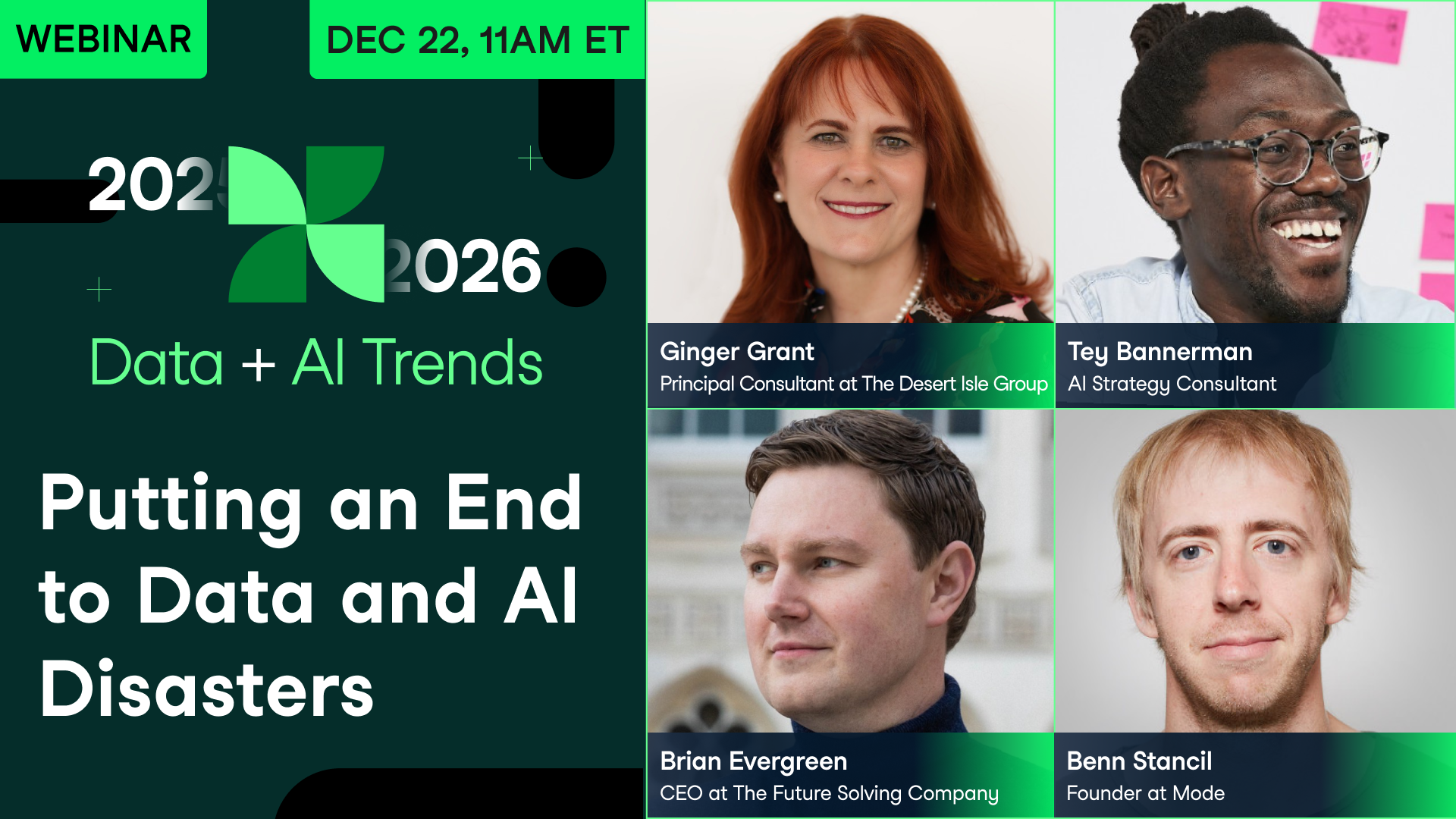
Webinar Preview

Summary

"Putting an End to Data and AI Disasters" is a session for data professionals exploring the challenges and advancements in AI and data analytics. The discussion covers AI disasters, the evolution of AI agents, the impact of AI on software development, and the rise of multimodal AI. Experts Ginger Grant, Benn Stancil, and Tey Bannerman share insights on AI's role in transforming industries, the importance of quality control in AI outputs, and the future of data analytics jobs. The session emphasizes the need for continuous learning and adaptation to use AI effectively, highlighting both the potential and pitfalls of AI technologies.

Key Takeaways:

  • AI disasters often result from over-reliance on low-code solutions and lack of coding skills.
  • AI agents are becoming more effective in specific, targeted tasks.
  • Software development is shifting towards AI-assisted coding, requiring new approaches.
  • Multimodal AI, especially in video, is advancing rapidly, raising concerns about content authenticity.
  • Data analytics roles remain essential as AI evolves, with a focus on data quality and integration.

Detailed Insights

AI Disasters and Challenges

The session opened with a discussion on AI disasters, highlighting the pitfalls of over-reliance on low-code solutions and the lack of coding expertise. Ginger Grant noted that many users are disappointed by the output of low-code tools. Benn Stancil shared that AI can complicate projects unnecessarily. Tey Bannerman emphasized the failure of companies to effectively market AI features, often resulting in negligible user engagement. The consensus was that while AI offers significant potential, its implementatio ...
Read More

n must be carefully managed to avoid these common pitfalls.

The Evolution of AI Agents

AI agents are becoming increasingly effective in performing specific tasks. Ginger Grant mentioned the potential for AI to automate visual reporting, reducing the need for human intervention in creating dashboards. Tey Bannerman shared an example of an AI agent used by a bank to improve the approval of customer communications, demonstrating the practical applications of AI in business processes. Benn Stancil highlighted the success of tools like Claude Code in building applications, showcasing the progress in AI-assisted development. The discussion emphasized the importance of focusing AI efforts on well-defined, limited-scope tasks to maximize reliability and effectiveness.

AI's Impact on Software Development

The panelists explored how AI is transforming software development. Benn Stancil argued that the traditional approach to coding will change dramatically, with AI taking on more of the development process. He suggested that software should be optimized for AI rather than humans, allowing machines to handle complex tasks more efficiently. Tey Bannerman noted the importance of understanding the limitations of AI coding tools and integrating them into workflows where they excel. The discussion highlighted the need for developers to adapt to these changes, focusing on using AI to enhance productivity and innovation.

The Rise of Multimodal AI

Multimodal AI, particularly in video, is advancing rapidly, raising questions about content authenticity and societal impact. Ginger Grant discussed the potential for AI-generated content to dominate platforms like YouTube, while Tey Bannerman warned of the implications for content authenticity and public perception. Benn Stancil expressed concerns about the societal impact of AI-generated content, comparing it to the negative effects of social media. The panelists agreed that while multimodal AI offers exciting possibilities, it also poses significant challenges in terms of content verification and societal cohesion.

The Future of Data Analytics Jobs

Despite advancements in AI, data analytics roles remain essential. Tey Bannerman emphasized the ongoing demand for data analysts and scientists, as many organizations still struggle with data quality and integration. Ginger Grant highlighted the importance of focusing on data models and ensuring solid data foundations. The panelists agreed that while AI can automate certain tasks, the need for skilled data professionals to manage and interpret data remains vital. The discussion reinforced the idea that data roles will continue to evolve, with a focus on using AI to enhance data-driven decision-making.


Related

white paper

2022 Data Trends and Predictions

Read about 9 trends shaping data science in 2022 and beyond

webinar

Data & AI Trends for 2026

Industry experts from MIT and IBM explore the most important trends shaping data and AI in 2026.

webinar

Using Data and AI for Social Good

It's the end of the year, and we need some cheer: hear four stories of organizations trying to make the world better by making technology more accessible, or by teaching disadvantaged children.

webinar

The State of Data & AI Literacy in 2025

Explore the latest trends shaping how organizations are building data and AI skills across their workforce.

webinar

The High Cost of AI Hype

With new breathtaking capabilities from generative AI released every several months—and AI hype escalating at an even higher rate—it’s high time we differentiate most of today’s practical ML projects from those research advances.

webinar

Preparing Your Workplace for an AI-led Future

Three data experts from AXA UK, share how the company built its data and AI training program from the ground up.