Перейти к основному содержимому

Заполните необходимые данные, чтобы получить доступ к вебинару.

Продолжая, вы принимаете наши Условия использования, нашу Политику конфиденциальности и подтверждаете, что ваши данные хранятся в США.

Share this webinar

Close your data and AI skills gap

We're the only platform uniquely engineered to advance data and AI skills across your entire organization. Let's explore a tailored program.

Book an Enterprise Demo
Upskilling a small team?Get started today
Artificial Intelligence

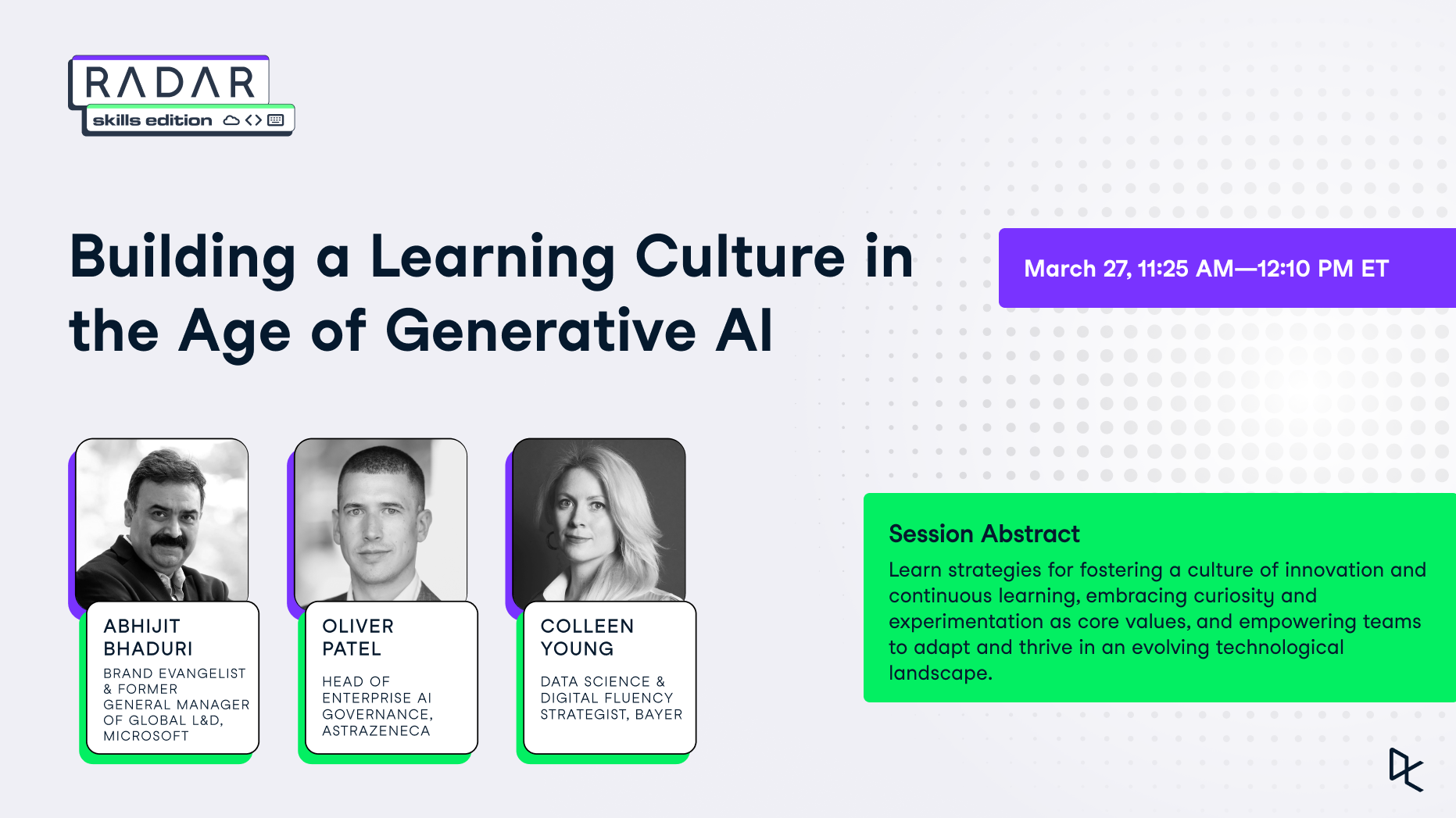
Building a Learning Culture in the Age of Generative AI

March 2025
Webinar Preview

Your Presenter(s)

Abhijit Bhaduri Фотография головы

Abhijit Bhaduri

Talent Management Advisor & Former GM of Global L&D at Microsoft

Abhijit Bhaduri advises organizations on talent and leadership development. As the former Partner and GM Global L&D of Microsoft, Abhijit led their onboarding and skilling strategy especially for people managers. Forbes described him as "the most interesting generalist from India." The San Francisco Examiner described him as the "world’s foremost expert on talent and development" and among the ten most sought-after brand evangelists. Abhijit also teaches in the Doctoral Program for Chief Learning Officers at the University of Pennsylvania. Prior to being at Microsoft, he led an advisory practice helping organizations build their leadership, talent and culture strategy. His latest book is called "Career 3.0 – Six Skills You Must Have To Succeed".

Oliver Patel Фотография головы

Oliver Patel

Head of Enterprise AI Governance at AstraZeneca

Oliver is a thought leader and educator on AI governance. As the Head of Enterprise AI Governance at AstraZeneca, Oliver leads the global AI governance function, which ensures that AstraZeneca maximizes the value of AI, whilst managing risks and complying with regulations. He is an IAPP Board Member and Training Instructor for the AI Governance Professional certificate. He is also a Member of the OECD’s Expert Group on AI Risk, as well as an Expert Advisor to the Dubai International Financial Authority on AI and privacy. Previously, Oliver was Director of Public Policy at Holistic AI, an AI risk management company. He was also Head of Inbound Data Flows for the UK government, where he led efforts to deliver EU-UK data transfer agreements. Prior to this, he spent several years as an academic researcher at University College London.

Colleen Young Фотография головы

Colleen Young

Data Science & Digital Fluency Strategist at Bayer

Dr. Colleen B. Young is a Data Scientist who specializes in strategizing digital modernization and transformation at companies. She received her B.A. in Anthropology from the University of California at Berkeley and a Ph.D. in Biological Anthropology from the University of Missouri, where she contributed to understanding the biological and behavioral corollaries of living in island environments. She currently works at Bayer where she identifies employee data science and digital fluency training needs to maintain company progress as a leader in solving the complex issue of Hunger for None and Healthcare for All. She supports curriculum development and delivery in science, technology, and data asset platforms and strategies. Her close partnership with DataCamp is an integral resource to support and expand this initiative at Bayer.

Summary

In the evolving field of generative AI, organizations are increasingly recognizing the necessity of cultivating a strong learning culture. The discussion explores the essence of creating an effective learning environment that not only adapts to rapid technological advancements but also empowers employees to manage these changes confidently. The conversation highlights the importance of fostering a culture where learning is seen as an integral part of daily work, rather than an additional task. Emphasizing a shift from a "know-it-all" to a "learn-it-all" mindset, leaders are encouraged to incorporate AI into everyday tasks, transforming potential fears into excitement and innovation. The panelists explore how AI literacy is critical to governance and how it must be customized to cater to different skill levels within an organization. They also highlight the significance of leadership in setting the tone for a learning culture that embraces change and innovation. The discussion further addresses the challenge of avoiding dependency on AI tools while ensuring that employees remain critical thinkers and innovative problem-solvers.

Key Takeaways:

  • A thriving learning culture is essential for organizational transformation and adaptation to AI advancements.
  • Leaders should focus on embedding learning within daily tasks to cultivate a "learn-it-all" culture.
  • Empowering employees through AI literacy is crucial for governance and managing technological change.
  • Learning programs should be customized to different roles and skill levels, with a focus on habit formation.
  • It's important to balance the use of AI tools with critical thinking and innovation to prevent dependency.

In-Depth Analysis

Embedding Learning in Daily Work

The integration of learning into daily work routines is essential in creating a culture that thrives on continuous improvement and adaptation. Abhijit Bhaduri emphasizes that learning should not be viewed as an additional burden but as a natural part of work processes. By incorporating AI into everyday tasks, organizations can create a pull for learning rather than pushing it as a mandate. For instance, starting meetings with a simple question about recent AI discoveries encourages employees to explore and share knowledge in a relaxed and engaging manner. This approach not only demystifies AI but also builds a growth mindset, transforming learning from a chore into an exciting exploration. Bhaduri also highlights the role of leadership in this transformation, suggesting that leaders share their own learning experiences to inspire others. This shift in perspective, from a "know-it-all" to a "learn-it-all" culture, is crucial in empowering employees to embrace technological advancements with enthusiasm rather than apprehension.

Customizing Learning Programs

Creating effective learning programs requires an understanding of the diverse skill levels and needs within an organization. Colleen Young discusses the importance of developing learning personas and pathways that address different roles and stages of expertise. By offering a structured yet flexible approach, employees can self-guide their learning paths, choosing options that align with their interests and career goals. This method not only empowers individuals but also ensures that learning is relevant and impactful. The use of both instructor-led and self-paced courses allows learners to progress at their own pace, fostering a sense of ownership and motivation. Young also emphasizes the need for organizations to assess and evolve their learning strategies continually, ensuring they remain aligned with both technological advancements and employee aspirations.

Leadership in Learning Culture

Leadership plays a vital role in shaping and sustaining a learning culture. The panel highlights the importance of leaders demonstrating a commitment to continued learning and development. By sharing their learning experiences and simplifying complex topics, leaders can inspire confidence and curiosity among their teams. This approach helps to alleviate fear and resistance to change, transforming potential obstacles into opportunities for growth and innovation. Leaders are encouraged to celebrate learning achievements and provide opportunities for employees to apply their new skills in meaningful ways. This not only reinforces the value of learning but also promotes a culture of innovation and continuous improvement.

Balancing AI Tools and Critical Thinking

As AI becomes more integrated into daily tasks, there is a risk of dependency on these tools at the expense of critical thinking and innovation. Oliver Patel raises concerns about the potential impact of AI on cognitive abilities and the development of critical skills. While AI can enhance productivity and efficiency, it is essential to maintain a balance that encourages employees to remain engaged and innovative thinkers. Organizations must ensure that learning programs include elements that challenge employees to think critically and solve problems creatively, even as they leverage AI tools to improve operations. This balance is essential in developing a workforce that is not only technologically adept but also capable of driving innovation and adapting to future challenges.


Связанный

webinar

How Generative AI is Shaping Higher Education

Join us for a deep dive into the evolving academic landscape and gain insights into the opportunities and roadblocks ahead in AI-powered learning.

webinar

Revolutionizing Learning: Exploring the Future of Upskilling with AI

Join us as the panel of AI and education experts discuss how to work with generative AI to upskill employees and improve corporate training programs.

webinar

AI Literacy at Scale: Building a Future-Ready Workforce

Industry experts explore strategies for scaling AI literacy across diverse teams, bridging the gap between technical expertise and business understanding.

webinar

Driving AI Literacy in Organizations

Gain insight into the growing importance of AI literacy and its role in driving success for modern organizations.

webinar

AI In The Enterprise: Developing AI Talent

Damien Herrick, Ita Petrika-Lindroos, and Thomas Bodenski discuss strategies for developing AI talent. Learn which AI skills and roles are in demand, how to attract the right talent, and how to build AI literacy across your organization.

webinar

The Learning Leader's Guide to AI Literacy

Adel Nehme, VP of Media at DataCamp, walks you through how to foster organization-wide AI literacy.