Przejdź do treści głównej

Wypełnij dane, aby odblokować webinarium

Kontynuując, akceptujesz nasze Warunki korzystania, naszą Politykę prywatności oraz fakt, że Twoje dane są przechowywane w USA.

Share this webinar

Close your data and AI skills gap

We're the only platform uniquely engineered to advance data and AI skills across your entire organization. Let's explore a tailored program.

Book an Enterprise Demo
Upskilling a small team?Get started today
Artificial Intelligence

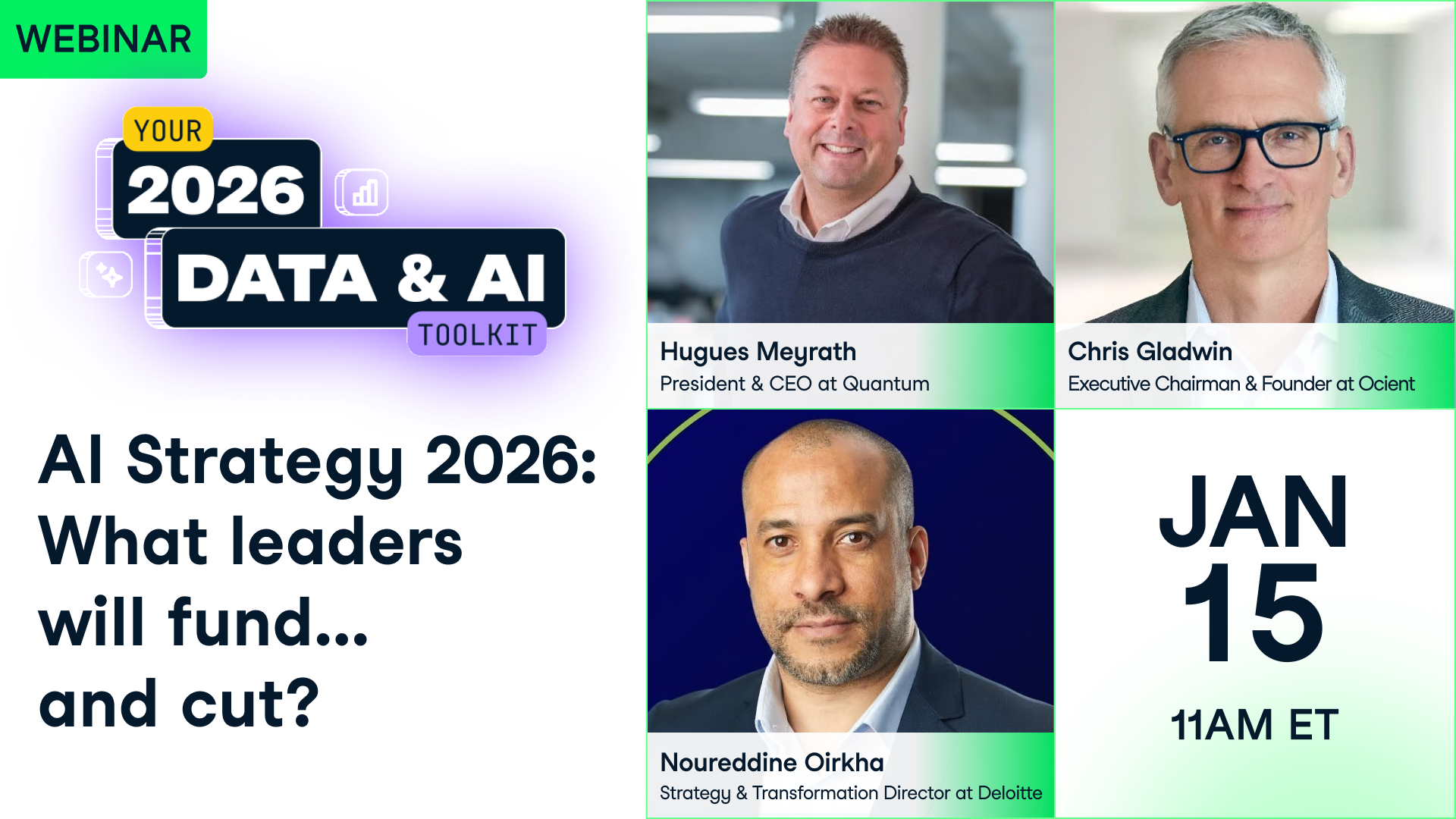
AI Strategy 2026: What leaders will fund... and cut?

January 2026
Webinar Preview

Your Presenter(s)

Hugues Meyrath Zdjęcie głowy

Hugues Meyrath

President & CEO at Quantum

Hugues runs the data lifecycle management company Quantum. He has over two decades of experience as a technology executive, with a focus on go-to-market strategy, SaaS, and cloud computing. Previously, Hugues was Chief Product officer at ServiceChannel, and had stints at Dell and Juniper Networks.

Chris Gladwin Zdjęcie głowy

Chris Gladwin

Executive Chairman & Founder at Ocient

Chris is the Executive Chairman, Founder, and former CEO at hyperscale data warehouse company Ocient. He's a serial entrepreneur, having previously been founder and CEO at on-prem object storage system company Cleversafe, and Founder at multi-cloud storage platform Endstor. Chris is also Board Chair at P33 Chicago and The Forge Adventure Parks.

Noureddine Oirkha Zdjęcie głowy

Noureddine Oirkha

Strategy & Transformation Director at Deloitte

Noureddine helps enterprises and government departments run digital transformation initiatives. He has 15 years of experience in business transformation, IT operations, and project management. Previously, Noureddine was Head of IT Operations at emovis.

Session Resources

Summary

AI Strategy 2026: What leaders will fund... and cut? is a session for business leaders and data professionals exploring the future of AI strategy.

The discussion emphasizes the importance of aligning AI strategies with business goals, the role of infrastructure in scaling AI, and the necessity of data curation. Experts highlight the transition from personal productivity tools to enterprise-level AI applications, emphasizing the need for clear business objectives to fully utilize AI's potential. The conversation also touches on the evolving skills required for data teams and the challenges of integrating AI into existing business structures.

Key Takeaways:

  • Align AI strategy with business and data strategies for cohesive growth.
  • Infrastructure and data curation are key for successful AI implementation.
  • AI's role is expanding from personal productivity to enterprise applications.
  • Clear business objectives are essential for effective AI deployment.
  • Training and evolving skill sets are important for data teams in an AI-driven world.

In-Depth Analysis

Aligning AI with Business Strategy

Aligning AI strategy with business goals is essential for maximizing its potential. Chris Gladwin emphasized the importance of defining clear business objectives, stating, "You really have to write down your business requirements." This involves understanding the specific outcomes AI should achieve, whether it's improving customer service, reducing costs, or enhancing product offerings. The alignment ensures that AI initiatives are not just technological experiments but are integrated into the broader business strategy, driving tangible results.

Infrastructure and Data Curation

Hugues Meyrath highlighted the necessity of strong infrastructure and data curation. He noted, "It's more than just data; it's about content and curation." Successful AI models depend on high-quality, curated data that aligns with business objectives. This requires investment in infrastructure that can handle large volumes of data efficiently. Meyrath warned that without proper infrastructure, many AI projects could fail by 2026 due to inadequate support for data processing and storage needs.

Transition to Enterprise-Level AI

The shift from personal productivity tools to enterprise-level AI applications is underway. Chris Gladwin pointed out that AI is now being used to deliver better enterprise applications, with the potential to create trillions of dollars in value. This transition requires organizations to focus on specific business problems that AI can solve, moving beyond experimental phases to strategic implementations that enhance business operations and outcomes.

Evolving Skills for Data Teams

As AI technology evolves, so do the skills required for data teams. Meyrath stressed the importance of training, stating, "Training existing employees is super important." Data professionals need to adapt to new tools and methodologies, focusing on domain expertise and infrastructure management. This evolution includes understanding AI's role in business processes and developing skills to manage AI-driven projects effectively. Organizations must invest in continuous learning and targeted hiring to build teams capable of fully utilizing AI's potential.


Powiązany

webinar

Data & AI Trends for 2026

Industry experts from MIT and IBM explore the most important trends shaping data and AI in 2026.

webinar

Leading with AI: Leadership Insights on Driving Successful AI Transformation

C-level leaders from industry and government will explore how they're harnessing AI to propel their organizations forward.

webinar

Leading with AI: Leadership Insights on Driving Successful AI Transformation

C-level leaders from industry and government will explore how they're harnessing AI to propel their organizations forward.

webinar

AI Regulations to Watch Out For in 2026

Industry experts unpack the major AI regulations you need to know about in 2026. You’ll learn how to interpret existing frameworks like the EU AI Act, what new rules are on the horizon, and how to stay compliant and mitigate risk.

webinar

AI and the Workforce: How Will AI Reshape Data and Technology Roles?

Industry experts explore how AI is reshaping the skills, responsibilities, and opportunities within the tech industry.

webinar

What’s Next for AI? Trends for 2025 and Beyond

Experts discuss the forefront of AI innovation. You’ll get an inside look at the current state of AI adoption, explore the key trends set to define 2025 and beyond, and hear about promising startups pushing the boundaries of what’s possible.