このウェビナーを共有する
データとAIのスキルギャップを埋める
私たちは、組織全体にわたってデータとAIのスキルを向上させるために独自に設計された唯一のプラットフォームです。貴社に合わせたプログラムを見てみましょう。
エンタープライズデモを予約するHow TD Bank Is Building AI Talent
July 2026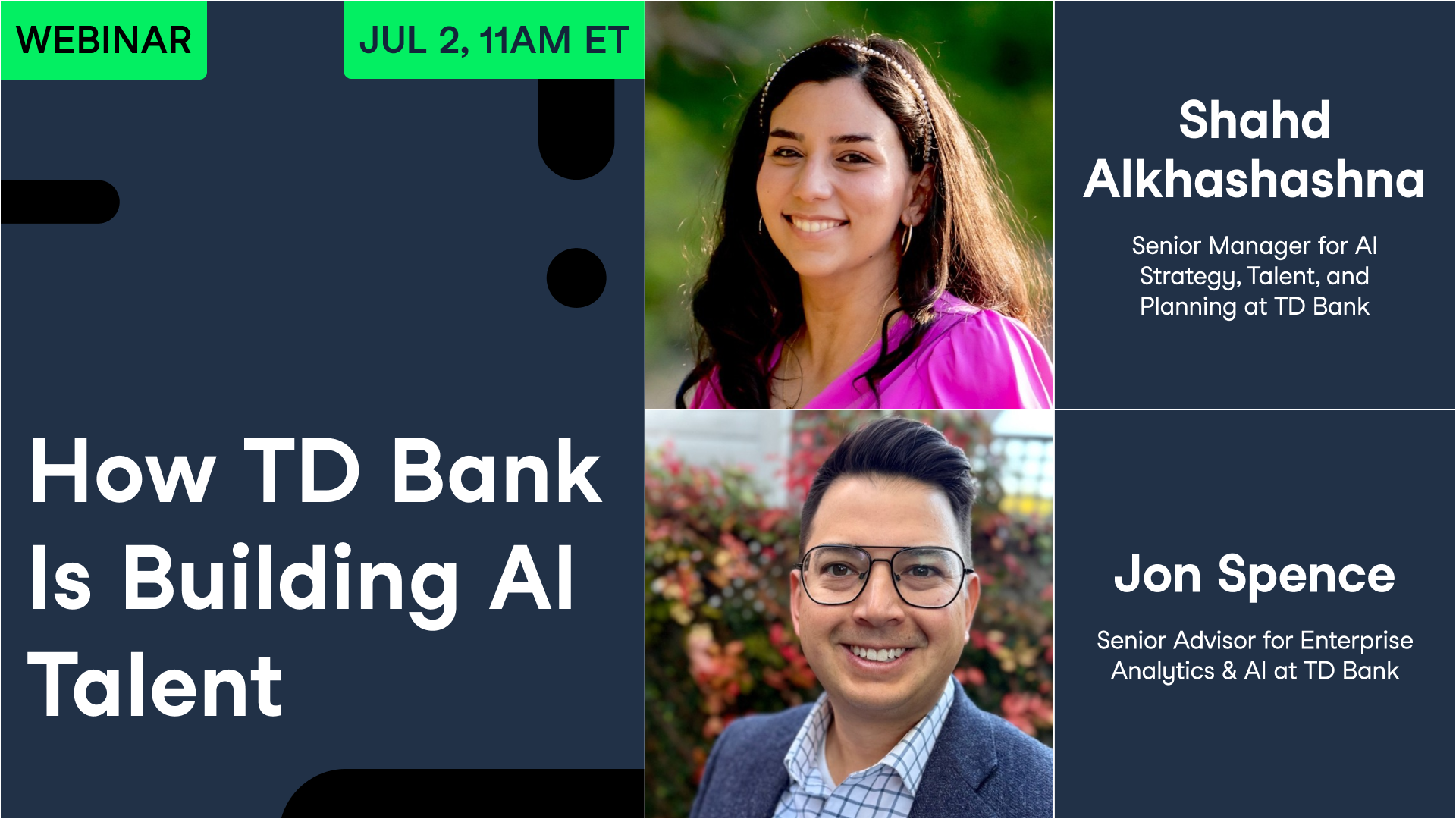
あなたのプレゼンター

Shahd Alkhashashna
Senior Manager for AI Strategy, Talent, and Planning at TD Bank

Shahd is part of the Strategy, Talent, and Planning Team at TD, working to build the skills and organizational capabilities the bank needs to succeed in an AI-driven future. Her work spans workforce strategy, talent development, and helping the AI2 function adopt AI at one of North America's largest financial institutions.

Jon Spence
Senior Advisor for Enterprise Analytics & AI at TD Bank
Jon advises on enterprise analytics and AI talent strategy. He has 15 years of experience in talent strategy, with a focus on analytics and AI recruitment, upskilling, and talent planning.
Summary
TD Bank has trained its executives before its analysts, built personalized development plans for 3,000 analytics and AI colleagues, and turned office snacks into a tool for AI culture change.
In this DataCamp session, host Richie Cotton speaks with Jon Spence, Senior Advisor for Enterprise Analytics and AI Talent Strategy, and Shahd Alkhashashna, Senior Manager for AI Strategy, Talent, and Planning at TD Bank. They walk through how a large financial institution runs an AI upskilling program at scale, from a Gen AI executive education partnership with Columbia University through career development plans mapped to each job family.
Spence explains why the bank started at the top of the house: leaders bombarded with a hundred-plus use cases first needed the fluency to prioritize them. Alkhashashna covers the technical training side, where TD uses DataCamp to build capability across its AI organization, and tells the story of a colleague who moved from a music and literature background to Data Scientist III through self-directed learning.
The conversation gets into the hard parts of any AI learning program: getting managers to protect learning time, celebrating career wins, choosing the technical skills that matter for data practitioners, scaling AI capability across teams, and the open question of how to measure return on learning investment. Both guests are candid that some of this is unsolved. The full webinar includes their answers to audience questions on timelines, cultural change, and attribution.
Key Takeaways
- TD Bank ran its AI upskilling program from the top down, giving VP-and-above executives two full days of education before scaling training to technical and business teams.
- The executive program was a Gen AI partnership with Columbia University that took a year to roll across the bank, with each session requiring six to eight weeks of planning.
- Career development plans are mapped to job families, so an applied machine learning scientist follows a different skill path than a business intelligence analyst.
- Managers are told to protect a recurring calendar block of at least thirty minutes a week for each colleague's learning, and the expectation is echoed by leaders at town halls.
- Spence booked himself into team calendars and ran live career-plan workshops, because a scheduled invite gets people to show up when a vague offer does not.
- One colleague moved from a music and literature background through corporate communications to Data Scientist III by taking a six-month personal leave for self-directed learning.
- For data practitioners, Spence ranks the highest-value technical skills as production Python, data engineering, and AI engineering beyond prompting.
- TD uses a DataCamp leaderboard competition, with gadget prizes for its top 30 learners, alongside an appreciation culture that celebrates internal moves and promotions.
- Measuring the business return on learning is still unsolved at the bank; Alkhashashna described it as a blank slate the team is actively working through.
Deep Dives
Why an AI upskilling program starts with executive education
TD Bank decided that leadership fluency had to come first. The bank's CEO put AI at the top of the priority list, so the team ran every VP-and-above executive through a Gen AI education program built with Columbia University. Day one covered fundamentals, the key players, and the geopolitics of AI. Day two was customized to TD, with technical teams and executives working through where the bank could apply the technology. Spence said the goal was not to turn leaders into practitioners. As he put it, executives face "a 100 plus use cases," and the training taught them which questions to ask and where the value sat. Different roles need different depth. Spence described how "different audiences need different levels of fluency," from strategic understanding for executives to applied capability for technical teams. The bank measured each cohort with satisfaction surveys and asked whether leaders would recommend the program to peers. That word of mouth filled the rooms: after three or four sessions, executives were telling colleagues to sign up, and some had to wait for the next one. Spence was clear that this single program was not the whole answer. "No single program really carries the strategy," he said; the value came from linking executive education to development plans, the upskilling program, and the learning platform underneath. The classroom content mattered less than the conversations it started afterward, which produced better questions, stronger sponsorship, and clearer priorities on where AI would pay off first.
Personalized AI development plans by job family
Once leaders had the language, TD built career development plans that translate broad AI ambition into specific actions. Personalization runs by job family. An applied machine learning scientist, a data scientist, and a business intelligence analyst each follow a mapped set of skill requirements, competencies, and business acumen tied to their role and level. Spence stressed that in a bank, the business context carries as much weight as the technical skill. A colleague who understands the business and applies technical capability becomes, in his words, "a powerhouse to us." He tells every analyst the same thing: you can build the best model in the bank, but if you cannot explain its value to your manager, the work stalls. The plans themselves get built fast. TD gives colleagues a four-week window, two weeks to draft and two weeks to review with managers and mentors. The team uses Microsoft Copilot as a thinking partner, feeding in each person's job family, strengths, and goals to generate draft SMART objectives that colleagues then refine. Managers do the connecting work, pointing people to a specific DataCamp course and setting a completion target for the quarter. The finished plan lives in the colleague's HR profile as a document they revisit rather than a one-time form. For someone whose goal is to strengthen their Python, the path is explicit: identify the gap, take the course, apply it, and become ready for higher-value projects.
Making time to learn: manager support and calendar blocks
Every AI learning program hits the same wall: people are busy, and learning slips. TD attacks it by protecting time on the calendar. Alkhashashna said the bank does not expect colleagues to upskill only on personal time, so the expectation, communicated to people managers and repeated by leaders, is that everyone gets a recurring block for learning. As she put it, "colleagues should be able to block even thirty minutes per week," and a standing slot on a Friday adds up over time because it is a recurring commitment rather than a good intention. Because leaders repeat the message on town halls, it reaches every team. Spence added a sharper tactic from his career-plan rollout. When colleagues said they wanted to plan their careers but had no time, he took two approaches. He joined team meetings and town halls to run live workshops so people left with a draft in hand. Then he booked himself directly into calendars for a set hour and ran the session online. Dozens showed up, and many told him "I would not have done this if you didn't book it." His pitch removed the excuse: "I'm making the time for you." The insight travels beyond learning. A scheduled invite that says the meeting is happening now beats an open-ended offer to find a time, which quietly never gets scheduled.
Culture change, celebrating wins, and one career that turned around
TD treats cultural change as deliberate, repeated contact rather than a single announcement. Alkhashashna described the approach as rinse and repeat: keep showing up in front of colleagues from different angles. The most memorable tactic was physical. Spence set up a booth in the office with a new treat each week. She was clear the snacks alone change nothing, but "it opens up the door to actually start talking about it." Colleagues gathered, talked, went back to their desks, and later pinged the team asking how to grow in a skill or advance part of their development plan. On celebration, the bank runs an appreciation culture that recognizes promotions and internal moves, such as a colleague shifting from personal banking analytics to TD Insurance, at town halls and team meetings. On the platform side, TD ran a leaderboard competition for its first ninety days on DataCamp, with gadget prizes for the top 30 learners. The strongest evidence for the whole approach is one colleague's path. She came from a music and literature background and spent ten years in corporate communications. After some soul searching, she took a six-month personal leave and trained on DataCamp full time, since learning on the side of her desk had not been enough of a commitment. She proved her skills through TD's Mind Power volunteer program and landed a data governance role. As Alkhashashna recounted, "she was very happy to get her foot in the door." She kept raising her hand for technical work and is now a Data Scientist III, still earning XP on the platform.
Technical skills that matter, scaling AI, and measuring ROI
Asked which technical skills data practitioners should build, Spence ranked three. Production Python comes first because it carries the highest return. "Many analysts can actually write Python," he said, but far fewer write code that others can maintain. Data engineering comes second, since reporting and credit-risk projects spend most of their time cleaning data. AI engineering comes third, going beyond the prompt-a-thons the bank runs to the engineering discipline behind AI systems. On scaling AI across a large organization, Spence offered a mindset shift. Instead of asking what a team can automate, ask which decisions people make repeatedly. A credit analyst makes the same calls over and over; a contact-center agent searches the same documents to answer the same questions. Framing the work around repeated decisions points to knowledge services and reporting services that scale, because they target work many people already do. Measuring the return on that investment is where both guests were candid. Alkhashashna said usage metrics are only the starting point: "we don't wanna just look at the usage metrics." She called it "a blank slate," a problem sitting on her desk that day. Cotton offered a partial answer from other sessions: where learning targets productivity, calculate hours saved; otherwise track proxy metrics such as time to first useful output, then convert to value.
関連
white paper
Digital Transformation in Finance: Upskilling for a Data-Driven Age
Tackle the unique digital transformation challenges for the finance industry.webinar
Architect a 90-Day AI Upskilling Program For Your Team
Nerupa Kidnapillai, a Senior Customer Success Manager at DataCamp, walks you through how to design and implement a focused AI upskilling initiative for your organization.webinar
AI In The Enterprise: Developing AI Talent
Damien Herrick, Ita Petrika-Lindroos, and Thomas Bodenski discuss strategies for developing AI talent. Learn which AI skills and roles are in demand, how to attract the right talent, and how to build AI literacy across your organization.webinar
Preparing Your Workplace for an AI-led Future
Three data experts from AXA UK, share how the company built its data and AI training program from the ground up.webinar
How Leaders Build AI Skills at Scale
Industry experts share how they’ve built AI training programs that scale without sacrificing relevance or engagement.webinar