Ga naar de hoofdinhoud
Thuis

Python courses

Python is a top language for data science, automation, and web development. DataCamp’s expert-built courses offer hands-on, interactive practice with real-world exercises. Start coding today and build skills to move your career forward.

Maak je gratis account aan

of

Door verder te gaan, ga je akkoord met onze Gebruiksvoorwaarden, ons Privacybeleid en dat je gegevens in de VS worden opgeslagen.
Group

Wil je 2 of meer mensen trainen?

Proberen DataCamp for Business

Recommended for Python beginners

Build your Python skills with interactive courses for data science, data analysis and machine learning, curated by real-world experts

Cursus

Introductie tot Python

BasisVaardigheidsniveau
4 hours
145.7K
Leer de basis van data-analyse met Python in 4 uur. Deze online cursus laat je kennismaken met de Python-interface en populaire pakketten.

Leerpad

Python-gegevensbasisprincipes

28 hours
74.4K
Verbeter je datavaardigheden, leer hoe je data kunt bewerken en visualiseren, en gebruik geavanceerde analyses om beslissingen te nemen op basis van data.

Weet je niet waar je moet beginnen?

Doe Een Evaluatie

Bladeren Python Parcours en parcours

Cursus

Introduction to Linear Modeling in Python

GemiddeldVaardigheidsniveau
4 hours
585
Explore the concepts and applications of linear models with python and build models to describe, predict, and extract insight from data patterns.

Cursus

Feature Engineering voor NLP in Python

GeavanceerdVaardigheidsniveau
4 hours
575
Leer manieren om nuttige info uit tekst te halen en deze om te zetten naar een formaat dat geschikt is voor machine learning.

Cursus

Bayesian Data Analysis in Python

GemiddeldVaardigheidsniveau
4 hours
557
Ontdek alle voordelen van Bayesiaanse data-analyse en pas het toe op allerlei echte situaties!

Cursus

ARIMA-modellen in Python

GeavanceerdVaardigheidsniveau
4 hours
555
Leer meer over ARIMA-modellen in Python en word een expert in tijdreeksanalyse.

Cursus

Kwantitatief risicobeheer in Python

GeavanceerdVaardigheidsniveau
4 hours
523
Leer meer over risicobeheer, value at risk en andere dingen die te maken hebben met de financiële crisis van 2008 met behulp van Python.

Cursus

Sentimentanalyse in Python

GemiddeldVaardigheidsniveau
4 hours
521
Zijn klanten enthousiast over je producten of laat je service te wensen over? Leer hoe je een volledige sentimentanalyse kunt uitvoeren.

Cursus

Market Basket Analysis in Python

GemiddeldVaardigheidsniveau
4 hours
499
Ontdek associatieregels in marktmandanalyse met Python aan de hand van boekwinkelgegevens en het maken van filmaanbevelingen.

Cursus

Anomaly Detection in Python

GemiddeldVaardigheidsniveau
4 hours
478
Detect anomalies in your data analysis and expand your Python statistical toolkit in this four-hour course.

Cursus

Beeldmodellering met Keras

GeavanceerdVaardigheidsniveau
4 hours
453
Leer hoe je beeldanalyse kunt doen met Keras en Python door convolutionele neurale netwerken te bouwen, te trainen en te evalueren.

Cursus

Generalized Linear Models in Python

GeavanceerdVaardigheidsniveau
5 hours
450
Breid je regressietoolbox uit met de logistieke en Poisson-modellen en leer hoe je ze kunt trainen, begrijpen en valideren, en hoe je voorspellingen kunt doen.

Cursus

Building Chatbots in Python

GemiddeldVaardigheidsniveau
4 hours
440
Learn the fundamentals of how to build conversational bots using rule-based systems as well as machine learning.

Cursus

Ensemblemethoden in Python

GeavanceerdVaardigheidsniveau
4 hours
436
Leer hoe je geavanceerde en effectieve machine learning-modellen kunt bouwen in Python met behulp van ensemble-technieken zoals bagging, boosting en stacking.

Cursus

Je datavisualisaties verbeteren in Python

GemiddeldVaardigheidsniveau
4 hours
379
Leer hoe je boeiende en aantrekkelijke visualisaties kunt maken die helpen om resultaten efficiënt en effectief over te brengen.

Gerelateerde bronnen op Python

blog

The 41 Top Python Interview Questions & Answers For 2026

Master 41 Python interview questions for 2026 with code examples. Covers basics, OOP, data science, AI/ML, and FAANG-style coding challenges.
Abid Ali Awan's photo

Abid Ali Awan

15 min

blog

How to Learn Python From Scratch in 2026: An Expert Guide

Discover how to learn Python in 2026, its applications, and the demand for Python skills. Start your Python journey today ​​with our comprehensive guide.
Matt Crabtree's photo

Matt Crabtree

15 min

kort overzicht

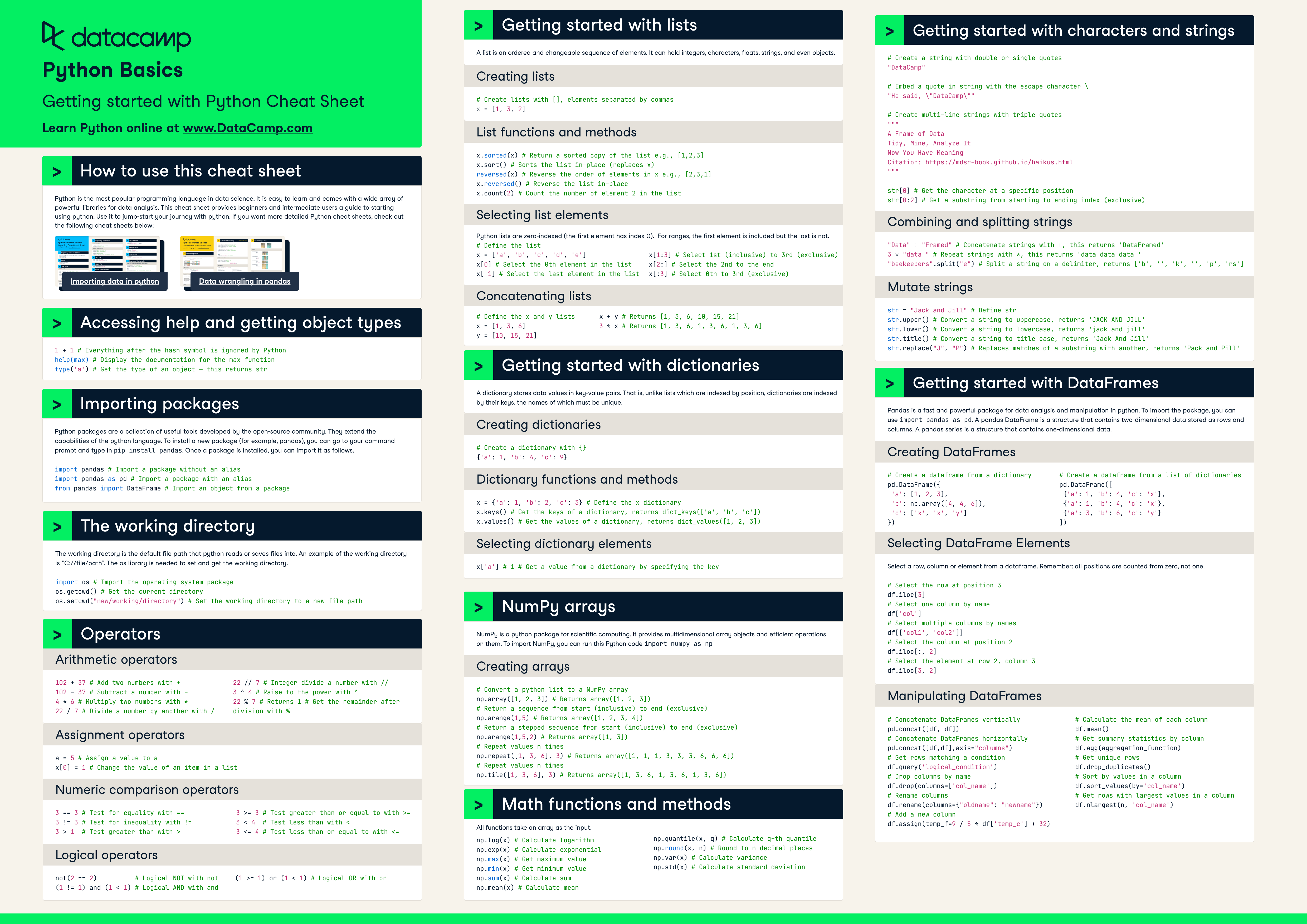
Python Cheat Sheet for Beginners

Python is the most popular programming language in data science. Use this cheat sheet to jumpstart your Python learning journey.
Richie Cotton's photo

Richie Cotton

8 min


Ready to apply your skills?

Projects allow you to apply your knowledge to a wide range of datasets
to solve real-world problems in your browser

Frequently asked questions

What is Python and why is it important in data science and AI?

Python is a widely-used, high-level programming language known for its readability, simplicity, and extensive libraries. It is important because of its versatility in various fields like web development, automation, data analysis, and artificial intelligence, making it a fundamental skill for many technological and scientific applications. This broad applicability has made Python one of the most popular programming languages in the world.

Do I need any prior programming experience to start learning Python?

No, you don't need previous programming experience. Our courses are designed to be beginner-friendly, guiding you step by step.

How can learning Python benefit my career?

Learning Python opens doors across multiple industries due to its high demand, offering broad career opportunities in technology, data science, finance, healthcare, academia, and marketing. Its versatility in data handling and analysis is particularly valued for driving data-driven decisions and innovation. Mastering Python can significantly enhance your professional skillset, making you a valuable asset in numerous fields.

What are some career paths that Python enables?

Python opens the door to a variety of career paths, serving as a catalyst for roles such as data scientist, data analyst, machine learning engineer, software developer, and web developer. Its widespread application in diverse fields like finance, healthcare, technology, and research means that proficiency in Python can significantly advance career prospects in these and many other industries.

What is the best way to learn Python?

The most effective way to learn Python is through a practical, hands-on approach. Interactive courses led by industry experts provide structured learning and real-world problem-solving, while building your own projects allows you to apply and solidify your skills, helping you to excel faster in Python programming. Read our full guide on how to learn Python for more guidance.

What’s the difference between Python and R?

Python is a versatile and user-friendly language ideal for general programming and data science, whereas R is more specialized for statistical analysis, complex data manipulation, and data visualization. Check out our Python vs R article for a more detailed comparison.

Are the Python courses updated with the latest industry trends and technologies?

Yes, we regularly update our courses to reflect the latest trends and technologies in the field.

Does DataCamp offer a Python Certification?

DataCamp offers professional certifications for Data Scientists and Data Analysts. You can use Python in either of these certifications to prove your skills and build a strong portfolio.

Andere technologieën en onderwerpen

technologieën