Accéder au contenu principal

Remplissez les détails pour débloquer le webinaire

En continuant, vous acceptez nos Conditions d'utilisation, notre Politique de confidentialité et le fait que vos données seront hébergées aux États-Unis.

Haut-parleurs

Entreprises

Formation de 2 personnes ou plus ?

Donnez à votre équipe l’accès à la bibliothèque DataCamp complète, avec des rapports centralisés, des missions, des projets et bien plus encore.
Essayer DataCamp pour les entreprisesPour une solution sur mesure, réservez une démo.

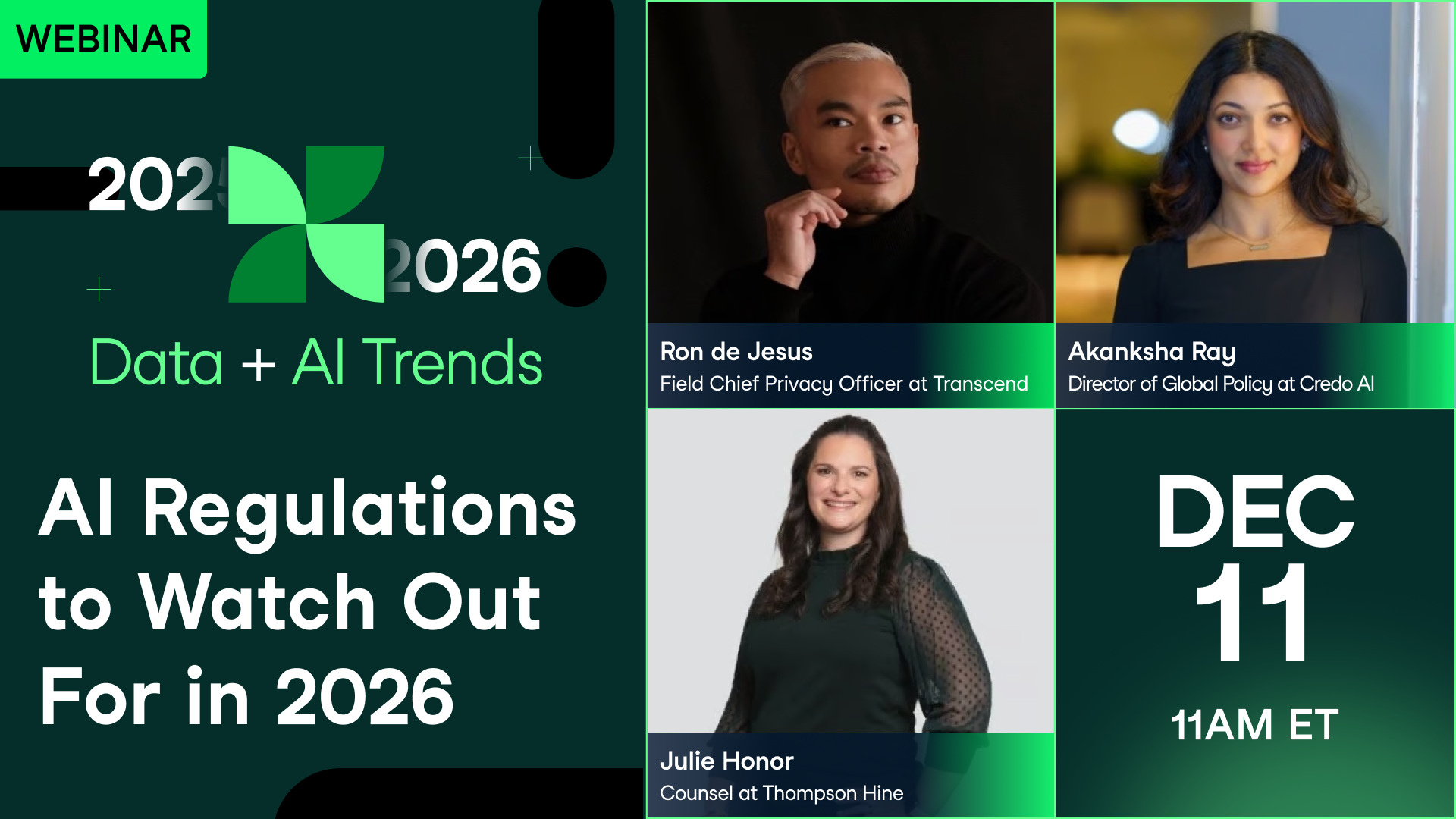
AI Regulations to Watch Out For in 2026

December 2025
Webinar Preview

Session Resources

Summary

AI Regulations to Watch Out For in 2026 is a session designed for professionals understanding the evolving world of AI legislation. The discussion centers on current and upcoming AI laws worldwide, focusing on compliance strategies for businesses.

AI legislation is rapidly evolving, with significant regulations expected by 2026. Key areas of focus include the EU AI Act, state-level regulations in the US, and industry-specific rules in sectors like healthcare and finance. The session highlights the importance of understanding these laws to avoid compliance pitfalls and emphasizes the role of transparency and data management in AI governance. Experts also discuss the global perspective, noting efforts in Asia and the UK to balance innovation with regulation. The conversation emphasizes the need for cross-functional collaboration within organizations to effectively manage AI compliance.

Key Takeaways:

  • Understanding AI regulations is important for compliance and avoiding legal issues.
  • The EU AI Act and US state-level regulations are key areas to watch.
  • Transparency and data management are essential in AI governance.
  • Global efforts are underway to balance AI innovation with regulation.
  • Cross-functional collaboration is necessary for effective AI compliance.

In-Depth Analysis

EU AI Act and Global Regulations

The EU AI Act is a key part of AI regulation, setting a precedent for global standards. It categorizes AI systems into risk levels, with high-risk systems facing stringent requirements. ...
Lire La Suite

Compliance involves understanding these classifications and implementing necessary safeguards. The EU is also working on harmonizing various regulations to simplify compliance. Akanksha Ray noted, "The EU is trying to establish their sovereign conformity template," highlighting the importance of staying informed about these developments. Globally, countries like China and Singapore are also advancing AI regulations, with China taking a more prescriptive approach and Singapore focusing on framework principles.

US State-Level Regulations

In the US, AI regulations are primarily emerging at the state level, with Colorado and California leading the way. These laws often intersect with existing privacy and consumer protection regulations, creating a complex compliance situation. Julie Honor emphasized the importance of understanding these intersections, stating, "You have your AI laws, data privacy laws, deceptive practices, and anti-discrimination laws to consider." Companies must understand these overlapping regulations, ensuring transparency and fairness in AI applications, particularly in high-risk areas like employment and finance.

Transparency and Data Management

Transparency is a recurring theme in AI compliance. Companies are encouraged to implement practices like model cards and just-in-time notices to inform users about AI interactions. Ron De Jesus highlighted the importance of these practices, saying, "Traditional privacy controls work well in AI use cases." Effective data management is also vital, as understanding where data resides and how it is used underpins compliance efforts. This involves creating an AI inventory and ensuring data is used ethically and legally.

Cross-Functional Collaboration

AI governance requires collaboration across various organizational functions. Legal, privacy, security, and product teams must work together to address AI risks and compliance. Ron De Jesus pointed out, "AI governance is incredibly cross-functional," emphasizing the need for integrated approaches. Companies should use existing compliance frameworks and committees to incorporate AI considerations, ensuring that AI initiatives align with broader business strategies and compliance requirements.


Connexe

webinar

Understanding Regulations for AI in the USA, the EU, and Around the World

In this session, two experts on AI governance explain which AI policies you need to be aware of, how governments are treating AI regulation, and how you need to deal with them.

webinar

The EU AI Act: How Will It Affect Your Business?

Dan Nechita, EU Director for the Transatlantic Policy Network, and Lily Li, Founder and Lawyer at Metaverse Law, explain what the legislation involves, how it will affect your business, and how to comply with the legislation.

webinar

Data & AI Trends for 2026

Industry experts from MIT and IBM explore the most important trends shaping data and AI in 2026.

webinar

US AI Regulations vs. The EU AI Act

Odia Kagan, a Partner at Fox Rothschild, and Julie Honor, a Counsel at Thompson Hine, outline what the EU AI Act and US AI regulations involve and how to comply with them.

webinar

What’s Next for AI? Trends for 2025 and Beyond

Experts discuss the forefront of AI innovation. You’ll get an inside look at the current state of AI adoption, explore the key trends set to define 2025 and beyond, and hear about promising startups pushing the boundaries of what’s possible.

webinar

Prepare Yourself for the 2026 AI Job Market

Karina Bernacki and Alexis Fink, share what the 2026 job market will look like and how to prepare for it. You’ll learn which roles will be in high demand, which industries are hiring, and how to stand out to recruiters and hiring managers.