Ir al contenido principal

Completa los detalles para desbloquear el seminario web

Al continuar, aceptas nuestros Términos de uso, nuestra Política de privacidad y que tus datos se almacenen en los EE. UU.

Altavoces

Empresas

¿Formar a 2 o más personas?

Dale a tu equipo acceso a la biblioteca completa de DataCamp, con informes centralizados, tareas, proyectos y mucho más.
Prueba DataCamp para empresasPara obtener una solución a medida, reserva una demostración.

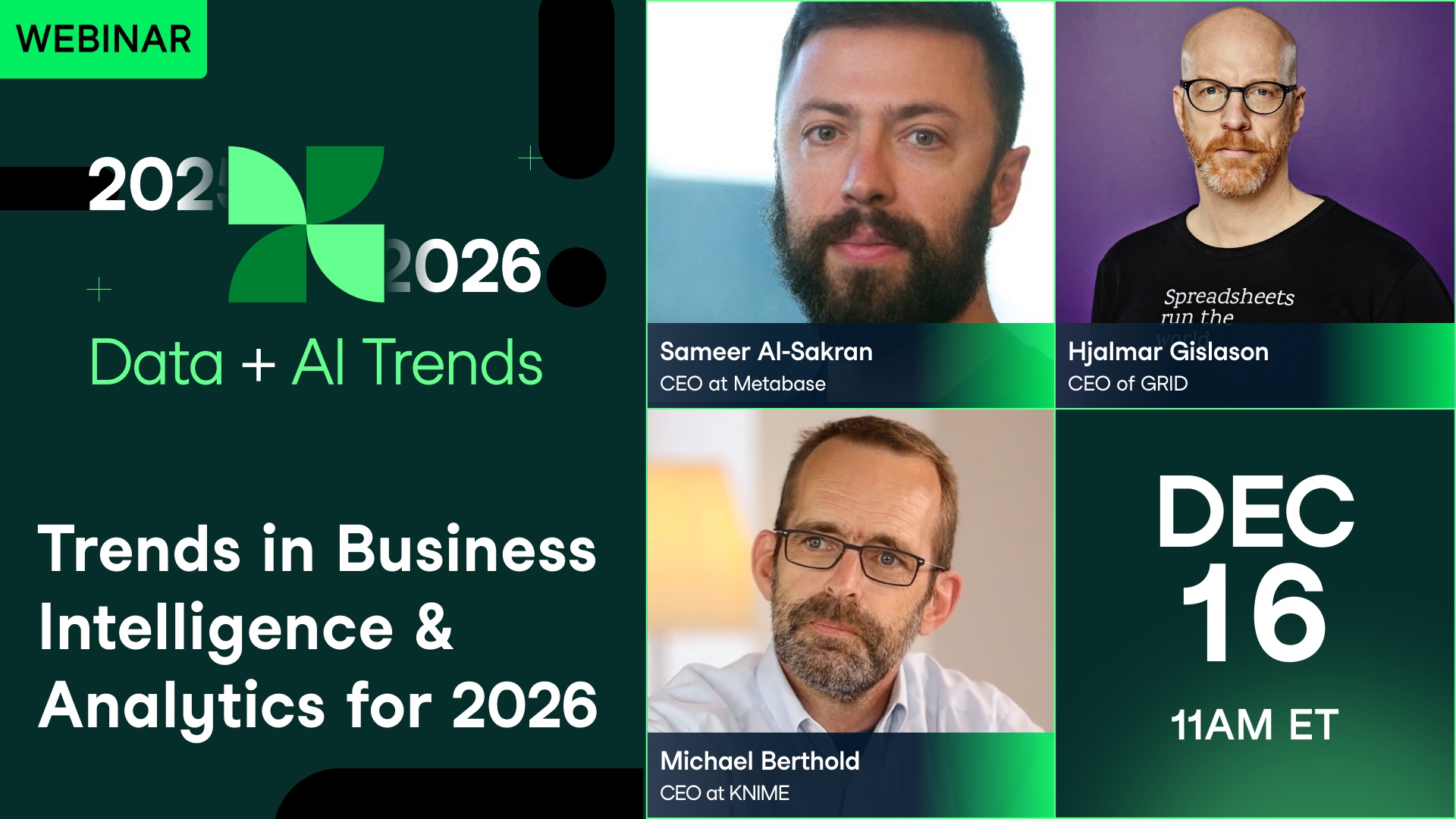
Trends in Business Intelligence & Analytics for 2026

December 2025
Webinar Preview

Session Resources

Summary

Trends in Business Intelligence & Analytics for 2026 is a session designed for data professionals looking to understand the evolving field of BI and analytics. The session explored the future of business intelligence and analytics, focusing on trends expected by 2026. Key topics included the rise of generative AI, the importance of data governance, and the evolving roles within data teams. The discussion highlighted the shift towards more automated and AI-driven processes, emphasizing the need for domain expertise and numerical literacy. The panelists, all CEOs of analytics companies, shared insights on how AI is transforming data workflows and the skills necessary to thrive in this changing environment.

Key Takeaways:

  • Generative AI is set to revolutionize analytics, automating many traditional tasks.
  • Domain expertise and numerical literacy are becoming increasingly valuable.
  • Data governance and understanding data assets are essential for effective analytics.
  • Self-service analytics is evolving, with AI enabling more personalized insights.
  • AI tools are powerful tutors, potentially accelerating skill development.

Detailed Insights

Generative AI in Analytics

Generative AI is poised to transform the analytics field by automating many traditional tasks. The panelists discussed how AI can handle exploratory data analysis, visualization, and even code generation. Sameer Al-Sakran noted, "Generative coding is going to eat analytics as a whole." This shift means that while AI can auto ...
Leer Mas

mate the busy work, the need for human oversight remains, particularly in ensuring the accuracy and reliability of AI-generated insights. The discussion emphasized that while AI can produce results quickly, understanding and verifying these results is crucial, especially in high-stakes environments.

Importance of Domain Expertise

As AI takes over more technical tasks, domain expertise becomes a key differentiator. Panelists agreed that understanding the context and meaning of data is essential. Sameer Al-Sakran highlighted that future analysts will need to be "quantitative practitioners" in their specific domains. This shift means that data professionals will need to focus more on interpreting results and less on the mechanics of data processing. The ability to critically assess AI-generated insights and apply them within a specific business context will be a key skill.

Data Governance and Quality

The session emphasized the importance of data governance and understanding data assets. As Hjalmar Gislason pointed out, "You still need to understand which questions you should be asking." Effective data governance ensures that data is accurate, accessible, and secure, enabling more reliable analytics. The panelists discussed the need for clear data strategies that separate critical metrics from exploratory analysis, ensuring that decision-making is based on solid data foundations.

Evolution of Self-Service Analytics

Self-service analytics is evolving with AI enabling more personalized insights. The panelists discussed how AI can help create custom dashboards and reports designed to individual needs. This personalization allows non-technical users to interact with data more effectively, reducing reliance on data specialists. However, the panelists cautioned that while AI can facilitate self-service, it is essential to maintain rigorous standards for data accuracy and interpretation. The role of data professionals is shifting towards enabling and guiding these self-service capabilities.

Skills for the Future

The session concluded with a focus on the skills needed for future success in analytics. Panelists emphasized the importance of numerical literacy, domain expertise, and the ability to effectively use AI tools. As Michael Berthold noted, "It's never been easier to learn and to acquire skills." The discussion highlighted that while AI can automate many tasks, the ability to critically assess and communicate insights remains invaluable. Investing in skill development and staying updated with technological advancements will be essential for data professionals adapting to this evolving field.


Relacionado

white paper

2022 Data Trends and Predictions

Read about 9 trends shaping data science in 2022 and beyond

white paper

2022 Data Trends and Predictions

Read about 9 trends shaping data science in 2022 and beyond

webinar

Data & AI Trends for 2026

Industry experts from MIT and IBM explore the most important trends shaping data and AI in 2026.

webinar

Data Science and Business Intelligence in 2025: How will AI Transform the Data Team?

Three guests explore the impact of LLMs and GenAI on analytics and data functions in 2025, how they will lower the barrier to entry for working with data, the skills data teams need to develop, and a lot more.

webinar

Data Trends and Predictions 2022

9 major data science trends that will impact organizations in 2022 and beyond.

webinar

What’s Next for AI? Trends for 2025 and Beyond

Experts discuss the forefront of AI innovation. You’ll get an inside look at the current state of AI adoption, explore the key trends set to define 2025 and beyond, and hear about promising startups pushing the boundaries of what’s possible.