Share this webinar
Close your data and AI skills gap
We're the only platform uniquely engineered to advance data and AI skills across your entire organization. Let's explore a tailored program.
Book an Enterprise DemoProgress from Junior Developer to 10x Senior
February 2026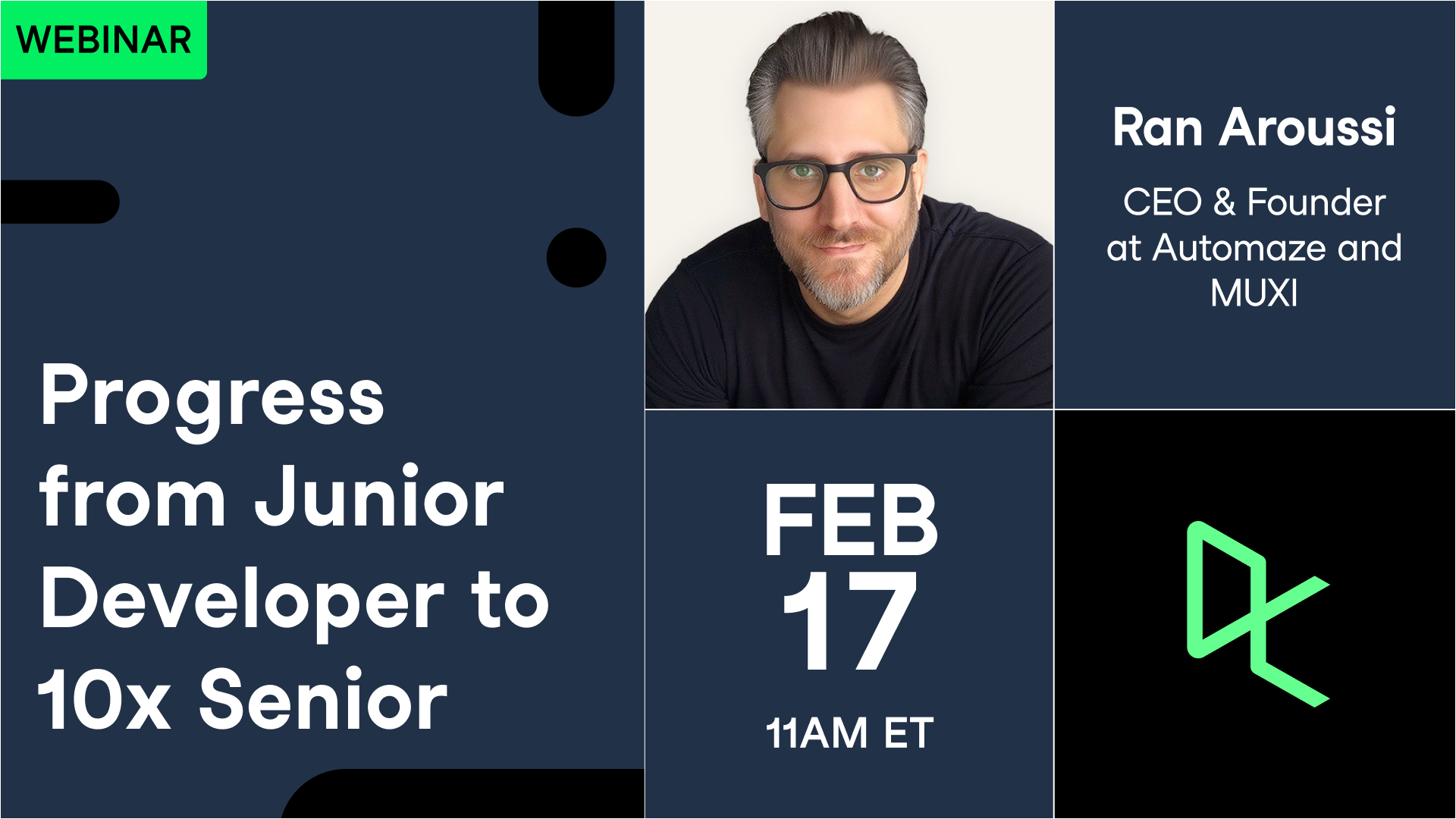
Your Presenter(s)

Ran Aroussi
CEO & Founder at Automaze and MUXI
Ran runs the CTO-as-a-Service company Automaze, and is the founder of MUXI, an open-source, production-ready infrastructure for AI agentI. He is a serial entrepreneur, having previously founded four other startups, including programmatic trading strategy company Tradologics. Ran is the creator of the yfinance Python package that gets 10M downloads/month. He is the author of "Production-Grade Agentic AI".
Session Resources
Summary
A practical career guide for junior developers, team leads, and data practitioners who want to stay employable—and grow—while AI changes how software gets built.
AI makes it easy to generate working code fast, but easier to miss when the underlying reasoning is wrong. The core risk is not “replacement,” but a slow loss of engineering judgment: juniors who can ship demos yet can’t explain design choices, debug failures, or defend tradeoffs. The fix is a deliberate progression—build fundamentals first, then hand repeatable work to AI while keeping human-led planning and decision-making constant. A senior developer in the AI era looks less like a faster typist and more like an architect: someone who can sketch the system from memory, anticipate edge cases, and turn user needs into clear technical constraints.
Along the way, the session argues that better prompts come from better product and engineering artifacts—mini PRDs, constraints, and success metrics—written before opening an AI tool. It also offers hiring and mentorship guidance: keep investing in the junior pipeline, but raise the standard on ownership and explainability. As Ran Aroussi put it, “I honestly don’t care who wrote the code… can you explain the code?”
Key Takeaways:
- AI makes output cheap; value shifts to problem framing, architecture, and verification.
- Juniors should use AI—but in stages—so they still build a mental model of systems and failure modes.
- “Vibe coding” can produce impressive demos while accumulating invisible technical debt in production.
- Strong prompts come from strong thinking: define inputs/outputs, constraints, edge cases, and “done” before coding.
- Team leads should hire and mentor for ownership: “explain this to me” becomes the new merge gate.
Deep Dives
1) The junior hiring crisis—and why the pipeline still matters
The anxiety behind today’s entry-level market is straightforward: if AI can handle “easy” tasks, what is a junior developer for? The session doesn’t deny the pressure—Aroussi predicts fewer junior openings and cites a measurable shift (“about 20% drop in job openings” alongside a “20% increase in entry level” pay). But it reframes the issue as a pipeline problem as much as a productivity one. If organizations stop funding junior development, they won’t magically produce future senior engineers. They will consume, rather than renew, the very expertise they rely on.
This is not only a headcount argument; it’s a theory of how engineering judgment is built. Senior engineers are not defined by their ability to type quickly, but by scar tissue: incidents, production outages, scalability surprises, and the lived experience of tradeoffs. Aroussi describes “earned knowledge” as the kind that can’t be skimmed from documentation or produced by a model on demand—the 3 a.m. database failure, the service that behaves differently at a billion requests, the organizational constraints that shape what “good” looks like. AI can compress “teachable knowledge” (syntax, patterns, APIs), but it can’t remove the need for real responsibility and consequence.
The tension for leaders is that AI does reduce the number of hands required to implement software. Yet the session argues that cutting juniors entirely is a strategic error: it hollows out the future of the organization’s own technical leadership. The proposed compromise is to hire fewer juniors, but train them faster and with more intent—shifting mentorship away from syntax drills and toward decision-making, debugging, code review, and accountability.
That accountability is also the dividing line between employable and obsolete. Aroussi’s blunt standard—“I honestly don’t care who wrote the code… can you explain the code?”—signals a new kind of junior: one whose job is not to produce lines, but to own outcomes. If you can’t explain the system you “built,” you didn’t build it; you only passed requests between tools. For leaders asking “how to hire junior developers in the age of AI,” the session’s answer is clear: the pipeline still matters, but it must produce architects-in-training, not prompt operators.
2) Mental models over syntax: why fast code can hide bad thinking
Aroussi’s most counterintuitive lesson comes from a classroom, not a codebase. When he volunteered to teach Python at his daughter’s high school, he spent two months forbidding students from touching a keyboard. Instead, they drew flowcharts and mapped data movement on paper. The goal was to separate the logic of a program from the mechanics of writing it. In today’s AI-heavy environment, that separation matters even more: syntax is cheaper than ever, but understanding is not.
The session argues that AI can create an “illusion of productivity” because it turns typing into a commodity. A landing page, an API, even an MVP can appear in minutes. But software was never mainly about typing; it was about deciding what to do and why, then predicting what breaks when reality disagrees. The danger is not that AI writes code, but that it lets developers—especially newer ones—skip the steps where mental models are built: problem framing, planning, and the repeated loop of implementation plus debugging. When those steps are skipped, failures become harder to spot. The system works “until it doesn’t,” and by then you don’t know where to look.
This is where the critique of “vibe coding” lands. In music production, trusting taste may be enough; a song doesn’t face concurrency bugs or database contention. In software, Aroussi describes vibe coding as “gambling with a better UX”—a demo-first approach that may look productive, yet piles on risk when the product grows, features stack up, or load increases. The session makes a grounded point: technical debt is often created not by bad intent, but by missing understanding.
To underline the cognitive cost, Aroussi offers a darker analogy about outsourcing core mental functions—reading, writing, reasoning—to machines. While partly humorous, it is meant as a warning: if developers stop practicing reasoning, they lose the ability to judge what AI produces. The career consequence is immediate: someone who can’t debug or explain the code isn’t a developer, regardless of how quickly they can generate it. The broader consequence is systemic: a workforce trained to accept outputs rather than form models becomes easier to automate—and harder to trust.
If this theme feels abstract, it becomes concrete in the later roadmap: keep human thinking constant, and treat AI as a tool whose value depends on what you bring to it. The session’s premise is that the mental model—not the keystrokes—remains the durable advantage for anyone following a junior to senior developer roadmap in 2026 and beyond.
3) A staged roadmap for using AI without outsourcing your brain
The session’s most actionable contribution is a staged progression for juniors: not “use AI” or “don’t use AI,” but when and how. The goal is to preserve learning while still gaining speed. “The critical constant,” Aroussi says, “is that the human thinking stays 100% across all stages.” In other words, delegation increases—but ownership does not decrease.
Stage 1: Foundation (roughly 300 hours). You write essentially all the code yourself. AI plays two supporting roles: a reviewer (critiquing your security, edge cases, and logic) and an on-demand guide (the modern replacement for flipping through books or scanning Stack Overflow). The purpose is to build the internal “coding muscle” that lets you understand cause and effect. Without it, you may ship functioning code that you cannot later reason about.
Stage 2: Assisted collaboration. Now AI becomes a pair programmer. You still write most of the code (Aroussi suggests around 70%), but you delegate boilerplate and tasks you’ve already mastered. The key rule: never delegate what you can’t debug. If the AI writes it and you can’t explain it, you’ve created an ownership gap that will surface under pressure.
Stage 3: Full leverage (around the next 1,000 hours). AI becomes a force multiplier. You might write 40% or less, leaning on pseudo-code, code completion, and rapid scaffolding. The emphasis shifts from accumulating knowledge to applying judgment: choosing tradeoffs, anticipating failure modes, and shaping the architecture.
Stage 4: Architect mode. At this point, the job is to spot problems early, defend decisions, and evaluate results quickly. Aroussi’s definition is exacting: the architect is “the person who can draw the whole system on a whiteboard from memory, explain every line of code and defend every architectural decision.” This isn’t a title; it’s a capability formed through repeated cycles of building, breaking, and repairing.
What makes the roadmap useful is its honesty about incentives. AI can remove drudgery, but it can also cut learning short. This staged approach is a clear answer to “how to become a senior developer with AI” without becoming dependent: keep the thinking, planning, and debugging skills growing even as AI does more typing. If you want the full detail—what to delegate, what to keep, and why—the complete talk adds concrete examples.
4) From better prompts to better products: PRDs, constraints, and the think–build–verify loop
Aroussi’s approach treats prompting as downstream of product thinking. The difference between weak and strong instructions is not length; it is decision-making. “Create an auth system” is a vibe-coded request: it hands off the most important choices. An architect’s prompt encodes tradeoffs—HTTP-only cookies, JWT expiry, refresh behavior, rate limiting—because it starts from how a user should experience the product and traces back to the technology.
This is where the session’s emphasis on PRDs becomes practical for day-to-day AI-assisted development. Before asking an AI system to implement anything substantial, Aroussi writes structured requirement documents at multiple levels: a broad PRD for the whole project, a PRD per large feature, and “mini PRDs” for large tasks. Even the mini version is disciplined: the problem, the requirements, constraints, edge cases, and success metrics. The examples are telling because they’re mundane, high-stakes features where mistakes show up in support queues and security incidents.
A password reset mini-PRD, for instance, includes a 15-minute expiry, single-use tokens, hashed storage (never raw), rate limiting, and UX rules that avoid revealing whether an email exists—details that are easy to skip if you jump directly into code generation. Another example—an in-app notification system—spells out peak throughput (“50,000 events per minute”), data stores for history versus unread counts, and what is explicitly out of scope (SMS/WhatsApp). These artifacts become the “contract” that guides the model and gives the human something stable to review.
Underneath the PRD practice is a loop: think → build → verify. Thinking is human-led: define the problem, inputs, outputs, constraints, edge cases, risks, and the definition of done. Building can be AI-assisted or AI-driven depending on the developer’s stage. Verification returns to the human: testing, reviewing, and—most of all—rebuilding a mental model of what was produced. Aroussi even describes pitting models against each other in code review, using one system to critique another, then feeding the critique back to tighten the solution. He also asks a telling meta-question—“what is your confidence level that this code is ready for production?”—to push the model into clearer self-checking.
The thread tying these practices together is responsibility. Better prompts are not clever tricks; they come from clearer product intent. And clearer product intent is what AI cannot supply for you. The session makes a strong case that the fastest path to “10x developer” results in the age of AI is not more code generation—it’s better specification and sharper verification, plus the ability to explain and defend what ships. Watching the full session is worthwhile for the concrete examples of what to write down before you ever ask a model to write code.
Verwandt
webinar
Towards 10x Team Productivity with AI
Richie Cotton, Senior Data Evangelist at DataCamp, demonstrates practicable ways to boost team productivity using generative AI and agentic workflows.webinar
AI In The Enterprise: From Prototype to Production
Aishwarya Naresh Reganti, Supreet Kaur, and Luke Jinu Kim discuss how to navigate the journey from AI prototypes to production-ready applications.webinar
Reengineering Your Business Using AI
Drake Wolfe, CEO of Elysium Labs and architect of the Auto-Generative Agentic Ecosystems Framework, walks you through the playbook for rethinking and reengineering your business with AI.webinar
Architect a 90-Day AI Upskilling Program For Your Team
Nerupa Kidnapillai, a Senior Customer Success Manager at DataCamp, walks you through how to design and implement a focused AI upskilling initiative for your organization.webinar
Strategic AI Transformation
Robb Wilson, CEO at OneReach.ai, Louisa Loran, former Director of Strategic Business Transformation at Google, and Evan Schwartz, Chief Innovation Officer at AMCS Group, will share the principles behind successful AI transformation.webinar