Partager ce webinaire
Comblez votre déficit de compétences en données et en IA
Nous sommes la seule plateforme conçue de manière unique pour faire progresser les compétences en données et en IA dans l’ensemble de votre organisation. Explorons un programme sur mesure.
Réservez Une Démo EntrepriseHow to Get Hired as a Data Scientist
April 2026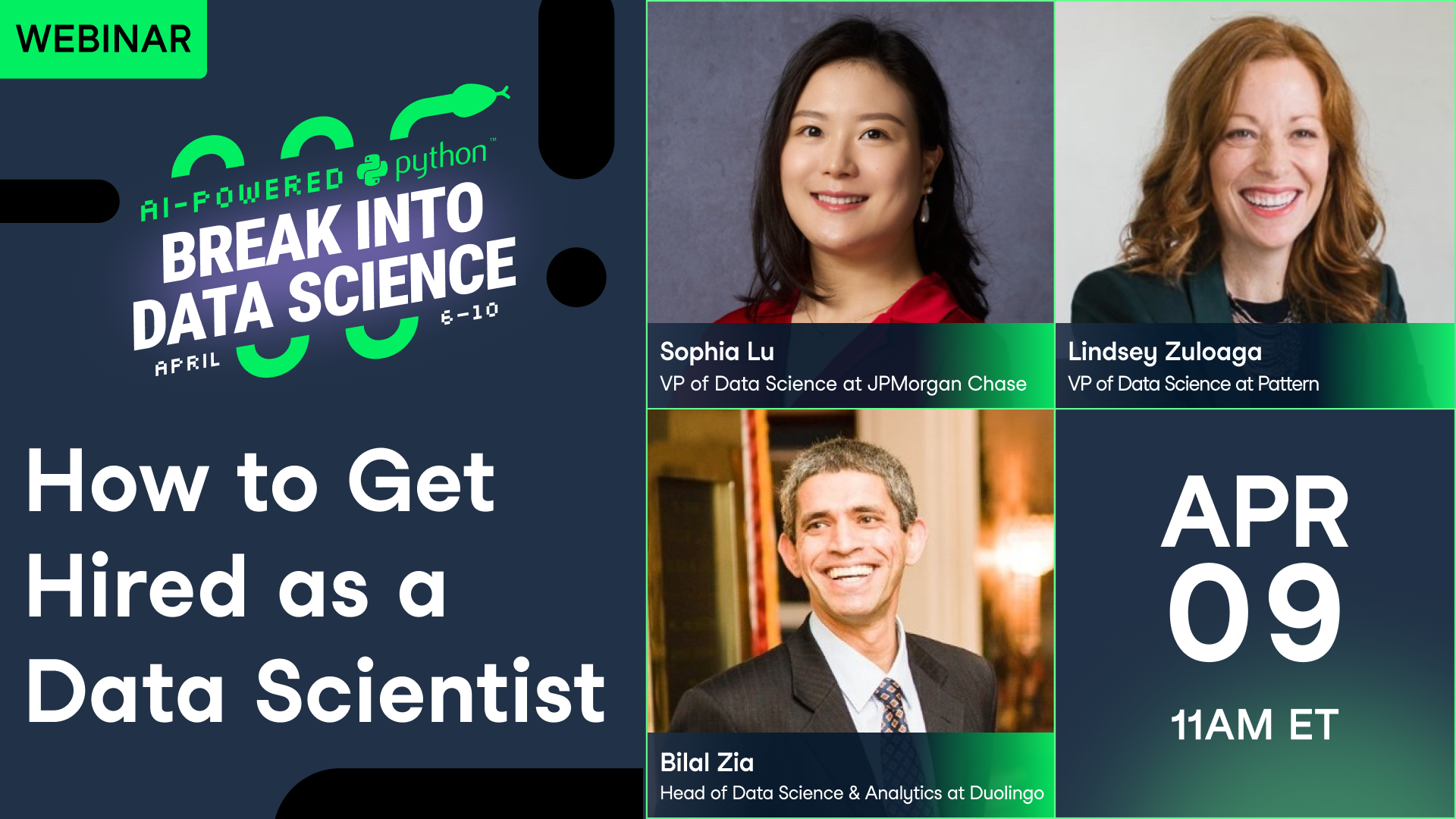
Vos présentateurs

Sophia Lu
VP of Data Science
Sophia is a data science leader with over 10 years of experience delivering advanced analytics and AI/ML solutions across consumer banking, wealth management, auto lending, retail, e-commerce, and digital products. Previously, she was an Advanced Analytics Lead at Macy's.

Lindsey Zuloaga
VP of Data Science at Pattern
Dr. Lindsey Zuloaga is the VP of Data Science at Pattern®, where she scales world-class teams to solve the most complex challenges in e-commerce. With a Ph.D. in Applied Physics and a decade-long legacy as a pioneer of AI in hiring at HireVue, Lindsey frequently speaks on the future of work. Her career is defined by a commitment to ethical AI and scientific rigor, making her a trusted voice on how AI is reshaping the modern workplace.

Bilal Zia
Head of Data Science & Analytics at DuoLingo
Bilal runs the data function at Duolingo. He was responsible for overhauling the data team to be high impact and AI-forward. Bilal's expertise includes building business forecasting infrastructure and creating machine learning applications. Previously Bilal was Principal Economist at Amazon and a Senior Economics Lead at the World Bank.
Summary
A panel discussion for aspiring and early-career data scientists on what it takes to get hired in 2026, featuring three active hiring managers: Sophia Lu (VP of Data Science at a major bank), Lindsey Zuloaga (VP of Data Science at Pattern), and Bilal Zia (Head of Data Science and Analytics at Duolingo).
The data science job market is shifting faster than most candidates realize. Generative AI has lowered the technical barrier to entry. Writing code, building models, and running analysis are no longer the hard parts. That shift has raised the bar on everything else: how candidates think, how they communicate, and how they connect technical work to business outcomes.
All three panelists agree that the core technical stack, Python, SQL, statistics, and machine learning fundamentals, still matters. It gets you into the hiring funnel. What moves candidates through is harder to teach: framing problems correctly, explaining complex ideas to non-technical stakeholders, and understanding what a business needs from a model.
For anyone looking to build a data science career, whether coming straight out of school, switching careers, or rethinking their approach to job applications, this session offers a direct look at what hiring managers see every day and what separates candidates who get hired from those who don't. Watch the full webinar for the complete discussion, including audience Q&A.
Key Takeaways
- Generative AI has commoditized basic coding tasks, shifting what employers value toward higher-order skills like problem framing, business judgment, and the ability to communicate technical findings to non-technical stakeholders.
- Technical skills, Python, SQL, statistics, machine learning fundamentals, remain necessary but now function as a baseline requirement, not a differentiator, in data science hiring.
- Interview performance carries more weight than resume credentials. Modern data science assessments cover communication, critical thinking, and collaboration alongside technical ability.
- Candidates can break into data science without formal job experience by building projects that show business context, not just model accuracy, and by investing in professional connections over mass online applications.
- Top data scientists combine technical capability with business judgment, knowing when an 80% solution delivered quickly is worth more than a perfect one delivered too late.
Deep Dives
How Generative AI Is Changing the Data Science Role
Generative AI has changed what data scientists are expected to do, and the shift is accelerating. Knowing how to code, build models, and run analysis was once the main thing that set data scientists apart. That advantage is eroding fast.
"AI is certainly lowering the technical barrier to entry in data science," said Sophia Lu. "The value of the role as a data scientist is shifting from baseline technical skills to higher-level capabilities, including problem solving, business judgment, cross-functional influence, and the ability to translate insights into decisions."
Bilal Zia put it plainly: AI is an army of research assistants. Every data scientist now has access to tools that handle the mechanical work, data wrangling, model building, exploratory analysis. That doesn't eliminate the need for human judgment. It raises the demand for it. "I don't think there's autonomous production that's trustworthy yet," Zia said. "But what this has done is accelerate the velocity of output a lot."
Expectations have moved upward as a result. Data scientists are now expected to understand the business context around their work, validate AI-generated outputs, and translate findings into decisions that non-technical stakeholders can act on. The mechanical work is easier. The judgment work is harder.
Lindsey Zuloaga saw the same pattern inside her own team. The data scientist who builds a model and hands off a Jupyter Notebook to engineering is quickly becoming obsolete. "Those roles are merging and kind of expanding," she said. "Data scientists need to do a lot more production-level code and even play the role of product manager a little bit more, too."
AI is not replacing data scientists. It is changing what the job looks like. The fundamentals still matter. You're expected to do more with them now. To hear the panelists go deeper on how this plays out inside their own teams, watch the full session.
The Data Science Skills Employers Actually Want in 2026
The core technical stack for data science has not changed. Python, SQL, statistics, and machine learning fundamentals remain standard requirements. But whether a candidate knows these tools is no longer the interesting question for hiring managers.
"It's less about whether you're familiar with a tool, and more about whether you can use it well and appropriately," Sophia Lu explained. "A lot of hiring managers care less about whether you know five different algorithms, and more about whether you can explain why you chose one over another." A candidate who explains that choice, based on the problem, the data, and the business constraints, signals judgment. That is harder to fake than technical knowledge.
All three panelists pointed to capabilities that are, in their experience, hard to find in data science candidates. The ability to communicate technical work in plain language is one. Bilal Zia described it as a recurring gap at Duolingo: "The ability to communicate technical solutions in a very intuitive way that business leaders who are not data scientists can understand and adopt, that has been, surprisingly, an issue for a lot of candidates."
Lindsey Zuloaga identified a second gap: data scientists who underestimate how much of their job involves working with people outside the data team. "Really amazing things come out of the data science team, but they don't make it onto the shelf," she said. "They don't make it into the product because you just didn't have the right stakeholders and the buy-in across the whole company."
Data scientists who can work between technical teams and business decision-makers are more valuable than those who stay inside technical boundaries. Strong Python and solid statistics remain the price of entry. What gets candidates hired and keeps them advancing is using those skills to solve real business problems.
What the Data Scientist Interview Process Looks Like Today
At most competitive companies, a resume review followed by a single conversation is no longer how data scientists get hired. The process has more stages now, each targeting a different dimension of the job.
"It's not the person with the strongest resume who we hire," Bilal Zia said. "It's the person who does the best in the interview process, regardless of their resume." At Duolingo, that means structured assessments covering technical skills, critical thinking, communication, and collaboration, each treated as a separate component.
Technical interviews remain standard, but the format has shifted. The multi-hour take-home project, once common, is becoming less frequent. Many companies now run whiteboarding sessions focused on how candidates think through unfamiliar problems, not whether they get the right answer. "Interviewers are less interested in whether you got the right answer," Sophia Lu noted. "They're evaluating how you think and how you approach the problem."
Lindsey Zuloaga described Pattern's process, which goes further than most. In addition to technical rounds, the company conducts top grading: a detailed walkthrough of a candidate's full work history. Deep reference checks follow. "We wanna talk to a lot of people that worked with them, who managed them, and see what they have to say," she said.
Across all three companies, hiring has become more structured and deliberate. Data science interview prep should include talking through technical decisions out loud, walking through past projects in detail, and knowing that how you explain your thinking matters as much as the thinking itself. The full webinar covers how each panelist's company structures its process.
How to Get Into Data Science Without a Traditional Background
The experience gap is real: how do you get a job that requires experience when you have none? The panelists were direct about what helps.
Sophia Lu's advice was to reframe what counts as experience. "It doesn't have to come from a formal job," she said. "It can come from projects, internships, even well-structured personal work or freelance work." The source matters less than how you present it. Candidates who articulate the problem, the approach, and the impact are ahead of most of the competition, even when that work happened outside a company.
Bilal Zia's recommendation on the resume: use AI to adapt it to each job description. "Point AI to the job description. Here's my resume. Adapt it so it's highlighting exactly the right things. Then do that for every company you apply to." It takes roughly ten minutes per application, he said, and makes a significant difference both in passing automated screening systems and in signaling to hiring managers that the candidate has read the role.
Lindsey Zuloaga had a simpler point: networking works, and it is more accessible than it sounds. She described her own experience coming out of a physics PhD and finding the application process far harder than she expected. "Applying online kind of feels like a black hole a lot of times," she said. "Get out into the world, start asking questions, start connecting in your local community. I think that can't be underestimated. It's really powerful." Going to data science meetups, reaching out on LinkedIn, or asking someone in an early-career role for a short conversation are low-cost moves with a real return over time.
Across all three pieces of advice, the pattern is the same: effort and specificity outperform credentials.
What Separates Model Builders from Business Impact Drivers
Many data science candidates can build a model. Few can get one used. The gap comes down to judgment, business context, and the ability to work across an organization.
Bilal Zia described the data scientists he most values: they don't jump to solutions. "First, fully understand the problem before posing solutions," he said. "A data scientist needs to really be a sponge for the context, and absorb as much of the context in the teams and the areas and the pillars that they're embedded in." That context pays off directly. When a business leader needs an answer fast, a data scientist with good judgment knows the difference between an 80% solution in two days and a complete one in three weeks. "By that time, nobody cares what the answer is," Zia said. In a fast-moving company, speed and relevance beat perfection.
Sophia Lu identified a second factor: influence. "Data science is never an individual sport," she said. "You work with many cross-functional partners. You really have to bring people along, whatever you do, and understand their incentives and communicate in their language." Analysis that doesn't reach the right stakeholders does nothing. Building credibility with non-technical colleagues, explaining findings in ways that prompt action, is what gets good data work used.
Lindsey Zuloaga put the operational reality plainly: "I have to get the model into production. I have to get the business people to use it, or tell customers about it, or train people on it. That is a whole other beast that has nothing to do with the actual data science piece."
Data scientists who want to grow beyond technical execution need communication skills, business context, and organizational relationships. None of those come from a dataset. The full webinar has more from all three panelists on how they assess these qualities during hiring and what they look like on the job.
Connexe
webinar
How to Get a Job in Data
In this session, you'll learn what hiring managers look for in candidates for data analyst and data scientist roles, and get tips on how to prepare yourself for the hiring process and your first weeks on the job.webinar
How to Get Hired in Analytics
Industry experts share what matters most when evaluating candidates. You’ll learn which technical and soft skills make the biggest difference, what a compelling portfolio should include, and how certifications fit into today’s job market.webinar
How To Land a Job in Data Science
Learn how to land a job in data science and how DataCamp can help.webinar
How to Land a Role in Data Science in 2023
Learn how to maximize your chances of breaking into a career in datawebinar
Radar—Ask a Hiring Manager: How to Land a Job in Data Science
Learn the key tactics that can help you stand out from the crowd.webinar