Share this webinar
Close your data and AI skills gap
We're the only platform uniquely engineered to advance data and AI skills across your entire organization. Let's explore a tailored program.
Book an Enterprise DemoBuild a Personal Brand To Help Your Career
February 2026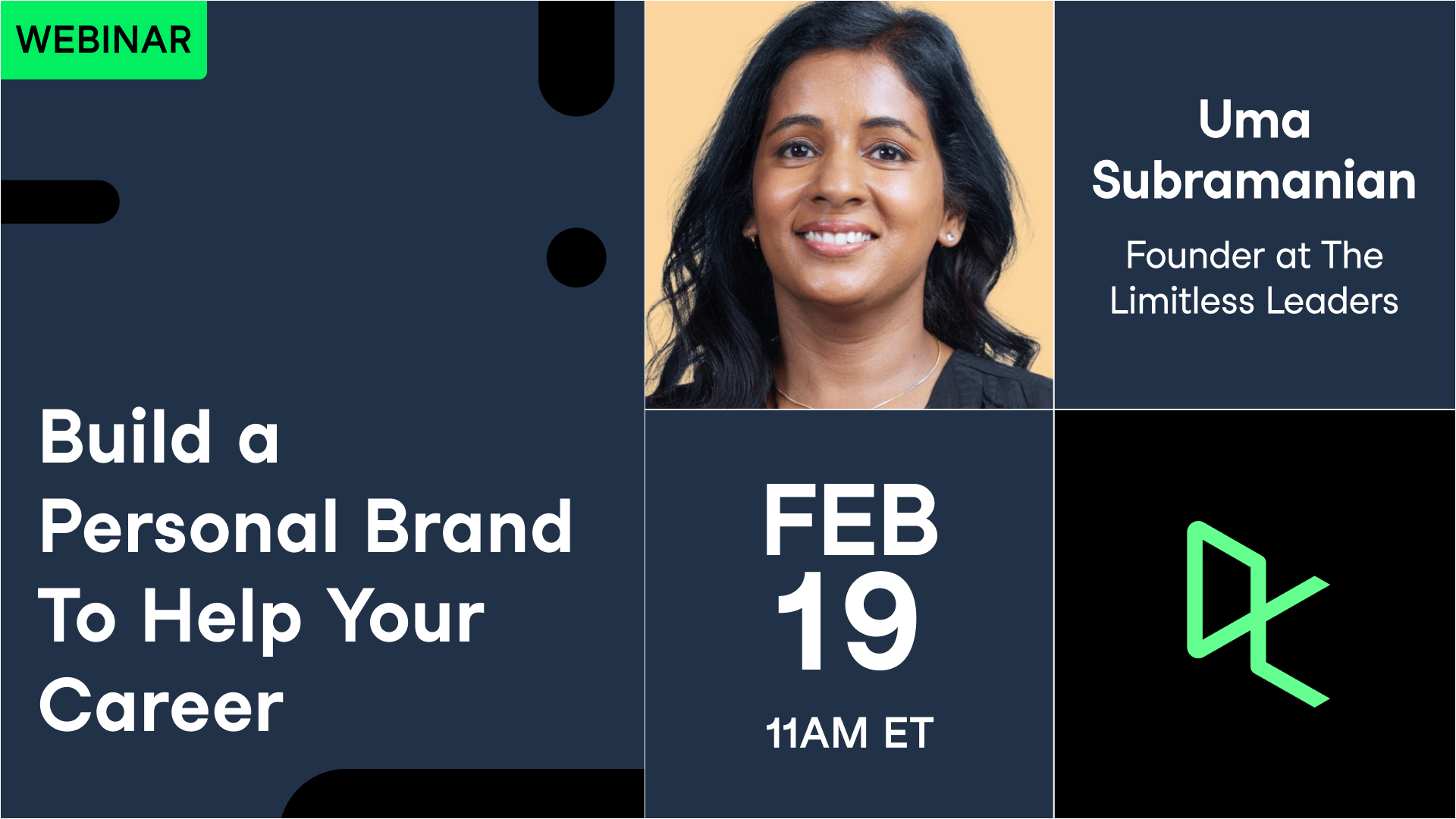
Your Presenter(s)

Uma Subramanian
Founder at The Limitless Leaders
Uma Subramanian helps mid-career tech professionals become confident, sought-after leaders who build influence and drive meaningful impact. She spent 20 years at Microsoft, where she worked closely with developer communities across roles focused on content, learning, and enablement. She later served as Senior Director of Developer Community and Success at Turing, supporting developers in their growth and career progression. Today, as Founder of The Limitless Leaders, Uma helps tech professionals intentionally shape their personal brand, leadership presence, and career trajectory.
Session Resources + Linkedin Post
Summary
A practical session for data and tech professionals who want their strong work to translate into clearer career momentum—whether they’re applying for a new role, aiming for promotion, or stepping into leadership.
Personal brand, in Uma Subramanian’s framing, is not a social-media game but a pattern of signals that shapes how others decide to hire you, staff you, and trust you with responsibility. Hiring managers and senior leaders rarely evaluate technical competence alone; they look for a clear story that makes your strengths and readiness easy to spot. When that signal is muddy—too task-focused, too vague, or too modest—doubt fills the gaps. The session offers a simple, repeatable framework (Identity–Expression–Imprint) to make that signal sharper: define the qualities that describe who you are becoming, express them through language and presence that emphasizes impact, and leave a consistent imprint people remember after you leave the room.
Subramanian grounds the concepts in concrete tactics: a short narrative slide deck that introduces your “through line,” interview answers structured for clarity, and small “signature moments” (from meeting design to follow-up notes) that make your contribution stick. The examples—her own career inflection point sparked by a single LinkedIn post, plus client stories involving panel interviews and internal visibility—are best appreciated in full, with the slides and frameworks demonstrated step by step.
Key Takeaways:
- Personal brand forms whether you design it or not; unclear signals create doubt and leave your story “open to interpretation.”
- Strong brands start with Identity: 5–6 adjectives, supported by evidence (strengths, experiences) and aligned to who you are becoming—not only what you’ve done.
- Expression focuses on translating work into outcomes: use language that highlights impact, frame details in business terms, and present structured thinking.
- Imprint requires consistency and memorability—through storytelling, “pattern interrupts” (like a narrative pitch deck), and thoughtful signature moments.
- Interview performance improves when answers are structured (e.g., “opinion plus two”), practiced on video, and paired with simple confidence routines like visualization.
Deep Dives
1) Why “being amazing” isn’t enough: brand as signal clarity
In competitive data roles, competence is often table stakes. The differentiator is whether decision-makers can quickly understand what you’re good at, how you think, and whether they can trust you with consequential work. Uma Subramanian’s core argument is that a personal brand is not decoration; it’s a shorthand that others use to make high-stakes decisions when they have limited time and incomplete information. As she puts it, “They’re not just evaluating your technical skills. They’re forming an overall impression.” That impression is built from dozens of small cues—how you describe a project, what you emphasize, what you omit, the confidence (or caution) in your delivery, even the level at which you choose to narrate your work.
The risk is not that talented professionals lack substance, but that they accidentally send mixed signals. Subramanian lists familiar patterns: underselling impact, staying at the “task” layer (“I built dashboards”) instead of the decision layer (“I changed how leaders allocated budget”), or going big-picture without specificity about value. Over time, those cues add up: “those signals create a pattern and that pattern becomes the story people associate with you.” When the story is fuzzy, evaluators fill in the blanks—and not always in your favor. That’s when you hear feedback like “not senior enough,” even if your day-to-day work already operates at that level.
Notably, this extends beyond interviews. The same signal clarity affects who gets staffed on stretch projects, who gets invited into key rooms, and who gets asked to present to skip-level leaders. Subramanian’s examples show that brand is “shaping decisions long before and long after the interviews and the meetings you’re in.” The implication for data professionals is practical: if you want your work to travel—across org charts, across hiring loops, across leadership perceptions—your brand needs to be clear and repeatable. The session’s promise is a way to reduce guesswork for others, so they can say “yes” faster. For the full impact, the live walkthrough of her framework and slides shows how abstract ideas translate into concrete messaging choices.
2) Identity: defining the professional you’re becoming (not just your title)
The first pillar of Subramanian’s IEI framework is Identity—an “evolving professional identity” anchored in who you are becoming. This is a subtle but consequential shift for data practitioners, who are often trained to let outputs speak for themselves. Identity work, in this framing, is not about inventing a persona; it is about naming the attributes that already show up in your best work so others can recognize them.
The exercise begins simply: identify five to six adjectives that describe you in a way that is both true and differentiating. Subramanian is explicit about what does not count: job titles and generic functions (“data analyst,” “I build dashboards”) are too common to create distinction. Instead, the goal is to surface a through line—how you operate, what you consistently optimize for, and the kinds of problems you’re drawn to. She models this with her own articulation from a pitch deck: “I love building things from the ground up” and “I love bringing people together and helping them grow.” These are not buzzwords; they are durable themes that can be supported with evidence.
That evidence matters. After selecting adjectives, Subramanian recommends backing them with strengths and “trends that reinforce it”—examples from work, internships, volunteering, or school projects, especially for early-career professionals. She adds two more identity ingredients that many people skip: values (how you make decisions) and aspirations (where you’re headed). In practice, aspirations act like a compass. They help you choose which stories to emphasize and what level to speak at—particularly important when you’re trying to be seen as ready for leadership and career growth.
Identity can also be validated socially. Subramanian endorses asking colleagues (and, selectively, friends) to describe you with their own adjectives, then comparing that list to your self-assessment. The gap between the two often reveals blind spots: capabilities you underclaim, or traits you think you signal that others don’t experience. The session also highlights a common leadership transition problem: people describe themselves using past-tense identity, even as their responsibilities have already shifted. Seeing that mismatch clearly—and correcting it—is where the framework becomes more than introspection. Watching the full session is particularly useful here because Subramanian demonstrates how identity statements get translated into interview-ready narratives and a leadership brand that reads as “ready now.”
3) Expression: turning projects into impact stories (language, framing, structure, presence)
Once Identity is clear, Subramanian moves to Expression: making your value visible “through language, presence, style, and structure.” For data professionals, this is where many careers stall—not because the work isn’t strong, but because the description of the work is trapped in implementation detail. Subramanian’s guidance is to describe work in terms of “impact outcomes, and decisions, not just tasks,” and then adapt the framing to the audience’s incentives.
Language is the first lever. The difference between “I built a churn dashboard” and “I changed how our retention team prioritized interventions, improving decision speed and reducing wasted outreach” is not rhetorical flourish; it’s signal. It tells evaluators whether you understand the business, can connect analysis to action, and can operate at the level the role requires. Framing is the second lever: even when the artifact is technical, the narrative should translate it into implications—business returns, risk reduction, customer outcomes, or strategic options.
Subramanian’s third lever—structured thinking—matters in interviews and senior meetings alike. She encourages presenting ideas with logic and clarity so others can follow the reasoning. In the Q&A, this becomes concrete with a concise answering approach: offer a direct conclusion, then support it with two points (“opinion plus two”). It’s a simple technique, but it reliably reduces rambling and makes your thinking easier to trust—especially in panel interviews where attention is fragmented and you need to sound more senior.
Then there is presence: tone, pacing, composure, and the nonverbal layer of communication. Subramanian makes a striking claim that many professionals ignore at their peril: “body language and tone and your voice those make up 93% of your of how your communication is perceived.” Whether or not you’ve seen that statistic before, the practical takeaway is hard to dispute: confidence is often inferred, not announced. Finally, she notes that professional style—polished slides, prepared materials, and “upgrading” how you show up when your role changes—can either reinforce or undermine the story you’re trying to tell. The session’s slide walkthrough is particularly helpful for seeing how these elements combine into a cohesive, credible impression for interviews, promotions, and leadership conversations.
4) Imprint: being remembered for the right reasons (consistency, pattern interrupts, signature moments)
The third pillar, Imprint, addresses a truth of modern careers: it’s not enough to communicate well once. People decide what you “are” based on repetition. Subramanian defines imprint as what colleagues or interviewers say after you leave the room—the notes they type into hiring tools, the summary they share with a skip-level leader, the story they retell when you’re not present. If identity is the strategy and expression is the execution, imprint is the distribution mechanism.
Imprint starts with consistency. Subramanian encourages keeping a small set of signature messages visible—your through line, your leadership signature, the value you repeatedly bring—and reinforcing it when relevant. The caveat is important: this is not about self-promotion by “beating the drum,” but about making it easier for others to recall you accurately (including recruiters scanning LinkedIn or hiring managers comparing candidates after a panel).
To become memorable, she offers several mechanisms. Storytelling increases retention; “pattern interrupts” introduce an unexpected element that breaks the sameness of typical meetings or interviews. Her most concrete pattern interrupt is a narrative pitch deck—short, polished slides that open with a quote, present a quick agenda, and then walk through your through line, your relevant wins, and (when appropriate) your strategy for the role. Subramanian’s own example is instructive: a simple LinkedIn post led to a conversation with a startup executive, and a short deck helped convert that conversation into an offer. She also shares “signature moments,” such as an unusually thoughtful follow-up note after an interview or a meeting design that is more structured and useful than the norm.
Imprint also depends on emotional residue. Subramanian emphasizes “energy and uplift”: show genuine care, avoid tearing down previous teams, and look for small ways to add value in the room. For data professionals who prefer substance over showmanship, this is good news—imprint doesn’t require being loud. It requires being intentional and consistent, so your personal brand is easy to repeat in rooms you’re not in.
If you’re deciding whether to invest time in these tactics, the client stories are the proof points worth hearing in full: a candidate who stood out in a panel and landed an offer at the top of the range, and an internal leader who regained visibility with a skip-level VP and soon drew two director-level opportunities. The webinar’s full walkthrough makes these imprint strategies feel less like “branding” and more like disciplined career craft, including a clear LinkedIn narrative that can drive inbound recruiter interest without feeling fake.
Connexe
white paper
Data Leader's Guide to Upskilling
Building around eight key personas can drive your data-driven transformation.webinar
Building a Personal Brand in Data
Discover best practices for building your personal brand in data spacewebinar
Breaking Into Data: How Building a Personal Brand Can Accelerate Careers
Breaking Into Data: How Personal Brands Accelerate Careers - With Kate Strachnyiwebinar
Radar—Employer Branding for Data Talent When You’re Not a FAANG
HR leaders at top brands outline key strategies for improving employer branding.webinar
Using Data and AI for Corporate Branding
Industry leaders teach you how to use data and AI to shape a modern branding strategy.webinar